

I recently asked you to fill out a survey.
1,455 of you responded. So I should note that the following results describe the readers who responded to the survey, not everyone who subscribes.
Here’s what I learned.
More women than I expected
64 percent of you are men and 36 percent are women. I’d assumed the proportion of female readers would be smaller.
Women were also more likely to have read my book. Among women, 64 percent have read all or part of my book Troubled. Among men, it’s 46 percent. This is consistent with the general finding that women tend to read more books and more memoirs than men.
Mostly married, with children
64 percent of readers have at least one child, and 24 percent have three or more.
Two-thirds of you are married. Among married readers, 83 percent have kids.
11 percent are in a committed relationship, while 21 percent are single. 1 percent of you are in a situationship.
Male (65%) and female (69%) readers are married at about the same rate, single at the same rate (21% each), and report the same number of kids.
You are highly educated
90 percent of you have at least a bachelor’s degree. More than half have a graduate degree. I love the highly educated. I love the poorly educated.
One in four subscribers has a doctorate or a professional degree. 11 percent of you have a PhD, 9 percent are lawyers, and 6 percent are physicians.
Income aligns with level of education. About 38 percent earn more than $200,000 a year, and 11 percent earn over $500,000. At the same time, 10 percent earn under $50,000, which includes students and retirees.
Men are about twice as likely to report income over $500K (13% vs. 7%). Women are more likely to say “unsure” about household income (9% vs. 3.5%). Men are far more likely to be business owners (11% vs. 5%) or executives (9% vs. 2.5%); women are far more likely to be full-time parents or homemakers (12% vs. 1.5%).
Nearly a quarter of you are retired. Which helps to explain the next finding.
More older readers than I expected
When I imagine a Substack reader, I picture someone in their early thirties. But a large share of you are Gen X and older.
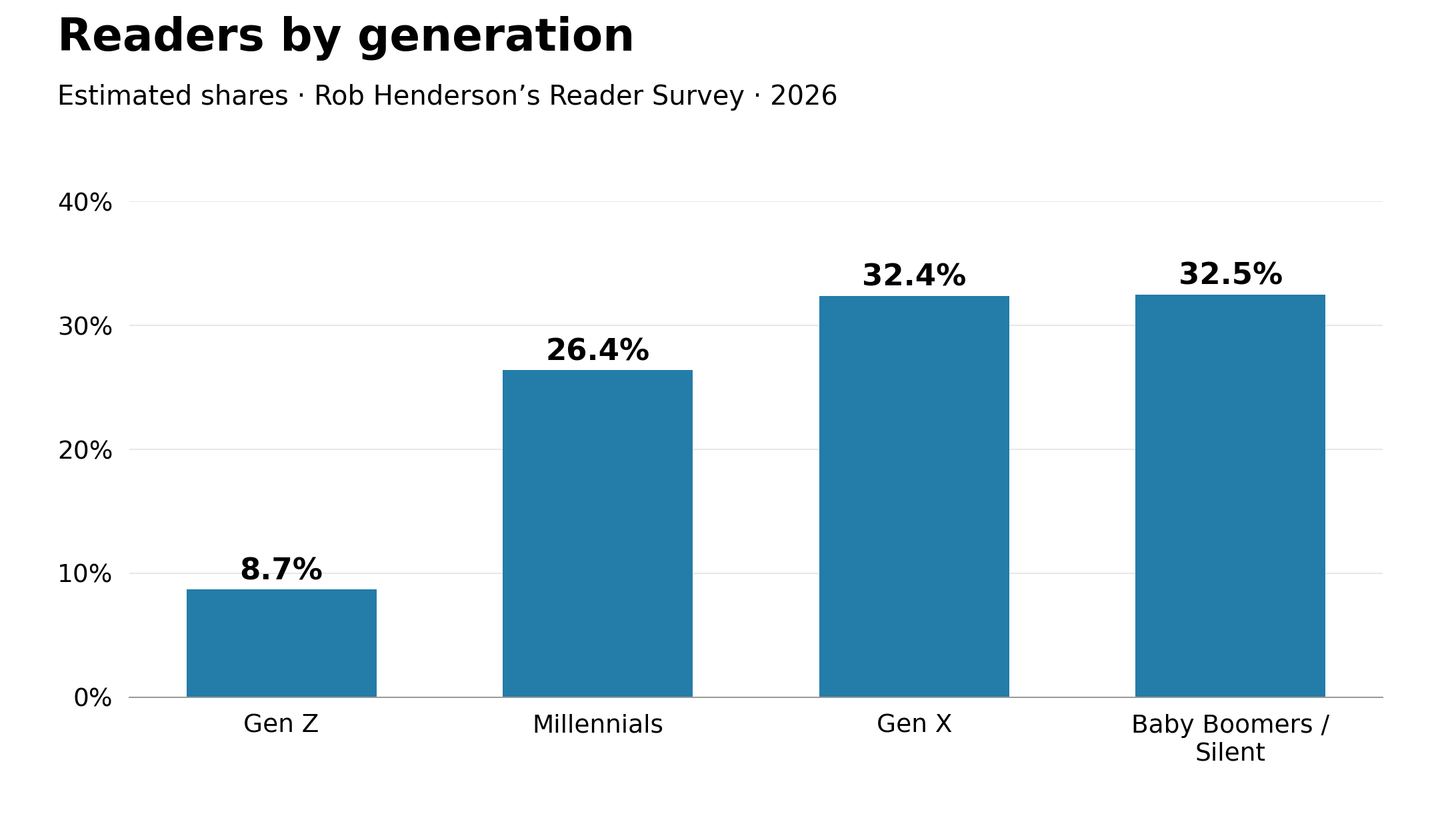
My readership used to skew younger. As we will see, many older subscribers, after reading Troubled, came to find me on Substack. Other older readers probably learned of this newsletter via my occasional appearances on Fox News.
What you do for a living
No single field dominates. Tech is the largest group at 14 percent. Healthcare and medicine come next at 12 percent. After that the shares get smaller: business and consulting at 8 percent, academia at 7.5 percent, finance and investing at 7.5 percent, law at 6 percent, and K–12 education at 6 percent. Smaller shares work in retail and hospitality, nonprofit organizations, media, the arts, and the military.
Politics
I asked you to place yourself on a scale from 1 (very liberal) to 5 (very conservative).
Overall, you are a slightly right-of-center bunch:
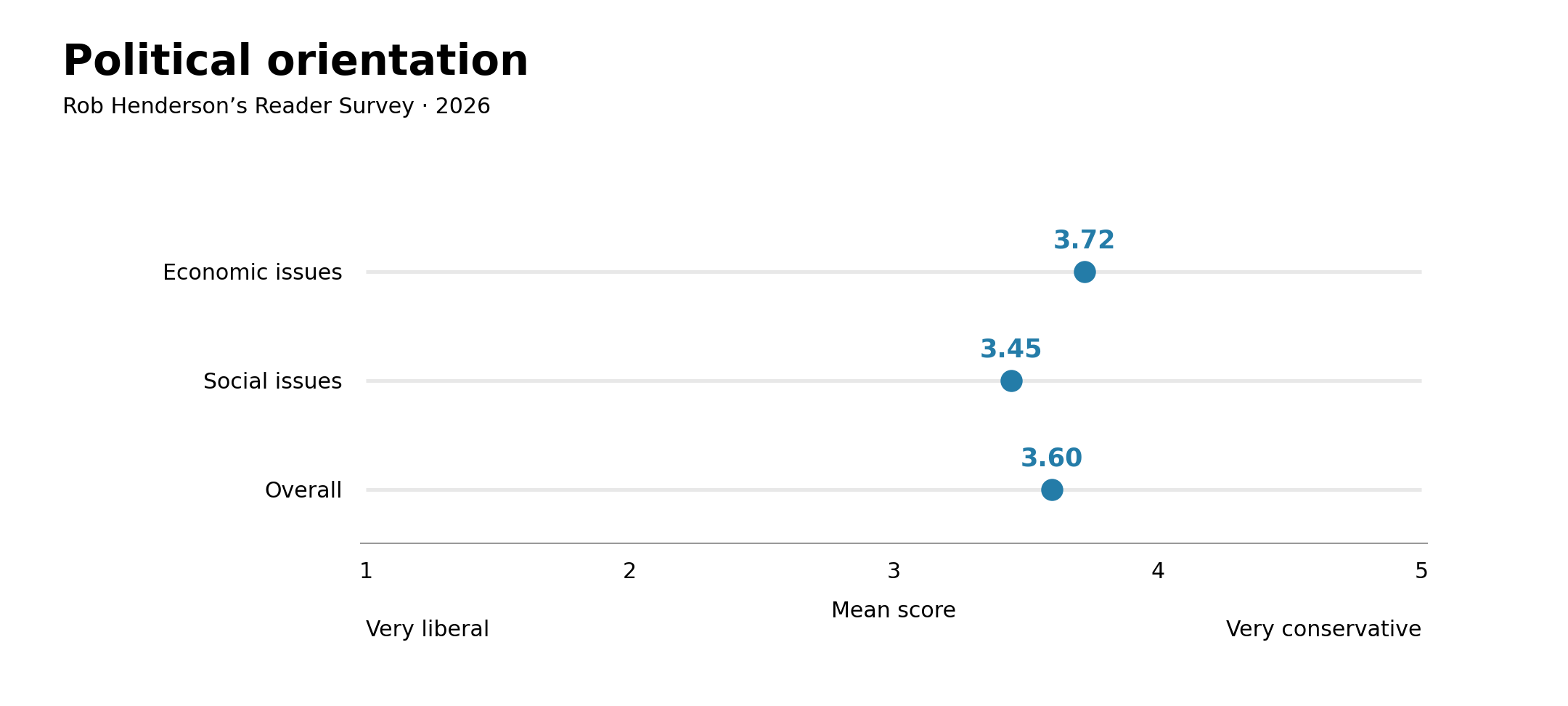
There were no sex differences in political orientation.
I also asked whether you are more conservative, more liberal, or about the same as the people you spend time with. 61 percent of you say you are more conservative than the people you spend time around. Only 6 percent said more liberal. In other words, most of you feel like the odd one out in your own social circles. Most of you feel your peers are to your left.
To modify a line from the great Chris Rock, every college-educated conservative has a bunch of liberal friends. And every college-educated liberal has one token conservative friend.
When I have meetups or events, sometimes attendees will tell me they feel a sense of gratitude or relief to be around others who also feel like the odd one out in their everyday lives. Many of these people aren’t even conservatives, but rather center-left liberals who didn’t join the great awokening.
Religion
26 percent Protestant, 21 percent Catholic, 5 percent Jewish, 3 percent Orthodox. Other readers identified as Hindu, Buddhist, and members of other faiths.
About 30 percent are atheist, agnostic, or nothing in particular, and that share is roughly the same at every age. Interestingly, younger readers are not less religious than the older ones.
Race and ethnicity
78 percent of readers are white. The rest of the readership is spread across many groups. Around 4 percent are East Asian, 4 percent Hispanic, 3 percent South Asian, and 2 percent Black. Smaller numbers identify as Southeast Asian, Middle Eastern, Native American, or Pacific Islander, each at 1 percent or less.
A handful of readers skipped the boxes entirely and wrote their own answers. These included “Italian American”1 and “Mediterranean” and one person who described himself as a “genetically planetary mutt” (same, you’re not alone in this). One reader used the space to complain about being asked at all. I’m sorry about this.
You read a lot
A bunch of nerds. Nearly half of you finished more than ten books last year.
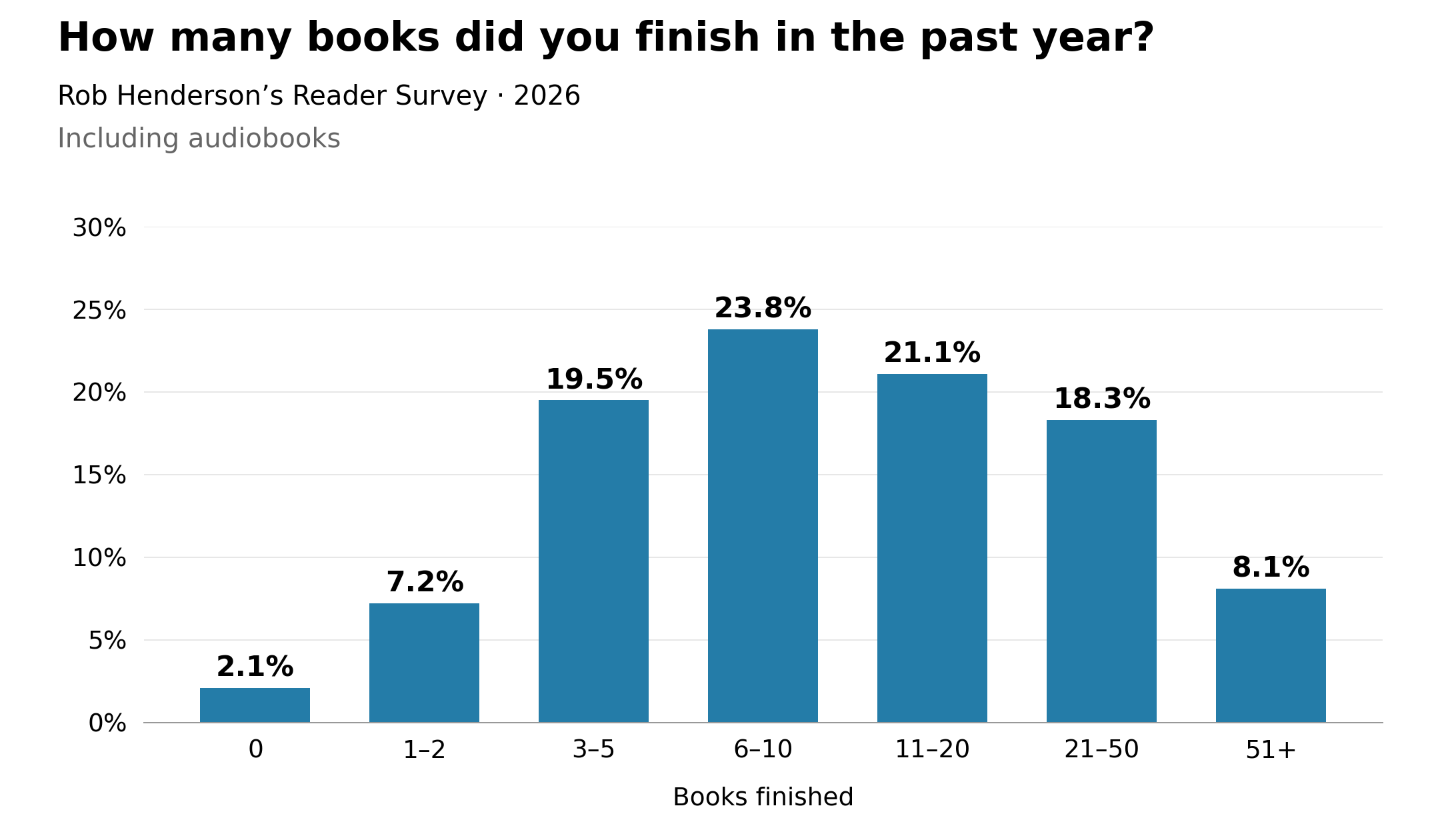
68 percent of you read at least four Substacks regularly, and 62 percent pay for at least one. You are the kind of readers that writers and publishers wish existed in larger numbers.
As for this particular newsletter, 54 percent of you read all of my last four posts. Thank you for that.
Most of you found me through a podcast (17 percent), Twitter/X (16 percent), Substack’s recommendation system (12 percent), reading Troubled (12 percent), or an article I wrote in another outlet (10 percent).
Men came to this newsletter via Twitter/X at twice the rate of women (20% vs. 10%).
Women came to this newsletter through Troubled at nearly three times the rate of men (19% vs. 7%). The book probably accounts for a sizable share of my female readership.
Younger readers found me through podcasts. Among readers under 25, 41 percent came from a podcast. That number drops with each age group: 30 percent for 25 to 34, 27 percent for 35 to 44, 20 percent for 45 to 54, 12 percent for 55 to 64, and just 8 percent for readers 65 and up.
My Twitter/X was the main source for readers between 25 and 54. About one in four in that age range found me there.
About 20 percent of respondents 65 or older discovered the newsletter through Troubled. Among younger age groups, the share was about 10 percent.
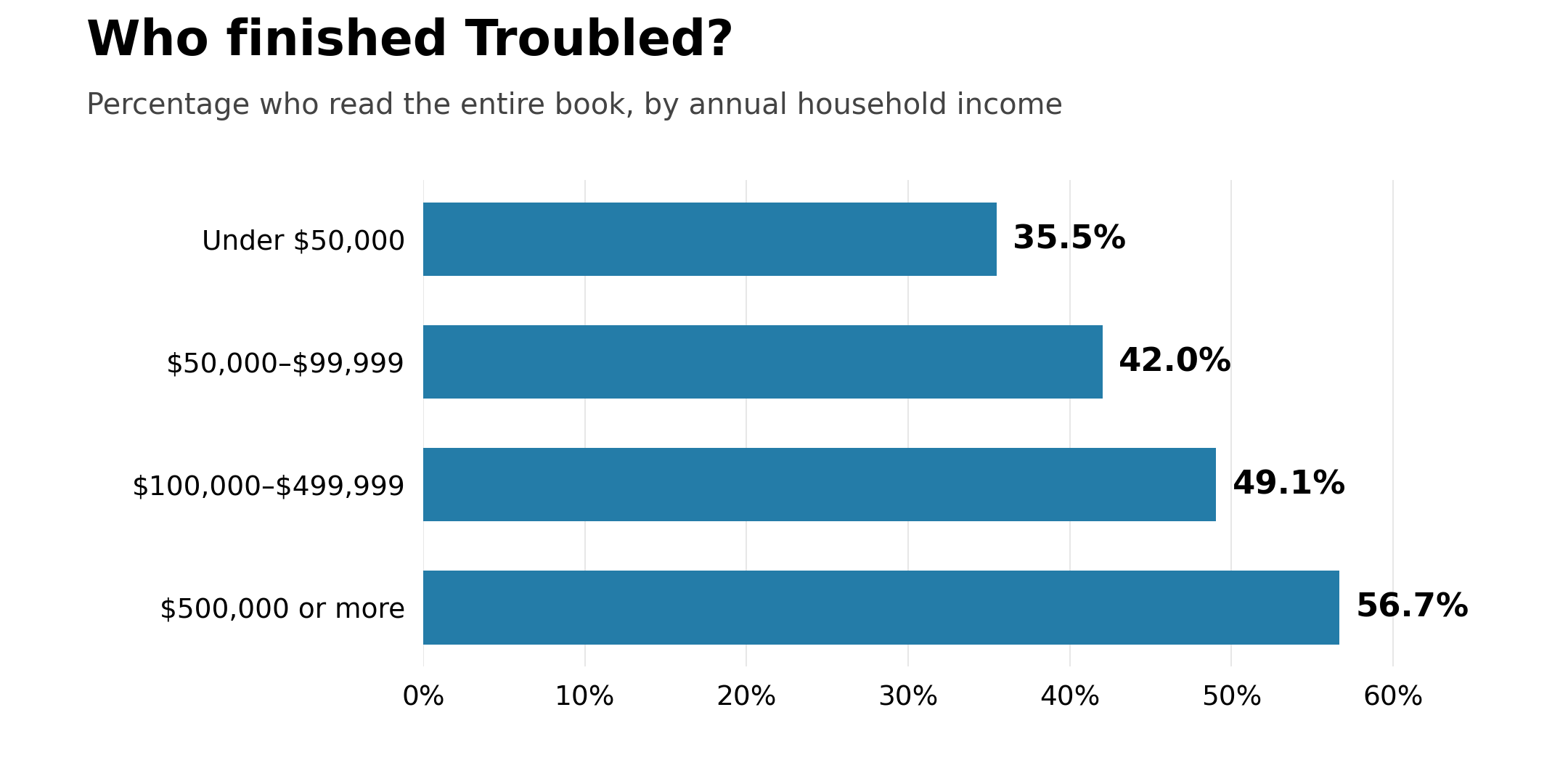
48 percent of you have finished reading Troubled, and 4 percent have read part of it. I take that as a good sign, because most people who start books never finish them.
Women were more likely to have finished my book: 58 percent, compared with 42 percent of men. Women also reported reading more books overall. 31 percent finished at least 21 books in the past year, compared with 24 percent of men.
Higher-income subscribers were more likely to have read Troubled. What’s really going on here, of course, is that reading my book will make you rich.
Your lives are not what you expected
I asked how much your life has departed from what you expected at 18. The majority of you say your lives went in a very different direction. About 63 percent of you say your life is dramatically different from what you anticipated as a young adult.
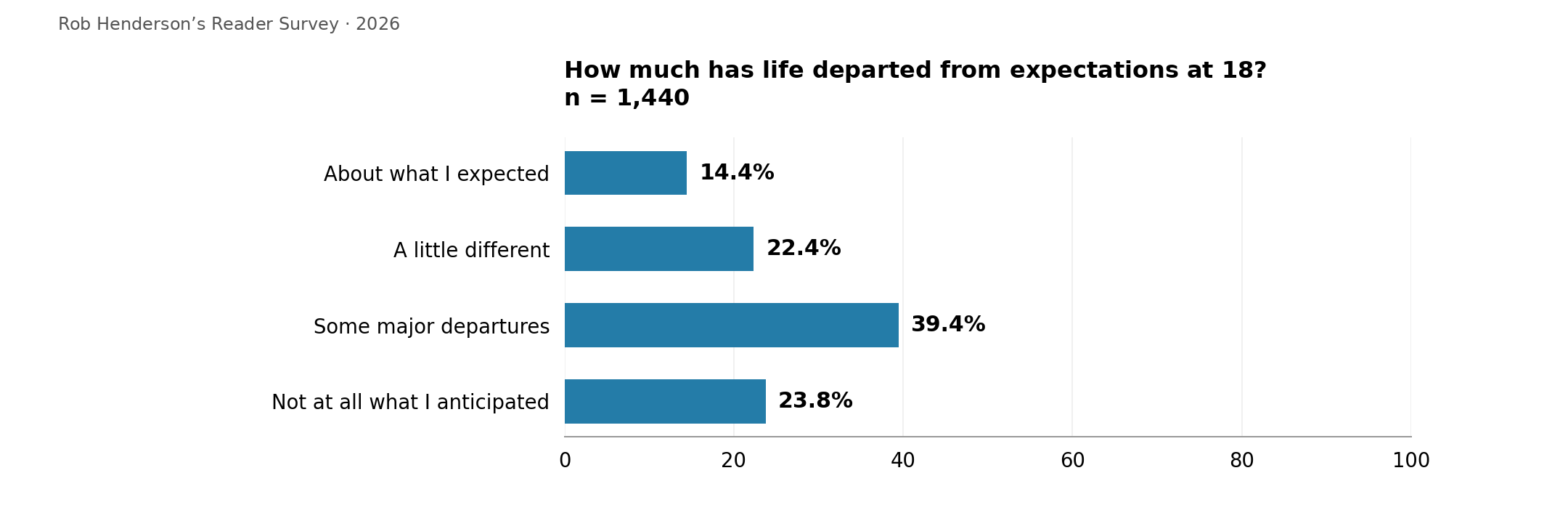
Readers from different childhood classes gave very different answers. Among readers who grew up poor, 53% say their life is “not at all what I anticipated” at 18. That drops to 30% for working class readers, and 21% for middle class readers.
Readers who grew up upper-middle class or wealthy are the most likely to say life went about how they expected.
How you grew up
I asked how you would describe the social class of the household you grew up in. The largest group, at about 45 percent, said middle class.
For the other categories, about 28 percent of you came from working-class or poor backgrounds, roughly the same share as those who were raised in upper-middle class or wealthy households.
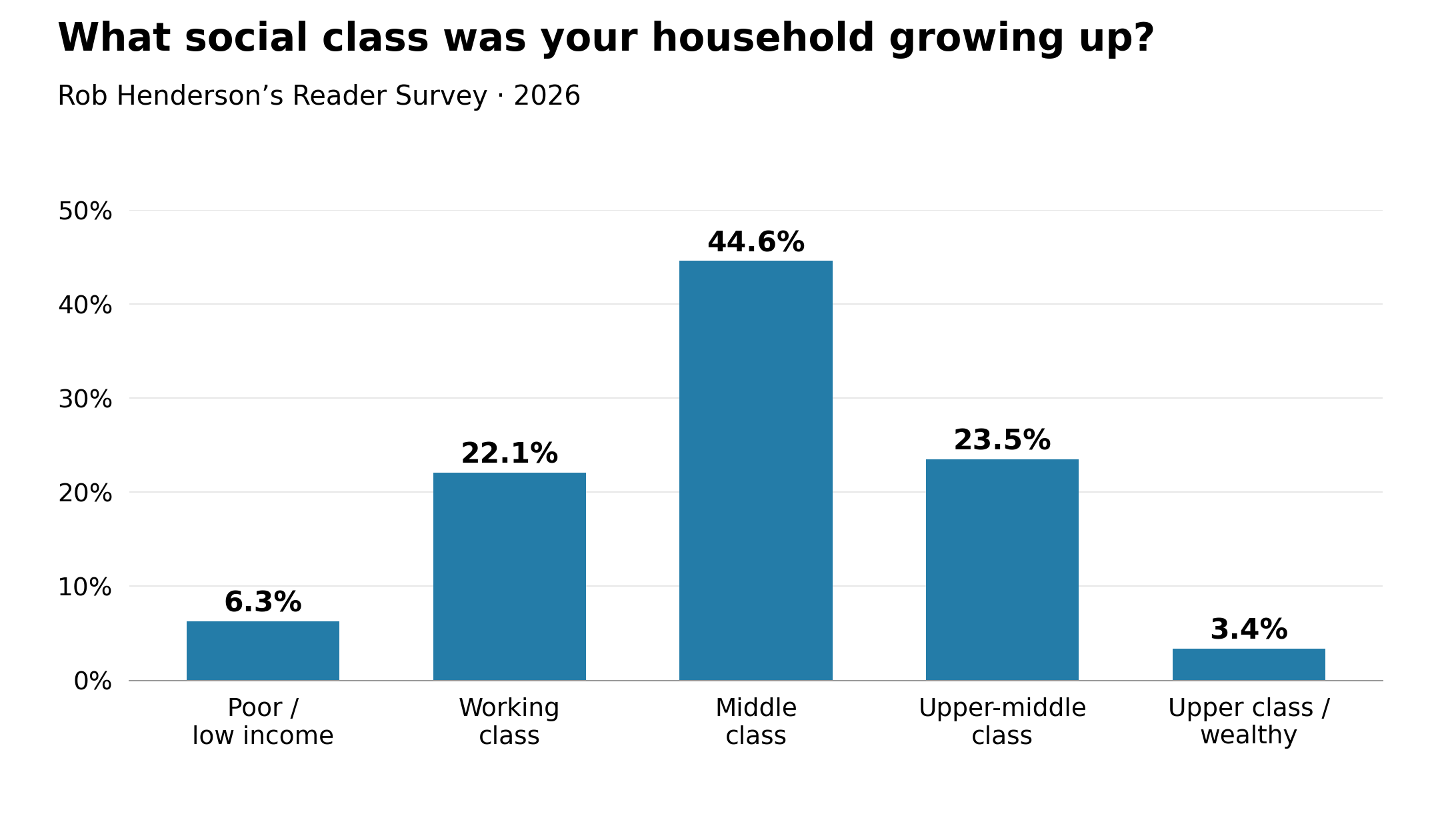
Given that 90 percent of you now hold a college degree and more than a third live in households earning over $200,000 a year, a good number of you, like me, have traveled a long way from where you began.
Social mobility
Most of you have climbed up the ladder.
I asked whether your current socioeconomic position is higher, lower, or about the same as the family that raised you.
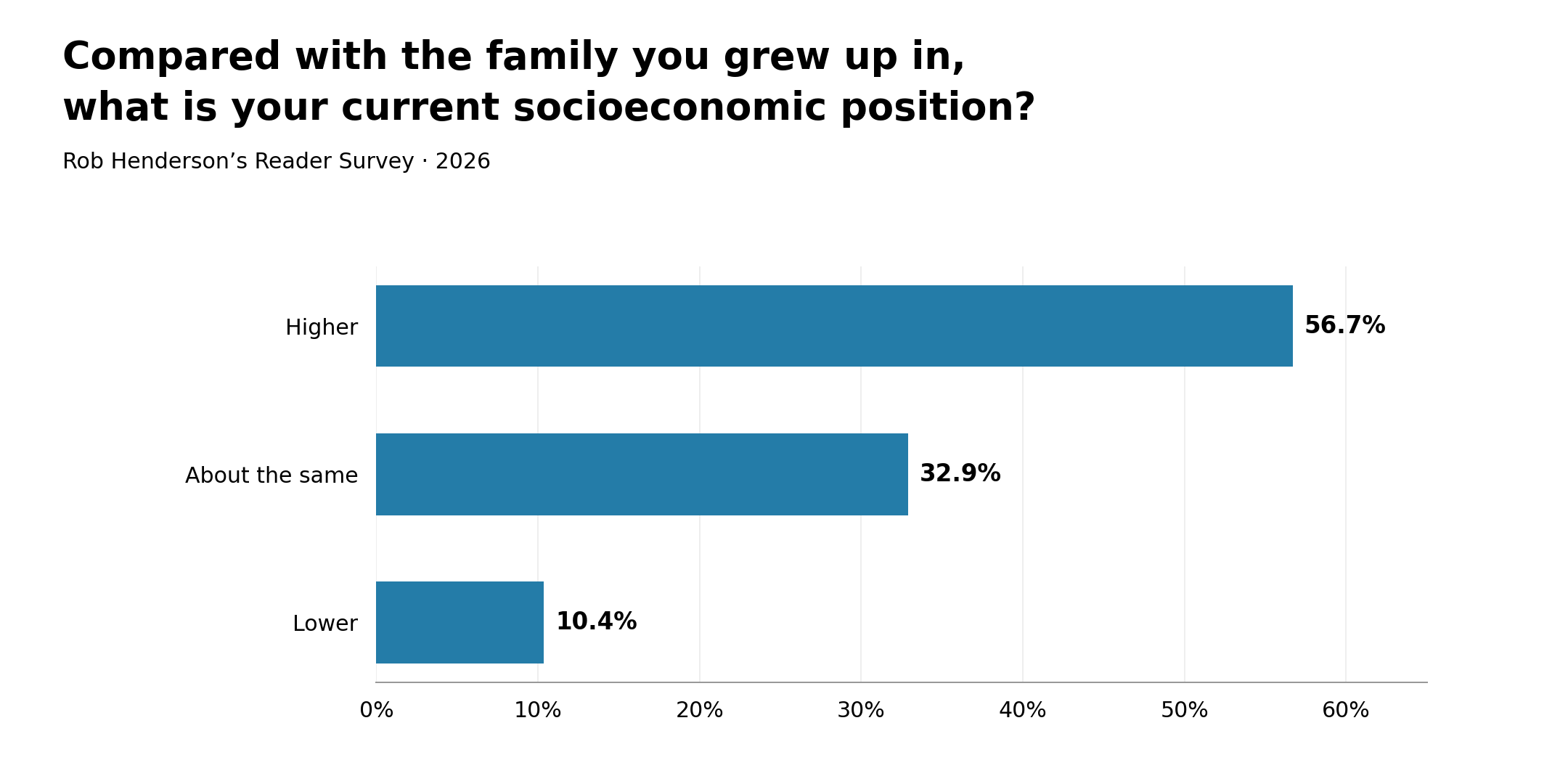
57 percent said higher. About 10 percent said lower.
Put another way, for every 1 reader who slipped below the family they grew up in, more than 5 have risen above it. More than a quarter of you grew up working class or poor, while very few of you live that way now.
Hidden preferences
I asked whether you have ever enjoyed a book, movie, or show but kept quiet about it because of what others might think. 36 percent overall said yes. But there were some interesting age differences:
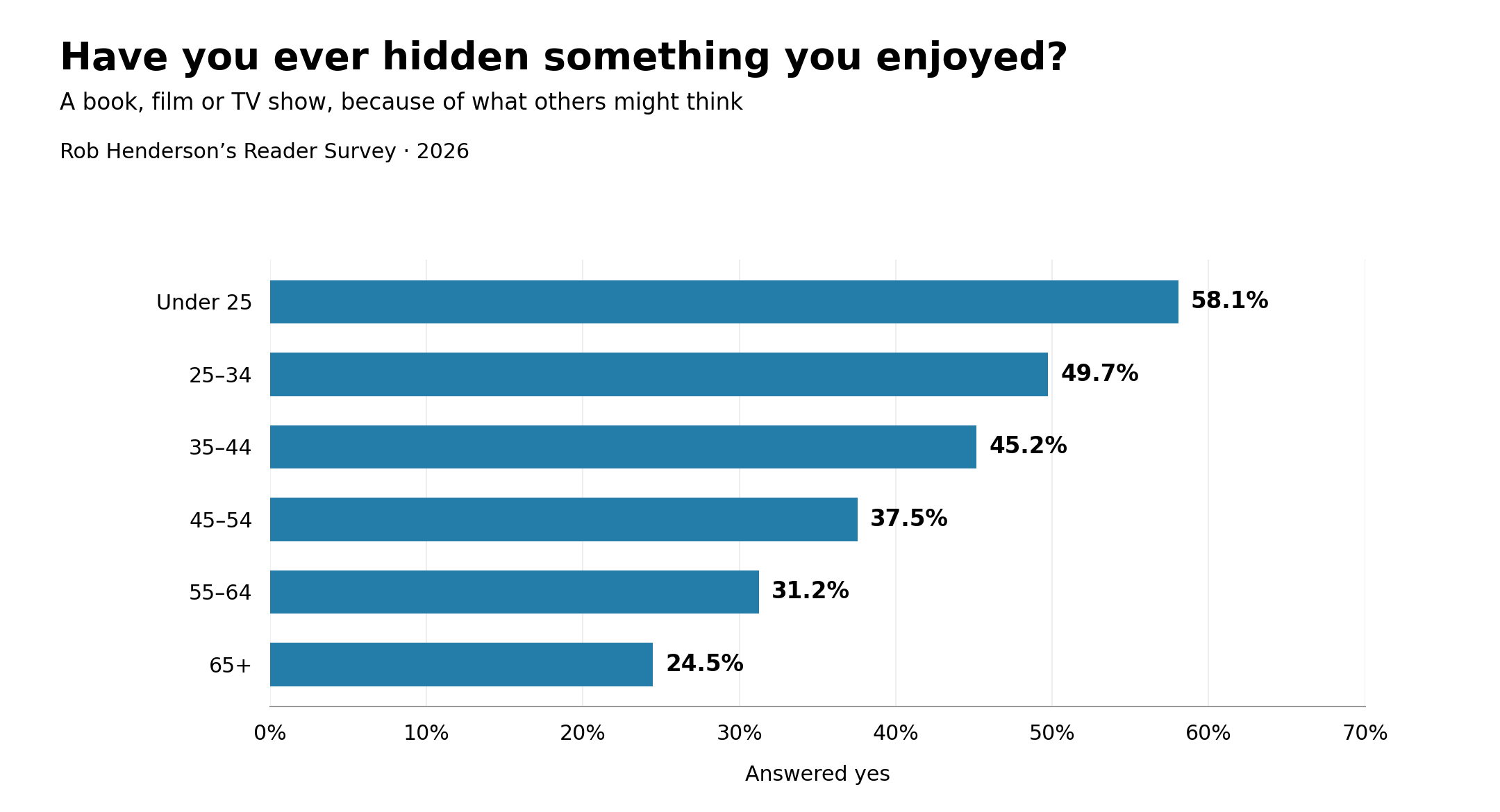
Maybe people stop caring what others think as they get older.
I also asked whether you would want to know what people say about you when you aren’t around. This one split almost perfectly: 49 percent yes, 51 percent no.
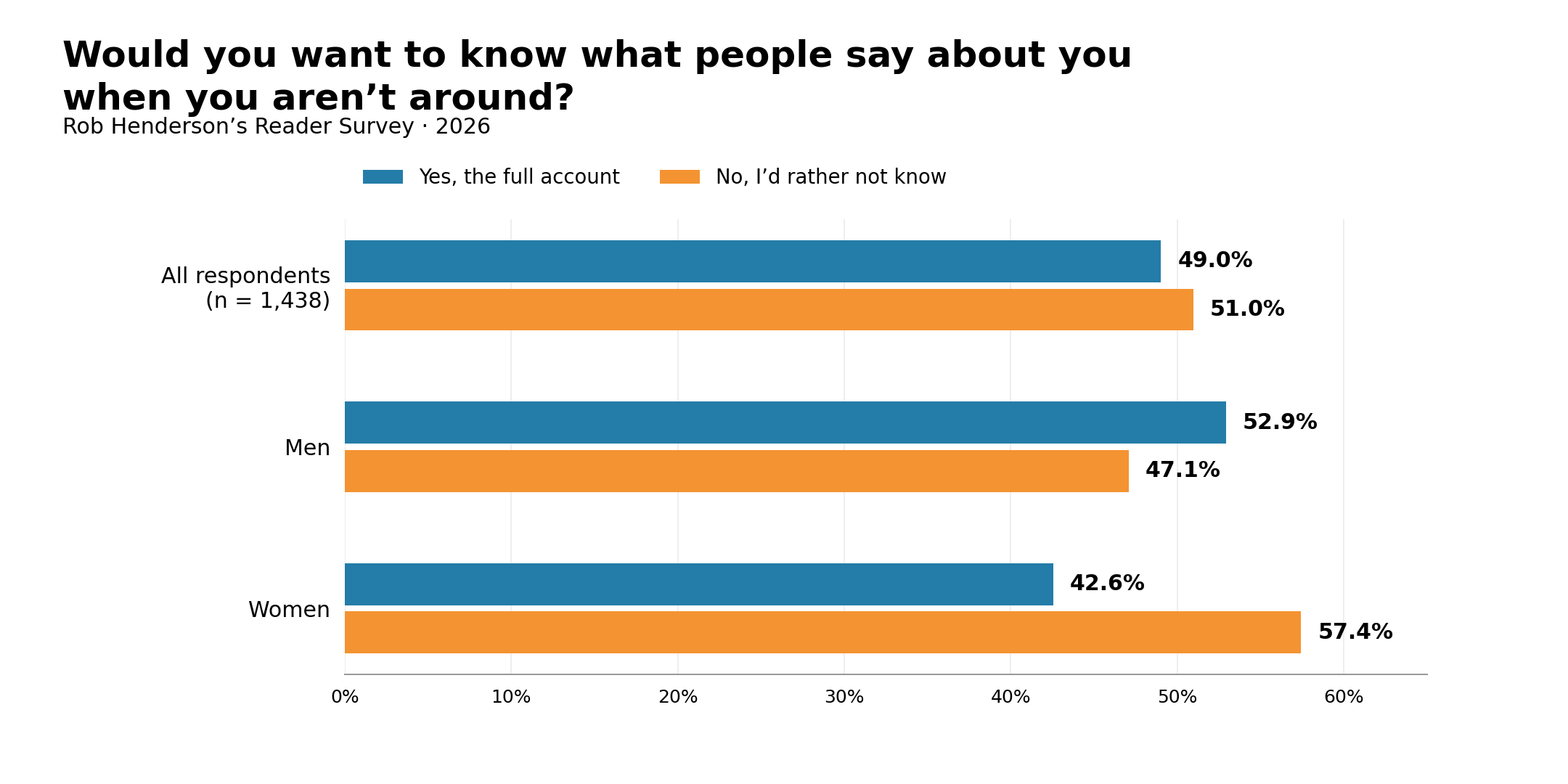
But there was a sex difference such that men were slightly more willing to hear it than women.
Final thoughts
The biggest surprise was how much my picture of readers differed from the people who answered. I pictured mostly young men, but the readership was much more varied.
I was also intrigued by the gulf between where many of you started and where you are now. Most of you have degrees, careers, and families. Perhaps some of you read about class because you have crossed its boundaries and noticed things that are hard to explain to people who have stayed in one place.
I was also struck by how many of you have lives you could not have pictured at 18. My younger self would have had difficulty imagining mine. As a kid I daydreamed about success but had no idea how I would attain it. I certainly would not have expected that my future would consist of spending an afternoon analyzing responses from my many online readers.
Thanks for telling me a little about yourself. You are not who I pictured. You are more interesting.
Back in 2018 I was in a Rite Aid in New Haven and heard a guy shouting into his phone “This lady kept calling me white! I was like listen I’m not white, I’m half-Italian half-Jewish.” A line would elicit laughter from the online right and online left for very different reasons.
Fascinating! I missed this survey somehow, but I’ve been traveling a lot and when I travel I tend to take a social media vacation. Here’s how I found your substack. I’m old - sheesh - I’m a boomer female. I read a great deal and read your book in one sitting. One of my favorite categories of books would be ‘books by and about people entirely unlike me’ so you can understand the appeal. I grew up as the daughter of a divorced woman - with my mother and her parents - as barely middle class but in a safe , pleasant neighborhood.
I found Substack via some other essayist. It’s the only social media spot that seems to allow , and even encourage thoughtful conversations that are not just provocative trolling for for likes.
I’ve moved up a lot in terms of class. In theory, I should have some luxury beliefs, but I don’t (or at least I imagine that I don’t).
This spread gives me hope that there is more about us that is alike and that we could/should seek out others to dialogue with. Great Sunday read