
Downward Mobility, Siren Song, Psychological Distress
Links and recommendations

You can now catch my conversation with Beatriz Kamps on The Listening Bea podcast.
Links for Spotify and Apple Podcast.
The Free Press:
Here’s my latest piece for The Free Press
Excerpt:
For generations, Americans assumed that their children would live better than they did. Today, that assumption no longer holds. In fact, the higher your parents’ income, the less likely you are to match it.
According to The Pew Charitable Trusts, fewer than four in 10 children born into the richest fifth of households stay there; more than one in 10 fall all the way to the bottom fifth. Similarly, a 2014 study in The Quarterly Journal of Economics found that while 36.5 percent of children born to parents in the top income quintile remain there as adults, 10.9 percent fall to the bottom quintile.
Sociologist Musa al-Gharbi, in his 2024 book, We Have Never Been Woke, argues that this downward mobility of children born into wealth is the psychological engine of contemporary politics. This may look like a trivial problem—the petty disappointments of a small slice of America—but the unhappiness of this group, raised to expect the world and denied it, has outsize consequences.
To be clear, this cohort has never faced genuine poverty. Still, they have experienced the sting of loss: They came of age after the Great Recession, watched job security fade as the digital economy made their skills obsolete, and learned that highly coveted jobs in academia, media, and politics were far fewer than promised. These disappointments, al-Gharbi writes, helped power the Great Awokening. Many disillusioned strivers aimed their anger at the system they believed had failed them, and at the lucky few who did manage to retain or enhance their class position.
Read the whole thing here.
The Only Reading App I Use:
I’ve been using Readwise since April of 2021.
If you follow me on Instagram or Twitter/X, you’ll know I regularly share screenshots like this from books or articles I’ve read:
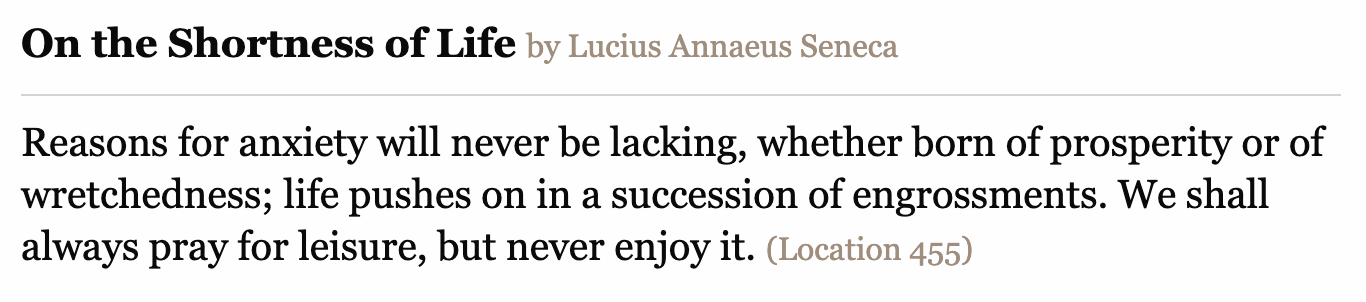
These screenshots come from my Readwise app.
Readwise aggregates your reading highlights from various sources like Kindle, Apple Books, Substack, Twitter, and so on. It stores your highlights in one place, making it easier to stay on top of your reading.
Each morning, it emails me 8 random excerpts from different books I’ve read. Since 2021, that daily message has been a quiet ritual for me: fragments from books I half‑forgot are resurfaced, like my own past self giving me a tap on the shoulder.
Moreover, when I’m thinking about a particular topic, a quick search pulls up not just my notes but every highlighted Kindle passage I’ve ever saved on the topic.
Exclusive Offer for My Readers
Use this link → https://readwise.io/robkhenderson/ to try Readwise free for 60 days (double the length of the standard free trial).
I suspect, like me, you’ll wonder how you ever read without it.
Links and recommendations:
The Share of Americans Having Regular Sex Keeps Dropping by Grant Bailey and Brad Wilcox
What is Blueskyism? by Nate Silver
Finally Men Got in Touch with their Feelings. How’s that Working Out? by Roy Baumeister
Can We Still Trust the Experts? The Siren Song of Influence by Cory Clark and Bo Winegard
In Defense of Inequality by Carlos Carvalho
The Overdiagnosis and Mistreatment of Autism by Hannah Spier
Follow me on Instagram here. The platform is less volatile and more chill than Twitter/X, so I post some spicier excerpts from my readings on my IG stories
You can follow me on TikTok here
Three interesting findings:
1. People with narcissistic and/or psychopathic personality traits are attracted to certain ideologies and forms of political activism. They use activism as a vehicle to satisfy their own ego-focused needs instead of actually working toward social justice. (source: Rise Above by Scott Barry Kaufman).
2. Changing jobs is a significant cause of stress, creating on average about a third as much stress as the death of a spouse, half as much as divorce, about the same amount as the death of a close friend, and 50 percent more than quitting smoking. (source).
3. Young people’s emotional and psychological distress is more pronounced in wealthy, industrialized nations. GDP per capita is inversely correlated with this sense of meaning: The wealthier a country gets, the more bereft of meaning its citizens feel. (source). I discussed a related finding here.
The paperback version of Troubled: A Memoir of Foster Care, Family, and Social Class is now available.
If you have gained any value from this newsletter and want to support my work, please buy a copy today. For yourself. For a friend or a loved one. If you can’t afford it, please support your local library.
Order your copy now:
Audible (I narrated the audiobook myself)

The Revolt of the Rich kids theme seems to have very striking resemblances to the characters of this video on the French Revolution- the Robespierre types and “Guillotine” strongly resembling “Cancellation” as part of the culture…
https://youtu.be/8qRZcXIODNU?si=jJSGAt-gXaqsXlNd
Re Revolt of the Rich Kids, this is the flip side of economic mobility. Not everyone can move into a higher quintile and some have to move down. That's just math.
The good news is that in a absolute terms, even the downwardly mobile get a better life due to technological progress.
The bad news is that the same isn't possible for status, which is a zero sum game in any given ordering of status.
But, people can choose to focus on (I) gratitude for their higher absolute standard of living, and (ii) choose a type of status where they can do well (many have nothing to do with wealth).