

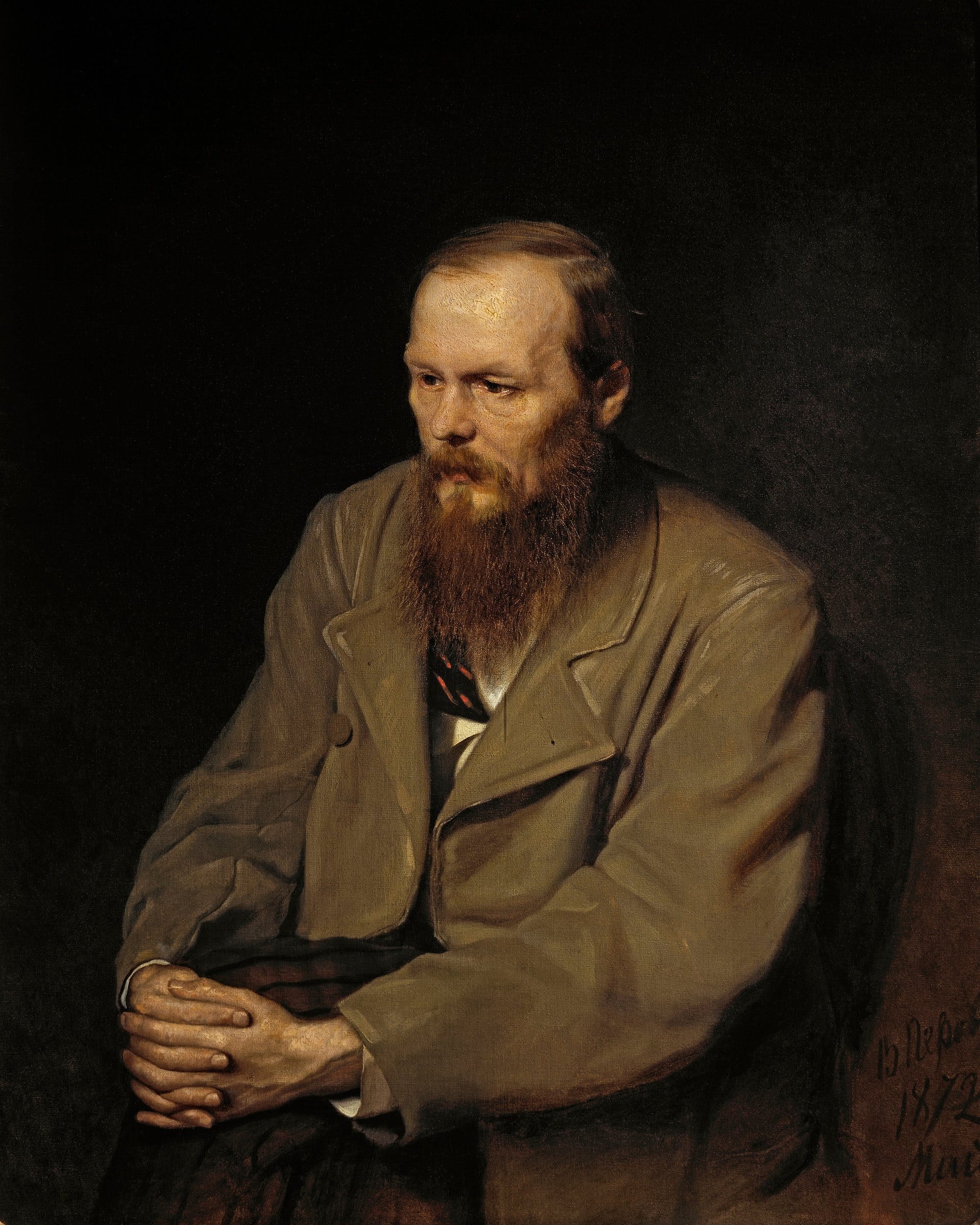
The most important chapter in Dostoevsky’s Devils was originally censored. When you read it, you immediately understand why. It is darker and far more disturbing than you expect.
Buried inside it is one of the most unsettling observations about human behavior ever put into a novel.
Published in 1872, Devils (also translated as Demons or The Possessed) by Fyodor Dostoevsky is a novel divided into 3 parts.
This is a discussion of Part 2, which is when the novel really comes alive.
You can read my discussion of Part 1 here.
Part 2 is where we finally witness the full picture of Nikolay Stavrogin, one of the central characters of the novel. Up to this point Stavrogin has remained mysterious. Now the question becomes unavoidable. Is Stavrogin a redeemable antihero or an irredeemable monster?
Dostoevsky’s portrayal of women is also interesting in Part Two. For a man of the nineteenth century, he often shows sympathy toward female characters and shows them exhibiting real agency in social life.
But he also portrays female psychology in a way that feels much more rooted in his time, which I discuss below. Dostoevsky’s depiction of the male response to this is equally intriguing.
The Liberal Salon and the Birth of Radicalism
We covered in our discussion of Part 1 two characters: Stepan, an aging intellectual, and Varvara, a wealthy aristocrat. Their long and complicated relationship takes up most of the early pages. At first this can feel like a slow detour. But it serves a purpose.
Dostoevsky is showing us the social conditions that produced the younger radicals.
Stepan and Varvara think of themselves as enlightened liberals. They like feeling modern and sophisticated. But they treat radical ideas as a kind of fashionable game, something to discuss over dinner and debate at parties.
Their children and students have taken those same ideas and turned them into a blueprint for social upheaval.
The parallel to the present is hard to miss.
Recall that at the end of Part 1, a man named Shatov punches Stavrogin in front of a crowd. Stavrogin is the novel’s central figure, and he is known for responding to provocation with violence. Everyone in the room expects him to fight back.
He doesn’t.
Instead Stavrogin calmly absorbs the blow and walks him out of the room.
Part 2 opens with rumors about that scene spreading across town.
Those rumors are not spreading on their own. A young man named Pyotr, the estranged son of Stepan, is deliberately spreading the rumors. Pyotr is a skilled manipulator. He understands that controlling information is a form of power.
Around the same time we are introduced to the town governor, Lembke, and his wife, Yulia.
The narrator of the book, a minor character within the novel, breaks the fourth wall to tell the reader directly that much of what is about to unfold is because of Yulia.
Yulia, the governor’s wife, hosts literary gatherings and social events. Intellectuals and radicals fill her home. Her salon becomes the social setting where socialist and anarchist ideas circulate and gain respectability.
Yulia is portrayed as a woman fascinated by the younger radicals, eager to be seen as sympathetic to them and their ideas.
The dynamic will feel familiar to contemporary readers. Older members of the elite sometimes seek approval from younger radicals. They adopt the latest ideas and display contempt for anyone who seems insufficiently modern or progressive.
You see this pattern with Karmozinov, a character in the novel who is portrayed as a celebrated author desperate for approval from the young radicals.


Dostoevsky places much of the blame for the town’s impending catastrophe on this attitude.
Yulia’s position is spelled out clearly in her own words. She says: “What I think is that one mustn’t despise our younger generation either. They cry out that they’re communists, but what I say is that we must appreciate them and mustn’t be hard on them.”
A recognizable form of patronizing liberal optimism. Yulia believes that polite society can tame radical ideas through kindness, inclusion, and invitations to stylish social events. Yulia’s solution to the frustration of the younger generation is to host gatherings and literary readings where everyone feels welcome and heard.
Of course, Yulia has completely misread the situation. The radicals in Devils are not trying to join respectable society. They are trying to destroy it. They are not looking for a seat at Yulia’s table. They are planning to burn the table down.
Yulia represents a type that appears in every era of political upheaval: the well-meaning member of the established class who believes that sympathy and open-mindedness will neutralize a revolutionary movement, without understanding the movement’s actual goal. Her kindness is not a solution to the problem. In Dostoevsky’s telling, it is part of the problem.
Yulia makes one more revealing comment in this section. She says: “I read everything now–the papers, communism, the natural sciences–I get everything because, after all, one must know where one’s living and with whom one has to do.”
Being informed, in Yulia’s world (and in ours), is not primarily about understanding. It is a marker of social sophistication. She signals her cultivation by announcing that she keeps up with the newest intellectual trends and current events. This psychology has not changed much in 150 years. The specific topics rotate. The social purpose, though, remains the same.
The Psychology of Political Radicals
An important moment in Part 2 comes during a conversation between two young men, Pyotr (Stepan’s estranged son) and Stavrogin (Varvara’s son) about how to hold a revolutionary group together.
According to Pyotr, socialists are driven by three things:
-Status
-Sentimentalism
-Fear of having an original opinion
Pyotr says people crave recognition. They want titles, ranks, and visible signs that they are important. So he invents positions within the group. The titles are mostly meaningless, but that is not the point. The point is that they flatter people’s egos and make them feel validated.
Pyotr argues that many people drawn to radical politics do not actually want to think. What they want is an opinion handed to them. Ideally one that makes them appear compassionate and morally serious without requiring any real effort or independent thought.
Stavrogin then offers his own suggestion. He says the most effective way to bind a group together would be through shared participation in a killing. If everyone had blood on their hands, no one could leave. Shared guilt would hold them together more reliably than ideology. A scapegoat.
Pyotr immediately proposes Shatov (a former radical who has left the group) as the victim.
Stavrogin replies: “I won’t give him up to you,” meaning he won’t allow Pyotr to kill him.
This leads us to a central question about Stavrogin.
Stavrogin is the closest thing the novel has to a main character, and he is by far the most interesting one. Whenever the story starts to drag and then he reappears, the energy comes back immediately.
But figuring out who Stavrogin actually is remains genuinely difficult.
He flirts with joining the radical group without committing to it. He will help if it entertains him. He will not help if it requires loyalty. He seems drawn to seduction and manipulation. Politically he appears almost completely indifferent. He watches the people around him get upset and scandalized, and he seems to enjoy it.
For much of Part 2, you might find yourself almost liking him.
But Stavrogin often reads like someone we today would recognize as having a psychopathic personality style: low empathy, superficial charm, a tendency to manipulate and harm others for his own amusement.
Yet faint signs of a conscience keep appearing.
There is a broader argument running underneath all of this.
The idea is that when a society abandons its traditional moral foundation, it does not produce people who reason their way to better ethics. It produces people like Stavrogin and Pyotr. People who are intelligent enough to see through the smokescreen of the old rules but lack any stable foundation to replace them with.
The moral vacuum does not remain empty. It gets filled with ideology, manipulation, nihilism, and violence.
Dostoevsky on Desire and Resentment
One of the more psychologically rich storylines in Part 2 involves a young woman named Liza. She is in love with Stavrogin, who does not return her feelings. At the same time, though, Liza is engaged to Mavriky, who is described as a genuinely decent man. He may be the closest thing the novel has to a straightforwardly good guy.
Liza seems to resent him for it.
There is a striking scene during a religious dinner gathering. In the middle of the dinner, Liza orders Mavriky to kneel in front of everyone. He is stunned. She knows the demand will humiliate him. He obeys her request.
Immediately Liza becomes furious. She tells Mavriky to stop kneeling and to get up. She seems disgusted not by her demand but by his eager willingness to comply.
Mavriky’s response is worth examining closely. He does not just kneel. He kneels so completely and so openly that the entire room can see what is happening. The effect is almost theatrical. It is as if he is thinking: you want submission, so I will give you submission so total that everyone here will understand exactly what you are asking for.
He seems to believe that by exposing himself so fully he will bother Liza’s conscience.
The narrator of the novel is skeptical of this strategy, saying, “Perhaps he imagined that she would feel ashamed of herself, seeing his humiliation, on which she had so insisted. Of course, no one but he would have dreamt of bringing a woman to reason by so naive and risky a proceeding.”
My read is that Liza resents Mavriky because he represents the safe, respectable choice she’s supposed to make. But she’s obsessed with Stavrogin, the dangerous man she can’t have. Liza takes out her frustration on Mavriky precisely because he’s good and patient.
When Mavriky kneels, Liza suddenly panics and cries out: “How dare you!”
The line sounds strange at first. She was the one who issued the demand. But the outburst makes psychological sense. In that moment she sees herself clearly. She has forced a good man to destroy his dignity in public, where everyone can see. She is horrified at what she has just revealed about herself.
So Mavriky’s strategy produces a mixed result. It does reach Liza’s conscience. But it also costs him. He exposes her cruelty while simultaneously making himself less attractive in her eyes by debasing himself.
Later in Part 2 comes one of the strangest and most revealing scenes in the book. Mavriky approaches Stavrogin privately and essentially offers him Liza.
Mavriky recognizes that Liza loves Stavrogin and not him. He tells Stavrogin he can have her.
Mavriky essentially says that Liza expresses love toward him, but unconsciously detests him. With Stavrogin, though, it’s the opposite: Liza outwardly hates Stavrogin, but still can’t help loving him.
Mavriky’s motives for making this offer to Stavrogin deserve scrutiny. I’m enough of a psychologist that I can’t help but think Mavriky’s intentions here are suspect.
Mavriky needs to see himself as a good man. So he tells himself a story: Liza loves Stavrogin, therefore the honorable thing is to step aside and let them be together. In this version of events, Mavriky becomes a martyr. He sacrifices his own happiness for the woman he loves.
That story is not entirely false. But it is not entirely true either.
Liza has repeatedly humiliated Mavriky. By offering Liza to Stavrogin, a man Mavriky knows to be dangerous, he may be acting on a resentment he cannot consciously acknowledge. It is a form of retaliation.
If Mavriky truly wanted what was best for Liza, there was another option. He could have stayed engaged to her, endured her cruelty, and protected her from Stavrogin by remaining in her life. Instead he chooses the gesture that allows him to appear noble while walking away, knowing that Stavrogin will almost certainly destroy her.
This is why readers have called Dostoevsky a psychological novelist for over a century. His characters rarely have clean motives. Beneath the surface there are layers of resentment, pride, and self-deception working simultaneously. Characters do things for reasons they do not fully understand, and neither do we.
Stavrogin, though, declines Mavriky’s offer. (Because he’s already married).
The Man Who Wants to Believe
Shatov is one of the most important characters in Part 2, and also one of the most tortured. He was once part of the radical movement. Now he has rejected it completely. When you look at Dostoevsky’s own biography, the parallel is hard to miss. Shatov believes in nations, in God, and in a special destiny for the Russian people. Dostoevsky held nearly identical views in the later part of his life. He had once moved in radical intellectual circles, then turned away from them toward religion and nationalism. Shatov follows the same path. He functions in the novel as something close to the author’s own stand-in.
One of the most striking exchanges occurs when Stavrogin asks Shatov directly whether he believes in God.
‘I only wanted to know, do you believe in God, yourself?”
‘I believe in Russia. . . I believe in her orthodoxy . . . I believe in the body of Christ .. . I believe that the new advent will take place in Russia. . . I believe .. .’ Shatov muttered frantically.
“And in God? In God?’
‘I... I will believe in God.’
“I will believe” is an unusual phrase. It suggests that belief is something still in progress. Perhaps it means belief through action. Perhaps it means living as if one believes until belief becomes real.
Whatever it means, it fits what we know about Dostoevsky himself. He wrestled with faith throughout his life.
This section of Part 2 also returns to Kirillov, one of the novel’s strangest and most philosophically minded characters. Earlier he laid out his argument in favor of suicide, which I discussed in my review of Part 1.
Kirillov now makes a claim about happiness. Human beings are unhappy, he says, only because they do not know they are already happy.
Stavrogin listens and then turns the logic back on him.
If the only reason you think you are unhappy is that you fail to understand you are already happy, Stavrogin suggests, then perhaps the only reason you think you are an atheist is that you fail to understand you already believe.
In other words, you say you are unhappy because you do not know you are happy. You say you are an atheist because you do not know you are a believer.
This connects back to Shatov, who tells Stavrogin at one point that he is an atheist because he is a snob. It is a blunt accusation. And it is made by a man who, when asked directly if he believes in God, can only say “I will believe.”
Neither Shatov nor Kirillov is a straightforward believer. Both struggle toward something they can’t quite reach. The difference here is in how they handle the struggle. Kirillov builds a philosophical system to justify suicide as a method of transcendence. Shatov admits his doubt and strives for belief.
The Horrifying Censored Chapter
This is where the novel becomes truly disturbing.
This chapter was originally censored. It was considered too shocking to print in Russia at the time. Even today, many copies omit this chapter. If you are reading certain editions of this book, you may not even know it exists.
Before reading this chapter, I had some vague optimism that Stavrogin might still be a redeemable figure. That he might do something genuinely honorable before fully succumbing to nihilism. After reading this chapter, that optimism is gone.
Stavrogin visits a retired bishop named Tihon and confesses to a horrific crime.
Stavrogin arrives at retired Bishop Tihon’s with printed letters. Stavrogin explains to Tihon that he has had around three hundred copies made and plans to publish them. The letters contain a written confession of a terrible crime. Stavrogin hands a letter to Tihon, who begins to read.
The confession describes Stavrogin’s recollection of events years earlier in Petersburg when he was living a hedonistic life. He was sleeping with a woman from high society and also with her maid.
During this time Stavrogin rented a room from a woman who had a young daughter named Matryosha.
Stavrogin witnesses the mother beating the young girl after his penknife goes missing. The mother assumes Matryosha stole it. Stavrogin knows she didn’t, but says nothing. He lets the beating continue. So even before the main crime, he is already taking pleasure in the suffering of this child.
Stavrogin then learns the family’s routines. He knows when the mother leaves. He knows when the father is off at work.
He then sexually assaults Matryosha.
In his confession, Stavrogin initially describes her as fourteen years old. Later, though, he refers to her as “this helpless ten-year-old creature.” This suggests he described her as older at the start of the letter in order to make himself appear less reprehensible, before letting the truth slip through.
The horror of the chapter does not end with the assault itself. What Dostoevsky describes afterward is, in some ways, even more disturbing.
Matryosha is confused at first. Then she responds with a kind of apprehensive affection, as if seeking reassurance from the person who harmed her. She smiles at him uncertainly. She tries to form some connection with him. Stavrogin responds with dismissive contempt.
Instead of feeling guilt or sympathy, Stavrogin begins to feel an intense hatred toward her. The things that produce this hatred are small details. Her timid smile. The moment she rushed into the corner and hid her face from him. These unwanted memories replay in his mind, tormenting him.
Over the following days Matryosha becomes physically ill. Based on her behavior, Stavrogin begins to suspect she may kill herself. He does not try to prevent it. He waits nearby. When he sees that she has hanged herself, he leaves.
Matroysha, after Stavrogin rapes her, tells her mother that she has “killed God.”
Stavrogin causes Matroysha to commit suicide and waits nearby while she does it.
The faint signs of conscience we noticed earlier in the novel now look different. Stavrogin was, from the very beginning, incapable of redemption.
The censored chapter shows that Stavrogin is not who he thought he was.
Up to this point he has been a thrill seeker. He places himself in degrading and dangerous situations deliberately. He even says at one point that when he knows humiliation is coming and remains fully aware of it, the experience excites him rather than repels him. Shame, for Stavrogin, has often been a kind of pleasure.
But something different happens after he assaults Matryosha.
He can’t move past it. The memory keeps returning. He cannot control his own internal reaction to what he has done. He admits that for the first time in his life he felt real fear.
What makes this striking is that the fear has nothing to do with punishment. Stavrogin says explicitly that he does not care about being arrested or imprisoned. He has been close to that before and it never troubled him. What he cannot manage is something internal. He discovers that he is not the person he believed himself to be. He thought he was a nihilist without conscience. Confronted with the full weight of what he did and its consequences, he finds out he is not entirely free of moral awareness.
This discovery terrifies him.
Dostoevsky seems to be suggesting that nihilism has limits.
The fact that Stavrogin seeks out Tihon, submits to a confession, and has printed copies of his crime prepared suggests that some part of him wants to be held accountable.
This separates him from Pyotr, who shows no signs of conscience at all.
Pyotr is fully committed to his destructive ideology no matter the cost. He and his fellow radicals see themselves as the elite vanguard—the one-tenth—and the mass of society as the nine-tenths who will be coerced into obeying their ideology.
Shigalov, another member of the radical cell, talks about cutting out Cicero’s tongue, gouging out Copernicus’s eyes, stoning Shakespeare to death. According to this ideology, slavery is equality, and that there has never been freedom or equality without despotism. In the herd, there must be equality. This requires the intentional destabilization of society.

So Pyotr seems to delight in the idea of destroying society, whereas Stavrogin seems to delight more in destroying individuals.
This reflects a difference in the kind of people they are and how this interacts with their destructive impulses. Stavrogin is handsome, charismatic, and desirable. He has personal options, which means he can indulge his destructiveness at the level of private life. Pyotr doesn’t seem especially attractive or charismatic. His destructive impulses are then acted out at the level of politics and ideology.
Dostoevsky seems to suggest that when someone’s options are limited, whether by personal attributes, temperament, failure, or self-inflicted constraints, they are drawn to radical ideologies. They interpret their own flaws as defects in society rather than in themselves.
This brings us to Stavrogin’s description of himself:
“Whenever in my life I have chanced to find myself in some exceptionally shameful position, some more than usually humiliating, despicable and, above all, ridiculous situation, it has always aroused in me not only boundless anger, but at one and the same time an incredible sense of pleasure. I felt just the same at the moment of committing a crime or when facing mortal danger. If I were carrying out a robbery, then as I stole I would be intoxicated with a sense of how low I had sunk. It was not the base deed itself that I loved, but the intoxication that came from an agonizing awareness of my own depravity…I confess that I often sought it out, because for me it was the most powerful of all such sensations.”
Stavrogin is making very clear that this is conscious. He wants the awareness. He is not excusing himself. He is not saying he committed crimes because he was poor (his mother is a wealthy aristocrat), or out of revenge, or because of some overwhelming and uncontrollable appetite for destruction. He is saying that the knowledge of his own depravity is itself what excites him and he deliberately and methodically indulges it with full awareness.
And yet he is still haunted by what he did to Matryosha. If he were content with who he is, he would not be writing this out and confessing it.
And at the end of Stavrogin’s confession, the bishop also tells Stavrogin that if he publishes the confession, people will notice certain details that Stavrogin himself thinks are most shameful. Readers, Tikhon tells him, are going to find Stavrogin ridiculous in addition to monstrous. And Stavrogin immediately understands what he means.
Stavrogin wants people to know he is a monster, but is terrified of being seen as ridiculous.
Stavrogin says, in effect: yes, you mean the parts where I describe kissing the girl’s feet and all these absurd little gestures to her. That is what will make me appear ridiculous.
This tells us something important about Stavrogin. He is a very vain character. He is prepared for people to know about his depravity, about what he did to Matryosha. But what really wounds him is the thought of appearing ridiculous, of seeming absurd.
Stavrogin’s intense feelings of guilt suggest some glimmer of conscience. But actions are what really matter, and what he has done is horrifying.
Stavrogin implies that marrying Marya (the disabled woman) was partly an attempt to get past what he had done to Matryosha. It was also, for him, another level of humiliation. He even says that it entertained him to imagine people discovering that he was married to Marya. He found it amusing to think of the shock and absurdity of it.
He felt he needed something drastic to distract himself from what he had done to Matryosha.
Radical Equality Becomes Crushing Despotism
The most famous line in the novel belongs to Shigalov, a social theorist and member of Pyotr’s radical cell: “I am perplexed by my own data and my conclusion is a direct contradiction of the original idea with which I start. Starting from unlimited freedom, I arrive at unlimited despotism.”
If a society attempts to create perfect equality, power inevitably concentrates in the hands of whoever is responsible for enforcing that equality. The result is not universal freedom. A small group ends up ruling over everyone else. In Shigalov’s vision, one tenth of society becomes the governing elite while the remaining nine tenths are reduced to a controlled and manageable mass.
Shigalov:
“One-tenth enjoys absolute liberty and unbounded power over the other nine-tenths. The others have to give up all individuality and become, so to speak, a herd, and, through boundless submission will be a series of regenerations attain primeval innocence, something like the Garden of Eden. They’ll have to work, however.”
Remarkably prescient. When actual communist societies emerged in the twentieth century, millions of people were reduced to livestock or piles of corpses.
Lyamshin, another member of the radical commune, says “For my part…if I didn’t know what to do with nine-tenths of mankind, I’d take them and blow them up into the air instead of putting them in paradise. I’d only leave a handful of educated people, who would live happily ever afterwards on scientific principles.”
Shigalov’s theory includes another disturbing feature. In the society he imagines, every citizen spies on every other citizen. Everyone belongs to everyone else, and each person is responsible for reporting on the behavior of others.
This detail anticipates the logic of actual communist police states. Systems built on informers, surveillance, and mutual suspicion appeared across communist regimes in the twentieth century. A world of constant suspicion, where anyone might secretly be informing on anyone else.
What makes this especially remarkable is that when Dostoevsky was writing, nothing quite like this yet existed. He was observing patterns inside small radical circles and projecting where those patterns might eventually lead if they were allowed to expand into a full political system.
Dostoevsky was imagining possibilities that had not yet materialized.
The scale of mass killing under twentieth century communist regimes did not yet exist in the nineteenth century. Governments at the time did not possess the same administrative power or technological capacity. The ideology had not yet been fully translated into political practice.
For a novel set in nineteenth century Russia, the social dynamics feel remarkably contemporary. The language is old-fashioned. But very little about the interactions requires translation for a modern reader. The types of characters, the self-deceptions, the manipulation of ideas for social advantage: all of it is immediately recognizable.
Dostoevsky was writing about socialist movements and the destructive logic of radical ideology. Fifty years after his novels, something very close to what he feared actually happened in Russia with the rise of Lenin and the Bolsheviks.
No one else had this foresight. It is hard to think of, for instance, a German novelist who saw and accurately depicted the rise of Nazism coming half a century in advance the way Dostoevsky foresaw the trajectory of Russian radicalism.
He seems to have understood something about where his society was heading that most of his contemporaries either could not see or preferred not to.
There is another interesting tension in Dostoevsky’s work. He was a passionate Russian nationalist, yet Russia does not emerge in a flattering light in this novel. He clearly loved the country, but he also believed it was vulnerable to catastrophe. My discussion of Part 3 here.
Dostoyevsky was a true genius and master of psychology. I remember marveling at his descriptions of human nature when reading Crime and Punishment as a teen, but this is beyond!
Thank you for your excellent analysis!
Cant wait for Part 3 :D
Thanks for this- I finally subscribed because of this. Looking forward to Part 3! Appreciate this and all your work.