

In Twilight of the Idols, Nietzsche wrote: “Dostoevsky was the only psychologist from whom I had anything to learn.”
Sigmund Freud claimed that Dostoevsky’s place in literature is “not far behind Shakespeare.”
But what originally interested me in Dostoevsky was this description from the twentieth-century Russian-British philosopher Isaiah Berlin:
“The complex of strange characteristics which forms the popular Western conception of the Russian national character largely owes its origin to the novels of Dostoevsky. The stereotyped picture of Russians as gloomy and introspective neurotics, who spend a large part of their nights in tormenting themselves with painful self-questionings and self-accusations, victims of uncontrollable emotional crises, passing from extremes of spiritual exaltation and ecstatic contemplation and acceptance of life to chaotic and destructive violence, illuminated by sudden moments of insight and transfiguration – this dark, stifling and demented world, which has frightened, repelled and fascinated those Europeans who discovered it, was created almost entirely by Dostoevsky, his successors and his imitators.”
The literary critic Gary Saul Morson has characterized Devils as “a book usually considered the greatest political novel ever written.” He also points out that “Dostoevsky was the only nineteenth-century thinker to have foreseen totalitarianism in detail. Uniquely, he guessed that the twentieth century would not be one of increasing humanitarianism and benevolence but of unprecedented tyranny.”
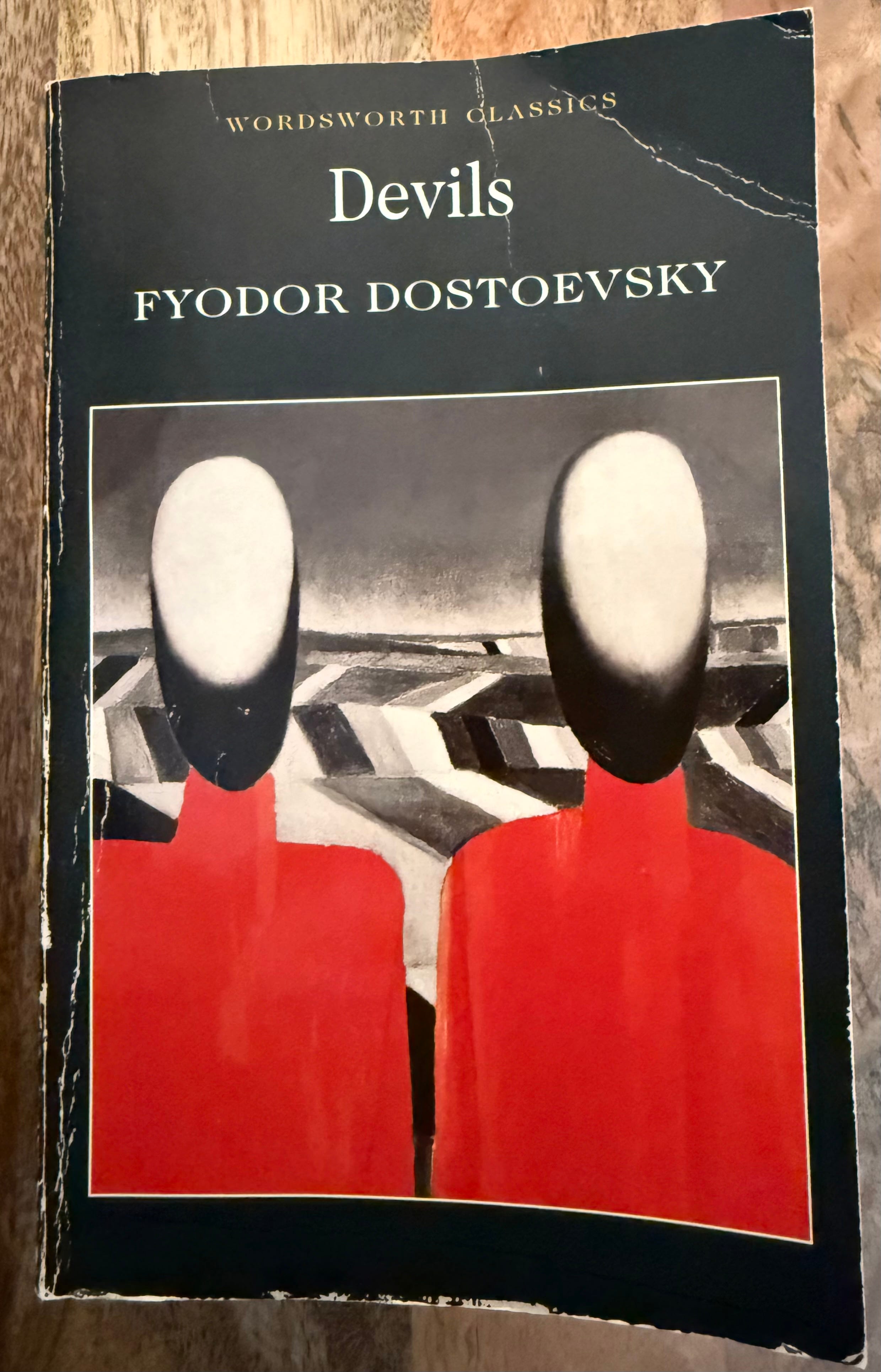
I picked up Devils (also sometimes translated as Demons or The Possessed) seven years ago when I was in my doctoral program at the University of Cambridge. I was browsing a used bookstore in town. In grad school, you don’t have much time to read fiction for pleasure. The book cost three pounds. So I bought it and figured I’d get to it someday, which has turned out to be now.
Half a century before Lenin, Dostoevsky’s Devils predicted the rise of communist totalitarianism. If this book had been published in 1922 instead of 1872 people would have said it was too on the nose.
Dostoevsky’s life reads like one of his own novels. His father was cruel and miserly. He grew up in the suffocating world of Russian provincial life. He lost both parents as a teenager. As a young man he was arrested for revolutionary political activity (he was at the time a radical leftist) and sent to Siberia for hard labor for several years. Throughout his life Dostoevsky suffered severe epileptic seizures.
Dostoevsky held a dark view of human nature. He saw how petty, cruel, and irrational people can be. He believed that human beings are often driven by resentment, vanity, and the yearning for power.
When Dostoevsky was taken to Siberia as a political prisoner in 1850, a woman named Natalya Fonvizina gave him a copy of the New Testament. It was the only book prisoners were allowed to keep. It sustained him through years of hardship and led him to faith.
This explains why Dostoevsky once called Charles Dickens the most Christian of writers. Not because Dickens wrote about religion which he seldom did. Rather, Dickens’ novels lead readers to care about the weak, the poor, and the unlucky. I started Great Expectations a few weeks ago but put it off to concentrate on Devils.
Devils runs to about 700 pages and is divided into three parts. Below is a discussion of Part 1. My discussion of Part 2 is here. And here’s Part 3.
Portrait of an Aging Radical
Part 1 is mainly about introducing the characters and setting the scene of the story.
The central figure early on is a middle-aged man named Stepan Trofimovich. He is a floundering intellectual. Years ago he had some reputation as a thinker and lecturer, but by the time the story opens he is mostly a relic.
Stepan is supported by a wealthy aristocratic woman named Varvara Petrovna Stavrogina. She supports him financially and keeps him close as a kind of dependent companion. Their relationship is strange. They are not romantically involved, but they are bound to each other in a complicated way.
Years earlier, Stepan served as live-in tutor to Varvara’s young son, Nikolay Stavrogin.
Nikolay Stavrogin is probably the most important character in the novel. But in Part 1 he remains mostly a mystery.
Stepan also has a small social circle. People visit him and Varvara, play cards, and debate politics and philosophy. These scenes carry a slightly comic tone. The characters speak grandly about ideas while often seeming shallow or confused.
Another character introduced early is Captain Lebyadkin. He has a sister named Marya who he treats badly. Marya is referred to as “lame” and “crippled.” She walks with a limp and behaves oddly and eccentrically. But she does not seem unintelligent.
Rumors about Stavrogin circulate throughout the town. One rumor is that Stavrogin is secretly married to the “lame” woman Marya.
By the end of Part 1, Stavrogin and the forces around him remain largely unclear. But the stage has been set. Dostoevsky has assembled a strange cast of intellectuals, aristocrats, radicals, and damaged outsiders. As the novel unfolds, they will become entangled in a story about ideology, resentment, and the power of ideas.
Another important figure introduced in Part 1 is Shatov, a former radical who has started to doubt his old beliefs.
Shatov describes his history with Stavrogin.
Years earlier Shatov had traveled to America. While he was there he ran out of money. Desperate, he wrote to Stavrogin asking for help. Stavrogin sent him one hundred rubles.
The money creates an awkward moral situation. We are probably meant to read it as guilt money. Stavrogin had supposedly slept with Shatov’s wife while Shatov was away. The payment seems to send a message, something like, “I wronged you, but here is some money. Now we are even.”
But Shatov never paid it back.
In the climax of Part 1, Shatov punches Stavrogin. This anger likely comes from several places at once. There is the affair with his wife. There is also the broader sense that Stavrogin is an unpredictable and dangerous person. Rumors follow him everywhere. He may have secretly married Marya. There are whispers that he seduced another woman Dasha as well. Stavrogin seems capable of anything.
When Shatov’s punch lands, Stavrogin grabs him. For a moment it looks like he might fight back. But then something strange happens. He stops. A faint smile crosses his face. He turns and walks calmly out of the house.
This reaction unsettles everyone.
In that moment the people around him seem to understand that Stavrogin is not a normal person.
The question that begins to hang over the story is: who exactly is Nikolay Stavrogin?
Even though Stavrogin will eventually dominate the novel, Part 1 really belongs to Stepan Trofimovich.
Stepan is in his fifties. As mentioned, he is an intellectual. Years ago he had a reputation as a serious thinker. But he has never produced much real work. Varvara calls him out on this repeatedly. She notes that he reads constantly and talks grandly about ideas. Varvara asks him: when are you actually going to write something?
Stepan also suffers from a persecution complex. He believes the government is watching him and considers him a dangerous radical. But the book makes clear this fear is mostly fantasy. If someone told Stepan the authorities had no interest in him whatsoever, Stepan would have felt insulted. He needs to feel important.
Stepan himself feels surprisingly modern. You could easily picture him today as a certain type of aging intellectual. Clearly smart. Widely read. But producing nothing. Living off the generosity of a wealthy patron while enjoying the theater of being a political radical and the flattering idea that the authorities find him dangerous.
Stepan also loves speaking French. This is clearly meant as a status signal. Among Russian elites, French was associated with European sophistication and cosmopolitan culture. By sprinkling his speech with French phrases, Stepan signals that he belongs to the educated, Western-facing world.
Stepan is a type of person that is easily recognizable today.
Moderate Boomers and Radical Zoomers
Discussing liberal attitudes toward the peasantry, Stepan says, “Like hasty people, we have always been too great in a hurry with our peasants. We have made them the fashion, and a whole section of writers have for several years treated them as though they were newly discovered curiosities. We have put royal wreaths on lousy heads.”
Stepan is criticizing the romantic way cultural elites talk about peasants. In Stepan’s view, such people have suddenly decided the peasantry are noble. The admiration is shallow and trendy.
Stepan then adds that “The Russian village has given us only the Kamarinsky dance in a thousand years. A remarkable Russian poet who was also something of a wit, seeing the great Rachel on the stage for the first time, cried in ecstasy: ‘I wouldn’t exchange Rachel for a peasant!’ I am prepared to go further. I would give all the peasants in Russia for one Rachel.”
Stepan is saying that from the enormous mass of Russian peasants, only one truly distinguished cultural practice has emerged in a thousand years. He is also saying Rachel (a famous French actress and symbol of high culture) is worth more than all peasants combined.
So even though Stepan presents himself as a liberal thinker, he looks down on ordinary people. He talks about equality and reform, but he still carries the snobbery of the educated elite.
Dostoevsky wants you to notice the hypocrisy. Stepan speaks the language of progress and enlightenment, but his attitude toward ordinary people is deeply condescending.
Another major theme in this section is the conflict between older liberals and younger radicals.
Stepan and Varvara represent an earlier generation. They believe in reform, but they also favor gradual change. The younger radicals want something far more sweeping and immediate and violent.
Dostoevsky illustrates this through a comic episode involving Varvara’s magazine.
Varvara financially supports a progressive literary magazine in St. Petersburg.
A group of young radicals approaches her with an amusing proposal. They argue that she should simply hand the magazine over to them, along with the money that funds it. In return they would generously allow her to keep one sixth of the profits.
From their point of view this is perfectly fair. They represent the true revolutionary cause, so of course they should control the publication.
Varvara and Stepan are bewildered by this.
Both see themselves as enlightened liberals. The younger radicals see these two middle-aged people as timid and outdated.
This tension comes to a head during a lecture Stepan delivers to an audience full of radicals. During the lecture Stepan argues that culture matters deeply. He says that boots are less important than Pushkin, the great Russian poet.
The reaction is harsh.
The radicals believe that material conditions are what matter most. Pushkin represents elite culture. So when Stepan suggests that Pushkin matters more than boots, the audience erupts. They hiss at him and shout him down. The scene turns humiliating. Stepan bursts into tears.
Dostoevsky was likely drawing on a real debate. The real-life critic Dmitry Pisarev famously wrote that boots are worth more than Shakespeare.
The scene with Stepan and the radical audience feels surprisingly modern.
You could easily imagine it today.
An aging intellectual defends gradual reform and the value of literature and high culture. A room full of younger activists boos him for being out of touch. In modern terms, he simply doesn’t “know what time it is.”
Stepan sees himself as an important public intellectual. He is deeply in love with this identity, even as the next generation views him as an outdated relic.
Stepan senses the political mood is changing. He tries to meet the younger radicals halfway. But he clearly does not understand them.
He thinks he can win them over with clever gestures. He mocks religion. He makes sarcastic remarks about the “fatherland.” He assumes that if he says the right fashionable things, the radicals will see him as one of their own.
Instead he is shocked when it does not work.
What Stepan fails to grasp is that the younger generation takes these extremist ideas far more seriously than he does.
Dostoevsky is making a point about generational change. The older liberals are willing to repeat radical slogans, but the people who come after them take them seriously. The older generation talked about bold social reform. The younger generation wants to act on them no matter the cost.
The result is an awkward handoff. The older liberals helped introduce these ideas into Russian intellectual life. But they are no longer in control of where those ideas go.
Varvara and Stepan represent an older generation that is somewhat shallow and self-absorbed. They are intelligent and educated, but they treat politics partly as a social fashion. The younger generation grew up around them. But these young people were not guided carefully. They inherited radical ideas without the discipline or restraint that might have kept those ideas in check.
The result could be something much darker. Young people raised by frivolous adults and steeped in revolutionary ideology may push those ideas far further than their elders ever intended. It seems likely these younger characters will become central as the story moves forward.
The Charismatic Mystery of Nikolay Stavrogin
Much of Part 1 unfolds almost like a comedy of manners.
The story takes place in a provincial town. Much of the action revolves around gossip, rivalry, and social intrigue. Varvara and her circle constantly worry about reputation, etiquette, and status. People visit each other, exchange rumors, and speculate about one another’s motives. Radical politics exists in the background, but for many of these characters it also functions as a fashionable conversation piece.
This feels true to life. From the outside, we tend to sort people into ideological categories. This person is a liberal. That one is an extremist. But in everyday life people are usually focused on much smaller things. Slights. Gossip. Personal rivalries. Status within their immediate social circle. Dostoevsky captures that dynamic with real precision.
It is still unclear at this point, though, how far the political themes will develop in this story.
Will ideology eventually take over the characters’ behavior? Or will major political events unfold while the characters remain absorbed in their private status games? This tension is what makes the rest of the novel so compelling.
Meanwhile Part 1 gives us several strange incidents involving Nikolay Stavrogin, who, remember, is Varvara’s son and Stepan’s former pupil.
Now, as a young man, Stavrogin’s behavior repeatedly shocks the town.
The first incident involves an elderly man named Pyotr Pavlovich Gaganov. Gaganov is a respected figure with a harmless verbal habit. He often says, “No, you can’t lead me by the nose.” One day, Stavrogin walks up to him without warning, takes him by the nose with two fingers, and leads him a few steps across the room.
The moment is bizarre and humiliating. It immediately becomes the talk of the town.
Today, if a large, physically imposing young man grabbed an older high-status man in a formal setting and dragged him across the room by the nose, it would cause a scandal. The social violation would be just as shocking now as it was then.
Stavrogin’s second act is equally provocative. He suddenly kisses the wife of a man named Liputin in front of other people. This scandalizes the onlookers. But Liputin himself seems strangely unbothered. We later learn that Liputin is a dark and Machiavellian character. His calm reaction foreshadows complicated scheming yet to be revealed.
The third incident is more extreme. Stavrogin bites the ear of a provincial governor.
After these episodes Stavrogin is temporarily confined and placed under supervision. The official explanation is medical. His mother Varvara claims that something went temporarily wrong in his brain as a result of an illness. Varvara works to present her son’s behavior as the result of some kind of neurological disturbance.
That response feels very contemporary. When a wealthy young man behaves outrageously today, his family often reaches for medical language. They talk about disorders, episodes, and neurological problems. The behavior becomes something unfortunate and unforeseeable rather than something worthy of blame and condemnation.
Once Stavrogin “recovers,” Varvara begins carefully repairing the social damage. She persuades him to make a series of farewell visits before he leaves for Italy. During these visits he is expected to apologize where necessary and smooth things over with the people he offended.
Stavrogin agrees without much resistance.
Word gets around the club that he wrote a polite and serious letter to the man he had led around by the nose. The apology was accepted.
But not everyone buys the story.
The narrator notes that many people privately believe the illness explanation is nonsense. They suspect Stavrogin knew exactly what he was doing and had simply been mocking them all along. Still, once the official narrative is in place, the town largely goes along with it. Social life depends on these kinds of shared fictions. When an agreed-upon story appears, people often accept it even when they have doubts.
Stavrogin remains the most intriguing figure in Part 1. He appears suddenly, behaves outrageously, disappears again, and leaves everyone trying to figure out what kind of person he actually is.
Stavrogin’s father died when he was young. He is not related by blood to Stepan, but Stepan played a large role in his upbringing. As a boy, Stavrogin was tutored by Stepan.
During those years Stepan developed a strange relationship with the boy. It was not predatory or abusive, but it lacked normal boundaries. Stepan often treated the young Stavrogin as though he were a fellow adult. Stepan would cry in front of him. He would complain about his own failures. He would rant about Varvara. In effect, he used the child Stavrogin as an emotional confidant, someone to absorb his anxieties and grievances.
That dynamic feels familiar today. It resembles a kind of modern parenting style in which children are treated as miniature adults. Instead of gradually and appropriately introducing children to the problems of adult life, parents expose them to everything. Stepan becomes a kind of stepfather to Stavrogin, but not a good one.
Stepan has a biological son named Pyotr. But Pyotr was not raised by him. He was sent away to live with relatives in another town.
So a pattern emerges. Varvara has a son but is not an attentive mother. Stepan spends time half-raising Stavrogin while his own son grows up elsewhere. The adults in this world consistently fail at basic parental responsibilities. My read is that these failures will matter later.
There is also a sharp little portrait of Captain Lebyadkin, the brother of the disabled woman Marya. When Lebyadkin interacts with the aristocratic Varvara, the narrator offers this observation:
“It is typical of such people to be utterly incapable of keeping their desires to themselves. They have, on the contrary, an irresistible impulse to display them and all their unseemliness as soon as they arise. When such a gentleman gets into a circle in which he is not at home, he usually begins timidly, but you only have to give him an inch and he will at once rush into impertinence.”
A remarkably accurate description of a familiar situation.
Someone enters a social circle above his station. At first he is insecure and cautious. But give him even a small sign of acceptance and he overcompensates immediately. He talks too much, pushes too far, and ends up embarrassing himself.
These moments are among the most enjoyable parts of the novel. Every so often the narrator pauses and offers a brief observation about human nature.
Women react to Stavrogin very strongly. Some are frightened by him. Others are fascinated. But almost no one is indifferent.
Stavrogin is described as handsome, charismatic, and socially magnetic. He can clearly attract beautiful women without much effort. That makes one detail especially puzzling.
Despite his attractiveness and status, he seems to have some kind of deep connection with Marya, the disabled sister of Captain Lebyadkin. Rumors suggest he secretly married her.
We do not know yet whether that rumor is true.
But the possibility raises a deeper question about his character. Is Stavrogin simply cruel and nihilistic? Or does he have some hidden capacity for compassion? Could his connection to Marya reflect genuine sympathy for a vulnerable person? That ambiguity is what makes him so compelling. The reader is never quite sure whether he is monstrous, compassionate, or something stranger than either.
The Suicidal Nihilist
Another memorable figure introduced here is Kirillov.
At one point he sits calmly drinking tea while explaining his philosophical theory of suicide.
Kirillov believes two things stop most people from killing themselves.
The first is fear of pain. Even when a method of death would likely be painless, people still imagine suffering and pull back.
The second is fear of what comes after death.
Kirillov argues that human beings are enslaved by this fear. He expresses it in a striking way: “God is the pain of the fear of death.”
In his view the idea of God exists largely because people are terrified of dying.
Kirillov believes that a new kind of human being will eventually appear. This “new man” will free himself from the fear of death by proving his freedom through a calm, rational suicide. Taking one’s own life not out of despair, but as a philosophical demonstration. Kirillov claims that, “He who dares to kill himself only to kill fear will become a god at once.”
His reasoning also leads to a bleak conclusion about ordinary life. People endure suffering and cling to existence anyway. Why? Because death frightens them even more. When people say they love life, Kirillov thinks they are deceiving themselves. They do not love life. They simply fear death.
It is like someone who says he loves his job when the truth is that he is terrified of unemployment. The attachment is driven by fear, not genuine affection.
Kirillov believes humanity currently lives under a kind of psychological trap. People endure miserable lives because they have been conditioned to dread death above everything else. A truly free person would not share that fear. He would see life and death as equally acceptable. Only then would human beings be genuinely free.
Most suicides, in his view, do not count. They are acts of desperation carried out in terror. A true philosophical suicide would be calm and deliberate, performed specifically to conquer the fear of death.
The logic reflects a broader intellectual atmosphere of the time. During Dostoevsky’s era, atheism, nihilism, and radical skepticism were spreading rapidly among Russian intellectuals.
Political Radicalism is Fueled by Resentment
Another striking passage in Part 1 comes from Shatov, the man who punched Stavrogin.
Shatov belongs to the younger generation, but he is not merely another radical. He is deeply skeptical of the movement he once belonged to. At one point he criticizes the radicals in harsh terms. He suggests their ideology contains a hidden hatred. According to Shatov, if Russia were suddenly transformed according to their own ideals, if it became prosperous and harmonious, they would actually feel disappointed. They would lose their target.
In his view their politics depend on having something to hate and condemn. Without an enemy their energy would collapse. He goes so far as to say the movement is driven by what he calls an immense hatred for Russia itself.
That observation feels remarkably modern.
You can see the same pattern in many political movements across history. People claim they want to improve society. But sometimes, even if their ideals were fully realized, they would remain angry and dissatisfied. The deeper impulse may not be constructive at all. It is rooted in resentment.
The energy comes less from hope than from the desire to attack and undermine. This pattern appears across the political spectrum. Beneath lofty ideals there is often a layer of hostility doing most of the real work.
Part 1 ends with one of the most memorable scenes in the novel. Shatov confronts Stavrogin and punches him.
Everyone expects Stavrogin to retaliate.
Instead something strange happens.
Stavrogin steps forward and seizes Shatov, but then stops. The narrator describes him as cold-blooded and calculating, a man capable of violence but also capable of complete control. Rather than striking back, he releases Shatov and calmly walks out of the room. The effect is deeply unsettling.
Shatov threw the punch expecting a fight or expecting Stavrogin to kill him.
Instead Stavrogin absorbs the blow and calmly walks out of the room. His restraint transforms the energy in the room. Everyone present suddenly feels that something deeper is going on.
You get the impression that Stavrogin is planning something. He is containing his rage because he has some larger end in mind.
Which raises the final question as Part 1 of Devils closes:
What is Stavrogin planning? Part 2 here.
You are "on it" and I look forward to Part 2. Dostoevsky also writes about the radical "new" generation in his novel, The Idiot, similar to how the young people want Vavra's money but not her input or advice, and are intentionally disrespectful and rude as they demand money and power.
One thing Dostoevsky seems to capture very precisely here is the moment when ideas stop being tools and start becoming identities.
Stepan treats ideas almost like intellectual fashion. They are things to discuss, signal, and perform. But the younger radicals inherit those same ideas very differently. For them the ideas are no longer conversational ornaments. They become moral obligations.
And once ideas become moral obligations, they demand action.
Part of what’s interesting here is the role of mimicry. Most of us absorb beliefs long before we understand them. That’s a natural part of development. But when those borrowed beliefs become identity markers too early, questioning them starts to feel like betrayal rather than discovery.
At that point ideas stop functioning as tools for understanding and start functioning as signals of belonging.
Dostoevsky seems to be describing a moment where a generation inherits ideas it did not discover, but defends them as sacred truths. When mimicry hardens into identity before self-discovery has taken place, resentment can easily become the fuel that keeps the system running.
I’ve been thinking about this dynamic recently while working on a small framework around how ideas rotate through generations. I wrote a short piece exploring that angle if anyone finds the pattern interesting.