


This viral tweet triggered lots of arguments about which body type women prefer.
Side-by-side are images of singer-songwriter Olly Murs, who underwent a 12 week body transformation.
In a poll, women overall preferred the “before” version, where Murs has more of a muscular dad bod. In contrast, men overall said they preferred the “after” version, where Murs has retained his muscularity and leaned out to single-digit body fat.
This difference reveals something fundamental about human mating psychology.
On the surface, it’s a simple question about body types.
Underneath, though, it points to a massive misunderstanding between men and women.
Women generally prefer being desired over experiencing desire for another. Men, in contrast, generally prefer to experience desire rather than be desired.
I ran a poll a few months ago and found that 72% of women would prefer to sleep with a person they personally find unattractive but the person finds them attractive. In contrast, 75% of men would prefer to sleep with a person they find attractive but the person finds them unattractive.
When women assess male attractiveness, it’s rarely based on physical appearance in isolation. Many women interpret bodies as indicators of lifestyle, values, emotional availability, and long-term compatibility.
When it comes to raw physical attraction, Olly Murs’ “after” body is clearly the winner. He’s leaner, more muscular, and just looks more biologically optimized for sex appeal.
But women usually don’t stop at surface-level attraction. They tend to take a broader view—asking, consciously or not, what does a body like that say about the guy who has it? A super-fit physique can signal things like intense self-focus, rigidity, or a guy who gets a lot of attention from other women. In other words: lower odds of exclusivity, and lower odds of emotional reliability.
Meanwhile, the “before” body gives off a different set of signals—more balance, more ease, more emotional availability. It suggests someone who might be better suited for a real, lasting relationship.
From an evolutionary point of view, this kind of reading probably exists for a reason. It helps women sort for partners who would actually stick around.
That said, if Olly Murs could clone himself into a “before” version and an “after” version, the “after” version would absolutely get more attention for casual hookups. Baseline physical attraction kicks in fast when there’s no time—or no reason—to run a guy through the full checklist.
There’s a reason why words “masculinity” and “muscularity” share the same root.
Male muscularity serves as a cue to mate quality.
On average, men are about 10% taller than women, but they are 33% heavier, possess 61% more total lean muscle mass, 75% more arm muscle mass, and have 90% greater upper-body strength.
Sex differences in muscularity mean that the average man is stronger than 99.9% of women. The gap in upper-body muscle mass between men and women is comparable to the difference in lean body mass between male and female gorillas—the most sexually dimorphic primate.
Just about everyone has an opinion about male body types. Here I’ll share some findings from various studies on this topic.
1. Muscularity is sexy.
In a paper titled “Why Is Muscularity Sexy? Tests of the Fitness Indicator Hypothesis,” researchers asked 141 women to rate different male body types.
Here are women’s average ratings for each male body type in terms of sexual attractiveness (on a scale of 1 to 9):
Built: 6.97
Toned: 6.87
Brawny: 6.37
Slender: 5.42
Typical: 4.28
Chubby: 2.95
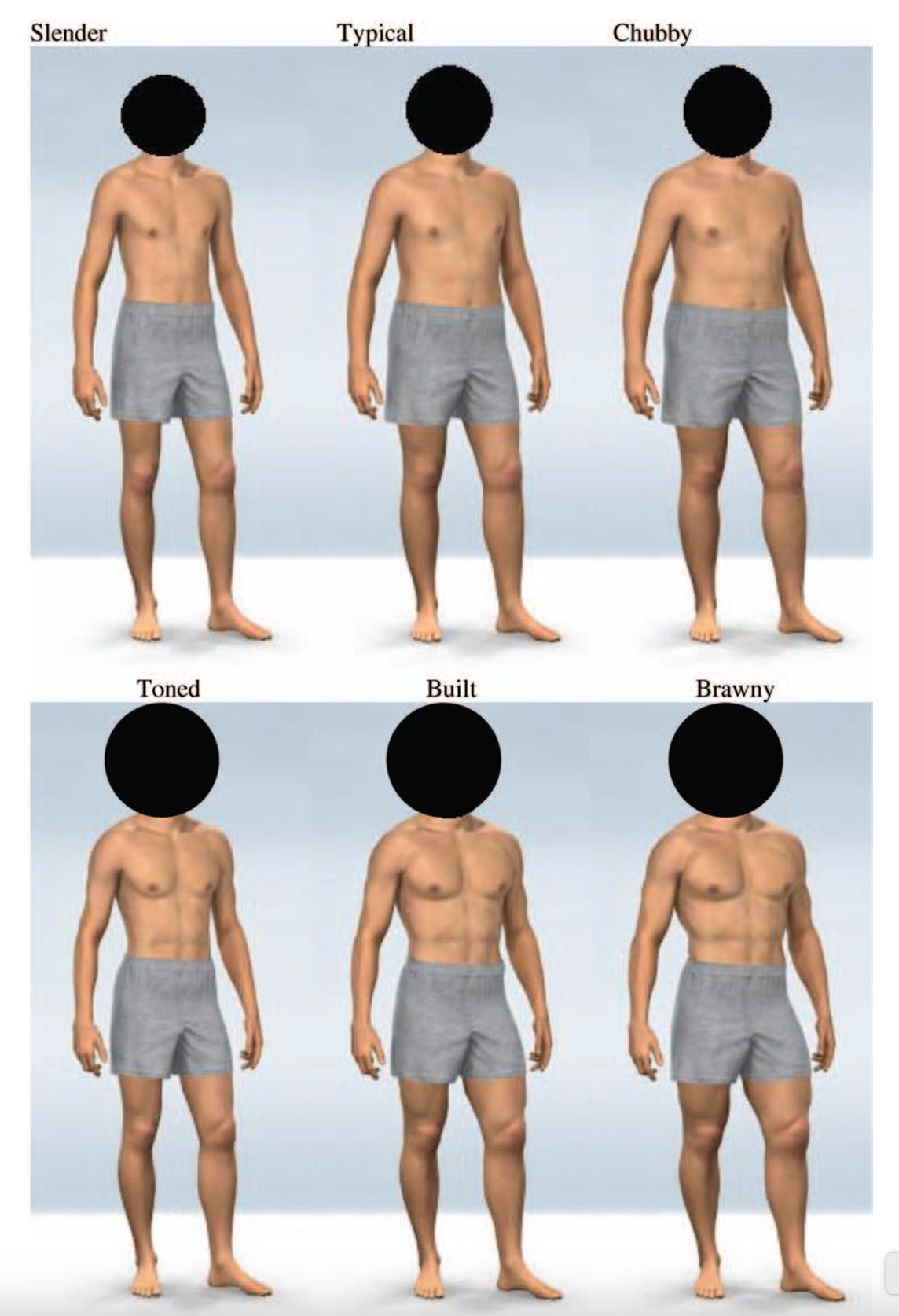
In a separate study, women reported that their short-term sexual partners were more muscular than their other partners. The researchers suggest women have fewer requirements for muscular men.
They write, “women were more willing to have short-term relations with muscular men without the requirement that they demonstrate characteristics particularly desired in long-term mates (trustworthiness, emotional closeness, etc.), possibly because these men possessed physical indicators of genetic fitness.”
The researchers then asked a group of male participants about their sexual history. Controlling for age and body fat, muscular men reported greater numbers of sexual partners.
Interestingly, the researchers also asked men about their self-esteem. Maybe muscular men simply feel better about themselves. This higher-self esteem could explain their higher sexual success. But the evidence didn’t support this.
Muscular men, regardless of their self-esteem, had more sexual partners. Finally, researchers asked a different group of men, “How many times have you had sex with a woman who had a boyfriend or husband at the time you had sex with her?” Muscular men reported more affairs with women who were in committed relationships.
2. Women like muscles; men are intimidated by them.
Researchers have found that a man’s physical formidability is a better predictor than his attractiveness for how many partners he has had.
In the study, researchers recorded short videos of 157 different men. Next, another group of men watched these videos. Researchers asked them a question about each of the men in the videos: “How likely is it that this man would win a physical fight with another man?” They used a scale ranging from “extremely likely” to “extremely unlikely.”
A group of women also viewed the videos. They responded to a question about each of the men: “How sexually attractive is this man?” They used a scale ranging from “extremely unattractive” to “extremely attractive.”
Eighteen months later, the men in the videos completed a questionnaire asking about their sexual history over the 18 months. How tough a guy looked to men predicted his reported mating success better than how attractive he looked to women. The researchers concluded, “Men with higher physical dominance, but not sexual attractiveness, reported higher quantitative mating success.”
In fact, some evolutionary psychologists have argued that throughout human history, dominance has been more important than attractiveness for men’s mating success.
Take beards. Evidence is mixed about whether women find beards attractive. Some women like them, others don’t, and for others it depends. But there is clear evidence that men view other men with beards as more intimidating than clean-shaven men.
Or take deep voices. Women are likely to think deep voices are attractive. But in comparison, men are even more likely to think deep voices are intimidating.
In a widely-cited paper titled, “Beauty and the beast: mechanisms of sexual selection in humans,” David Puts presents evidence suggesting that male competition has had a stronger effect than female selection on male physical traits.
Male competition has given rise to male traits like strong muscles, deep voices, and facial hair. Men evolved these traits not so much because women find them sexy, but more because other men find them intimidating. The evolutionary psychologist Steve Stewart-Williams has suggested that male secondary sex characteristics are more like deers’ antlers than peacocks’ tails. The peacock tail evolved to attract female peahens. But male deer evolved antlers not to impress female deer, but to compete with other males.
3. Muscles are indicators of health and fitness.
In a new paper titled “Men’s Bodily Attractiveness: Muscles as Fitness Indicators,” researchers collected responses from 503 women and 942 men.
They wanted to estimate women’s and men’s size preferences for each muscle. They found that overall, men and women think bigger muscles are more attractive than smaller ones.
But some muscles are viewed as more important than others. The top five muscles in order of size preference, as rated by women, include:
Obliques
Glutes
Abs
Biceps
Shoulders
Researchers suggest "women prefer muscles that are hard to build to be larger than muscles that are easier to build." Interestingly, men’s ratings of size preferences were larger than women’s. In other words, men thought bigger muscles were better, while women didn’t have quite the same preferences. They wanted big muscles, but not too big.
This sex difference may be in part due to the findings above revealing that dominance (rated by men) is more important than attractiveness (rated by women) for sexual success. Bigger muscles might not be highly attractive to women, but they’re certainly intimidating to male sexual competitors.
4. Muscles attract attention.
Both women and men take greater notice of men who look strong. Researchers have found that, with all else equal, people spend more time looking at individuals who look more formidable (strong, able to impose physical costs).
They suggest that formidability may be a feature of others that the human mind has evolved to detect, in the same way that we have evolved to automatically encode people’s age and sex when we first meet them.
Furthermore, people can instantly and accurately assess the formidability of others. The same group of researchers collected photos of 64 men, as well as measures of their handgrip strength.
Next, they showed shirtless photos of these 64 men to 187 participants. The participants looked at the photos and then provided their ratings of how strong they thought the men were.
Researchers found that after viewing each image for only 33 milliseconds (about 0.03 seconds), participants’ ratings of how strong the men looked were correlated with how strong the men actually were, as revealed by their handgrip strength measures. People instantly and accurately estimated how strong the men were.
The researchers suggest, "formidability may begin to influence the course of social interactions almost as soon as they have begun.”
5. Strength correlates with health.
In a study on cardiovascular (heart) disease, researchers collected data from 1,104 male firefighters over the course of 10 years. They found that men who were able to do 40 push-ups or more had a 96 percent reduced risk of heart disease compared with men who could do less than 10 push-ups.
Perhaps more surprisingly, push-ups were a stronger predictor of whether a person would get cardiovascular disease than an aerobic treadmill test.
Forty push-ups are much more than what the typical college-aged male can do. One study found the average male in college is capable of between 18 to 26 push-ups.
In his memoir The Hero’s Body, William Giraldi describes his experience as a young man attempting to become a body builder, lifting weights in his uncle’s basement:
“I fell instantly asleep each night before eighty thirty, and my slumber was so consummate, so weighted, I’d wake in the exact position in which I’d blacked out. No pill, no bottle, no smoke or aerobic intercourse has ever allotted me the immovable slumber that occurred after a session of hellward training. I’ve been missing that subterranean sleep for twenty years. What happened to me in the fluorescent corner of that basement was a literal empowering, a structural overhaul…it all produced an elation I hadn’t suspected was available to me. I’d bumbled into being devirginized a year earlier and even that gift, the rapture of sex, could not compete with the fortified sense of self I gained in that basement.”
I experienced something akin to this transformation during my senior year of high school, when my friends and I would ditch class to spend hours in the weight room. I gained about 20 pounds that year, mostly in muscle. I strongly doubt I would have had the confidence to leave home and join the military at age 17 had I not done that.
It’s kinda funny how guys tout the truism that ‘men and women are different’ in so many conversations about gender. But, when women demonstrate that difference in perception of bodies, they conclude that we must be lying. 😂
Every guy who lifts enough to have a noticeably fit body knows that you get way more attention from other men about how your body looks than from women.