


NYC Event:
You are invited to attend my live event with Freya India, one of my favorite writers. May 13 at 6:30pm.
Details and registration here.

Wall Street Journal:
I have a new piece out in the Wall Street Journal about the psychology of people who believe “words can harm.”
Many people now believe that words can cause lasting harm.
This belief has grown strong enough for some to justify violence. A recent survey by the Foundation for Individual Rights and Expression found that more than 40% of Gen Z respondents said it can be acceptable to use physical violence to prevent someone from giving a speech.
A newly published paper led by Samuel Pratt at UCLA seeks to measure this belief directly. The researchers built what they call the “Words Can Harm Scale,” a survey asking people how much they agree with statements like, “I could be left emotionally scarred by something I read.”
Read the whole thing here.
The Times:
I also have a new piece for The Times of London reflecting on the American Dream for America’s upcoming 250th birthday. The semiquincentennial (say that 5 times fast).
By most broad measures, Americans today are better educated, live longer and have more disposable income than previous generations.
So why, as this country prepares to celebrate its 250th birthday, do so few Americans believe the dream is available to everyone?
The data suggests that we are, as a country, losing faith in ourselves. And when you look at which Americans express scepticism about the future, the pattern becomes even more alarming.
A 2025 study by the Archbridge Institute found that 60 per cent of Americans with only a high school diploma believed their children would do as well or better than themselves. Among college graduates, that number falls to 52 per cent.
Additionally, Americans who earned more than $100,000 a year were more likely to say their kids would have fewer opportunities when they grew up, compared with Americans who earned less than $60,000 a year.
[…]
But it’s not just our wealthiest citizens who are eroding our belief in the American Dream. Social media is adding another layer to this pessimism, especially among the young.
Read the whole thing here.
The Only Reading App I Use:
I’ve been using Readwise since April of 2021.
If you follow me on Instagram or Twitter/X, you’ll know I regularly share screenshots like this from books or articles I’ve read:
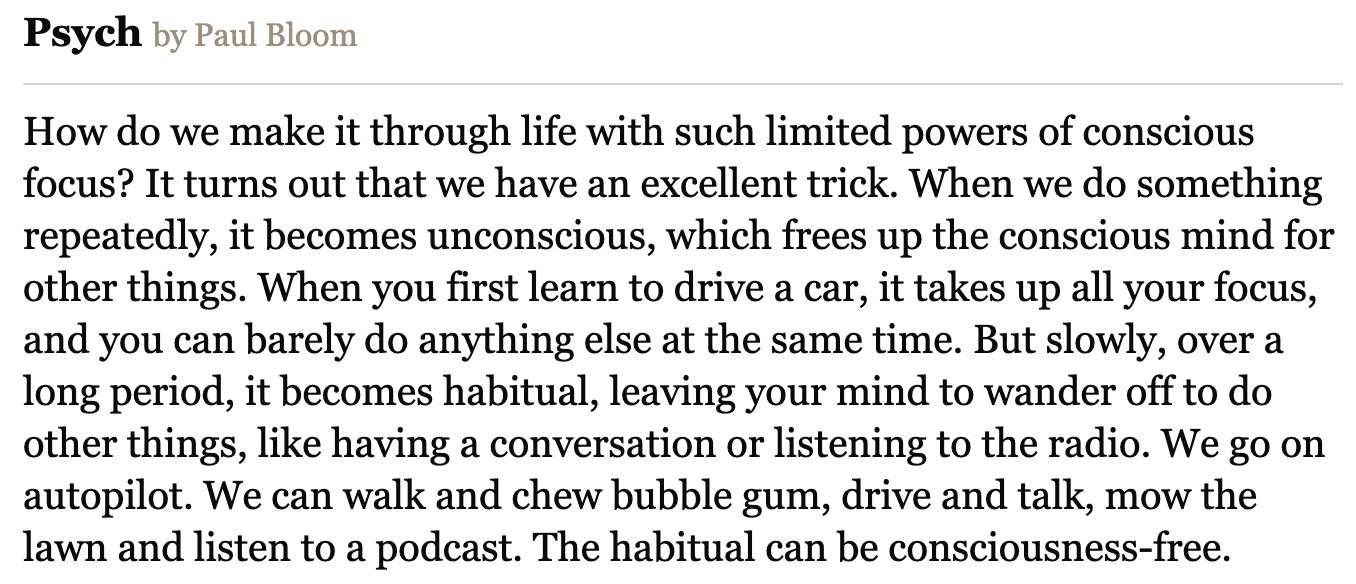
These screenshots come from my Readwise app.
Readwise aggregates your reading highlights from various sources like Kindle, Apple Books, Substack, Twitter, and so on. It stores your highlights in one place, making it easier to stay on top of your reading.
Each morning, it emails me 8 random excerpts from different books I’ve read. Since 2021, that daily message has been a quiet ritual for me: fragments from books I half‑forgot are resurfaced, like my own past self giving me a tap on the shoulder.
Moreover, when I’m thinking about a particular topic, a quick search pulls up not just my notes but every highlighted Kindle passage I’ve ever saved on the topic.
Exclusive Offer for My Readers
Use this link → https://readwise.io/robkhenderson/ to try Readwise free for 60 days (double the length of the standard free trial).
I suspect, like me, you’ll wonder how you ever read without it.
Links and recommendations:
The Mystery of the Female Sex Drive by Roy Baumeister
Why We Should Be Skeptical About High Graduation Rates by Neetu Arnold
How Communism conquered China by Clark Aoqi Wu
Thirst Traps Over Think Tanks: Dems Want Hotter Candidates on the Ballot by Lauren Egan
Follow me on Instagram here. The platform is less volatile and more chill than Twitter/X, so I post some spicier excerpts from my readings on my IG stories
You can follow me on TikTok here
Three interesting findings:
1. Relative to conservatives (6%), liberals are 3 times more likely (18%) to say Israel is “an enemy” of the United States. (source).
2. Privileged women are the most pessimistic of all. Women in middle-class professions are less likely to say they feel valued by society, and are less likely to believe that if they work hard they will succeed in life when compared with working-class women. (source).
3. More than one-third of people have fallen in love with someone that they didn’t initially think they could. And over 70% of people have become deeply attracted to someone that they initially weren’t attracted to. (source).
The paperback version of Troubled: A Memoir of Foster Care, Family, and Social Class is now available.
If you have gained any value from this newsletter and want to support my work, please buy a copy today. For yourself. For a friend or a loved one. If you can’t afford it, please support your local library.
Order your copy now:
Audible (I narrated the audiobook myself)

Very important missing factor for interesting findings part 3: People become attracted over time, especially women. The reason we are no longer getting together is because we are spending more time online and less time with other people with whom we could "learn to love". In monogamous societies this works because cheating and deviation from the norm of marriage is socially punished, but in our tolerant world of today the top 20% of men have all the options the bottom 80% of men get zero or close to zero attention, so all the women complain that "men" are all cheaters when they are just talking about the 20% of men that have all the women around them all the time.
Do you think that perhaps the infantilization of children and youth plays a role in how parents view their children's ability to be better off than they are? For example when my older two (now in college) were small the state of Massachusetts wanted to have kids in booster chairs until they were 12. Obviously the impulse is for safety but that put aside biologically a girl could have a baby at 12 and yet we would treat her as if she was no different than a 5 year old. Another example I have a friend who has a 3rd grader and she refers to the child as one of her littles. The child is 10 years old. They are not in preschool. I have three children of my own and while yes they are precious to me, I treat the college kids like they have their own brain and can take care of themselves. Sometimes for my oldest son it's a stretch because he makes stupid choices but so did I at that age. I think so many parents do not view their children as capable but rather as someone whom they need to shepherded thru life. How can such a person believe their child will be better off than they were? We've had stories of college kids having their parents call if the professor gave them a bad grade. Parents monitor everything from location to grades. Those of us who grew up earlier did not have this kind of gatekeeping. In some cases it might have been because our parents couldn't not becausebthey wouldn't. We don't allow children to make mistakes because they have been made such a reflection of us. While yes I can sometimes look at economics and say sheesh my kids are going to have a rough time, I also need to think how have I helped prepare them and teach them to be capable in handling these challenges? How can they develop confidence? True confidence. Obviously there are a million reasons why parents might feel that their children will not be better off but I just wonder if it's not some of our own thinking that will create a self-fullfilling prophecy.