
Apparently, A Lot Of Aspirational Elites Think Working At Chipotle or Panda Express Is Beneath Them Even Though It Absolutely Is Not
Temporarily embarrassed aristocrats and the war on work


I needed a job when I was in high school. I filled out applications for Taco Bell, Grocery Outlet, and a few other places. Eventually, I landed a job at a local Italian restaurant as a busboy and dishwasher. This job sucked about as much as you would expect. Still, it was better than all the manual-labor jobs I’d done before because it was indoors. From ages 11 to 15, I would rake leaves. Clean gutters. Stack firewood. Dig ditches to install sprinklers. Those jobs were tough—working out in the scorching California sun and drinking water out of a rubber hose. By the time I got a “normal” job washing dishes (“normal” meaning you’re paying taxes), I was grateful to be indoors in a place that had air conditioning and predictable hours. And not have to ride in the back of a pickup truck to the local landfill.
And I liked my restaurant coworkers. Most were in their early twenties, some in their thirties. My manager, Jim, was a small guy with a mustache who was in his forties. During my interview with him, he explained that he had been in prison but that the owner of the restaurant thought he deserved a second chance and hired him to manage the restaurant. Jim was very loyal to the owner because of this. He worked harder than anyone I’d ever met to ensure that the restaurant operated smoothly.
Yes the job sucked but the psychological effect of being employed, of earning my own money, of having slightly older coworkers, flirting with older waitresses, busing tables and interacting with patrons in an adult-adult manner rather than being treated as a kid, gave me a remarkable shot of confidence as a 15 year old kid. I received several raises in the first few months on the job, along with much praise from the restaurant owner, which confused me at the time. But in hindsight, I can understand why. Just showing up and doing the job consistently and without complaint will put you ahead of just about everyone else who works those kind of jobs.
On breaks, all my conversations with coworkers eventually turned to the topic of money, or lack of it. We would fantasize about what we would do if we suddenly struck it rich (a few coworkers played the lottery): vacations, cars, a house by the beach. I was making minimum wage, which was then $6.75 an hour. The manager Jim and the owner both noticed how efficiently I worked.
I was this awkward 15-year-old kid. Jim pulls me to the side. He had this large mustache and he had this large tattoo on his forearm. He’d done some time in prison. And he got out. He started working at this restaurant. The owner liked him because of how hard he worked. Made him an assistant manager and then the manager. Jim had been working there for something 10 years by the time I started working there. He pulls me to the side and he says, “Rob, you’re doing a great job here. We’re going to give you a raise.” A couple weeks after that, he does the same thing. Gives me another raise. Eventually, I’m making more than a lot of the pizza makers. I just thought, okay, well, I’m washing dishes. I’m doing my job. I felt a little awkward that he was praising me so much for doing such a simple job so well. But then I would hear stories about other dishwashers who worked there when I wasn’t on the clock, and how they would take frequent smoke breaks, how they would go to the bathroom a lot, and how essentially they would do everything they could to avoid doing the actual job they were being paid to do. And even at that young age, I slowly came to realize that it doesn’t take that much work to stand out. If you just do your job without complaint and do it well, people will take notice.
I liked that I was making my own money, and I especially liked getting tips.When I’d bus the tables, I’d collect the tips left by patrons and stuff them into my apron. Then, at the end of the shift, I’d pull out these dollar bills from my apron, soaking wet from an evening of washing dishes, and split them with my coworkers.
Eventually, I wanted to quit my job at the restaurant. I had grown weary of washing dishes, to the point where the smell of tomato sauce made my stomach turn. I associated it with dirty dishes and half eaten plates of pasta. The only time something exciting happened was when I was washing dishes, heard some glasses shatter, and looked out into the dining area. Two guys I knew from my high school were in a fist fight, and my manager broke it up and told them to leave or he’d call the cops.
Later I got a job at a supermarket bagging groceries. I was so relieved—stocking shelves and bagging groceries were not the most glamourous tasks, but they beat scrubbing dishes and trying to get the smell of onions and garlic out of my fingernails. I had to put in my two weeks notice at the restaurant. And I remember being nervous when I had to tell my manager, Jim, about this. And he was happy for me. He said, no, this is good. I know no one wants to be working at a restaurant washing dishes. You want every job you get to be better than the job you had before. And that’s what you’re doing. You went from washing dishes, now you’re going to bag groceries, and hopefully the next job after that will be something even better. And that was the advice that I needed at that time. And I could easily imagine some journalist or some sociology professor or anon poster on X witnessing that interaction and scoffing and saying, oh, you have this kid in this run down, working class town, making minimum wage. He went from one dead end job to another. He’s trapped in these impersonal and powerful forces he can’t understand or control. He’s a wage slave. A lot of right wing online people would call me a “wage cuck.” Someone who’s living paycheck to paycheck, trying to make ends meet. If I’d heard something like that as a teenager, it would have just demoralized me. But thanks to Jim, I felt I was advancing in the world. I wanted that feeling again.
Let’s talk about the Christopher Rufo post. He points out that the Panda Express near his house is offering 70K per year plus benefits for an assistant manager role. You can make 100K a year working at Chipotle. You could earn a comparable income as an assistant manager at a Walmart or many other chain restaurants or stores.
This ignited a firestorm of more than 900 comments from other right-leaning or dissident right people who seem to be enraged at the fact that Rufo is pointing out that, yeah, you can get a job and earn six figures if you get hired at one of these places.
Reading those comments, I’m so glad that online culture didn’t exist when I was a teenager. I could easily imagine that changing my attitude toward hard work, especially as someone who didn’t have much in the way of mentorship or guidance or adult role models or a father around. Social media hardly existed at that point in 2006. It was MySpace and not much else.
But today, if you’re a 15 or 16 year old kid, and you’re seeing comments to Christopher Rufo’s post that yeah, you can work at Panda Express and make 70k if you stay with the job long enough and become assistant manager. And the comments are, “oh, this is an absurd thing to post.” “The job market is so bad.” “What’s the point?” “This isn’t it.” All the Twitter or social media lingo. There’s one commenter that wrote “learn to burrito is the new learn to code” in reference to the Chipotle job opening. It’s mockery. It’s demoralizing.
This attitude and hostility toward work. You see it a lot on the political left. That’s part of the package of ideas about how work is exploitation and how and we need to overthrow the system to create a more equitable and just society. But I’m mystified to see that this attitude also exists on the right as well. There’s always this danger of overinterpreting comments on social media, but it does bleed over into the real world. When you talk to young people, they do spend a lot of time online and they do absorb this stuff.
This whole line of thinking makes my blood boil because a lot of these people think they’re too good for this work. Tracing Woodgrains, he called them “temporarily embarrassed aristocrats,” which I think goes a long way to explaining the reaction to Rufo’s post.
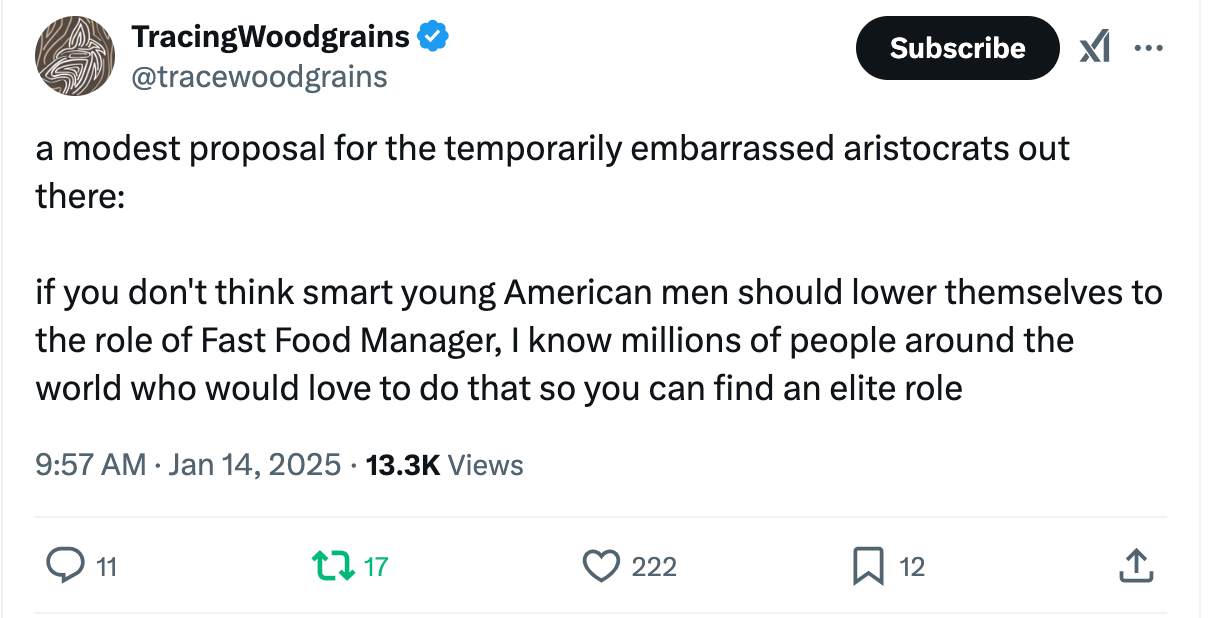
Regardless of political orientation, many aspirational elites have more respect for criminals than for ordinary people working ordinary jobs. They consider menial work humiliating and easily imagine, in response to such indignities, committing crimes.
They could easily imagine committing crimes rather than face the humiliation of going to a job where you have to clock in and wear a uniform and put on a visor and an apron and get to work.
More and more young people think they’re above this kind of work. But here’s the thing: even if you want to be successful in a white-collar job, or be an online influencer, or whatever it is you think is “good enough” for you, there’s no way you can truly appreciate that position without spending some time in tough circumstances first. It doesn’t have to be working in fast food or washing dishes like I did. But maybe a few months as a camp counselor or mopping floors or in some other role where you have to show up to a place you don’t want to be, follow orders, and learn how an organization works. You see how a hierarchy functions, where older people have more experience and you need to learn from them. The main reason I can really value what I do now is because of those earlier jobs. If you’re handed everything right away, you won’t appreciate it—and in many cases, you’ll just squander it. Sadly that’s a kind of lesson you can’t be told; you have to experience it.
In Generations by Jean Twenge , she points out that by 2019, households headed by Millennials were making considerably more money than those headed by the Silent Generation, Baby Boomers, and Generation X at the same age, after adjusting for inflation.
Moreover, Gen Z is doing well financially. The average 25-year-old Gen Zer has an annual household income of over $40K, 50% above the average baby-boomer at the same age. Their home-ownership rates are higher than millennials at the same age.
Young people aren’t doing as bad as they think they’re doing. In decades past there wasn’t this relentless quasi-demoralization campaign getting people to feel their lives aren’t good enough, that their outcomes aren’t matching their exceedingly high aspirations. In a WSJ piece titled “What Happens When A Whole Generation Never Grows Up,” the economist Melissa Kearney notes that “Our expectations are so much higher today. Generations before us didn’t expect to have large houses where every kid had a bedroom and there were multiple vacations.”
In the past, people accepted that scrimping, saving, and making sacrifices were just part of life—especially when it came to getting by, raising a family, and building the kind of life you wanted. It was understood. But now, people—especially young college graduates—have much higher expectations for themselves. Peter Turchin’s idea of intra-elite competition really helps explain this.
Relatedly, I also dislike when writers (or influencers or musicians or other creatives) say things like, “This is the only thing I’ve ever been good at.” It perpetuates the view that creativity or writing is a gift rather than something that must be worked at constantly. Yes, you need some bare minimum level of ability to be a good writer, but not as much as you might think. It also implies that the writer can only do things he or she is “good at.” Most people aren’t working jobs which demand some unique talent. Yes, you are fortunate to make a living writing. But if you couldn’t, it’s not as if you’d be forever jobless. You’d figure it out and wait tables or paint parking lots or file documents like everyone else. You’re not that special.
Even in high school, I remember the constant drumbeat about college: "College graduates earn a million dollars more over their lifetime than non-college graduates, so you better go to college." A lot of young people heard that and thought, Oh, if I go to college, I’ll be a millionaire. It sounds stupid in hindsight, but when you’re 17 and don’t know much, that’s not an unreasonable conclusion to draw. The reality, though, is that hard work is always going to be part of the equation. Sure, you can earn a million dollars as a college graduate, but it’s going to take decades of work and effort—it’s not like you get your bachelor’s degree and someone hands you a trust fund.
This helps explain what’s going on with the dissident right and these young people who think, If I have XYZ attributes, society will just hand me credentials, money, or status. Like, Oh, I have this IQ score, I’m this percent conscientious, and I went to this kind of school—so obviously, I’m owed something. But no, you still have to work. You can have two people with the same IQ and level of conscientiousness, but the person who applies those traits to something meaningful is going to be more successful than the one who just stares at their "scorecard" and wonders why life isn’t working out. Having good stats on paper means nothing if you don’t actually put in the effort.
There’s an idea from Jordan Peterson about how too often we get our questions backwards. The question isn’t “Why aren’t young people working hard?” It’s “Why did young people ever work hard at all to begin with?” Where did that work ethic come from in generations past or decades past? A lot of that was because we had a culture that conferred status to hard work, that had adults and role models who said hard work was important. As that attitude has evolved, young people are responding accordingly. It’s not as if the default is that humans are all hard workers. We’re going to try to do as little as we possibly can unless there’s reason not to. We’re seeing that now.
A lot of people expect their job to give their life meaning. But for most people, you’re not going to find deep fulfillment from being the assistant manager at Chipotle—and that’s okay. In the past, people found meaning in other areas. Arthur Brooks talks about the “four pillars of meaning”: faith, family, vocation, and community. If you’re ambitious, talented, hardworking, and creative, you can find meaning in your job. You can land a creative, interesting, and lucrative role that gives you fulfillment. But for most people—even those who are above average in many ways—their primary source of meaning isn’t going to come from their job. Historically, it came from one of those other three pillars: having a family, contributing to their community, or being involved in a religious or social organization where they felt useful and connected. But as those other sources of meaning have been mocked and ridiculed and harder to access, work has become the last pillar standing.
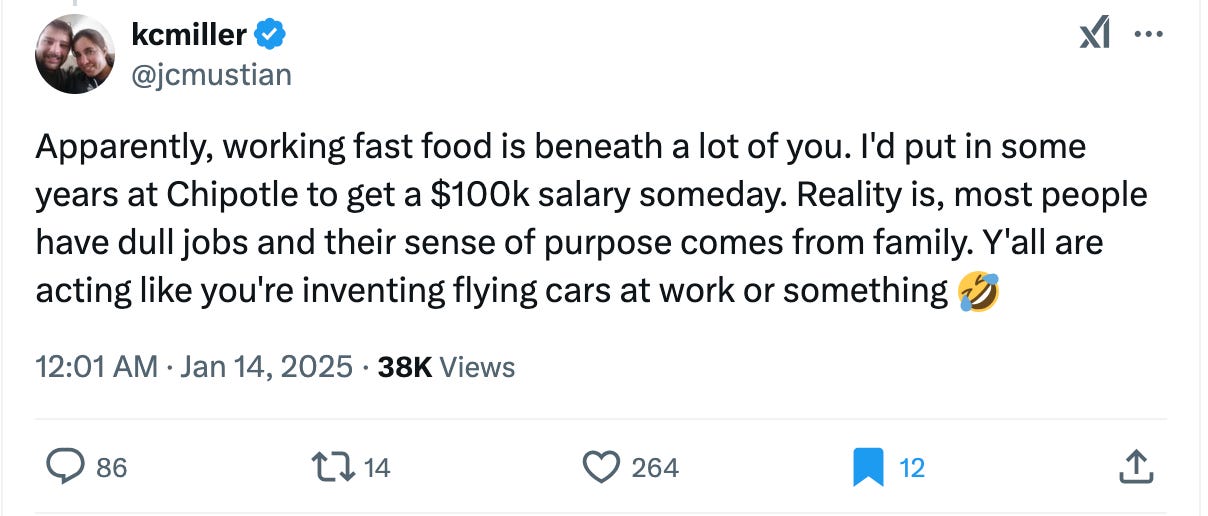
So now, work has to be everything—it’s expected to be the main source of purpose in life. And for most people, that’s just not realistic. I think we’ve made a mistake by overemphasizing that one pillar while neglecting the others. So much of the guidance people receive is focused on getting a good education, landing a great job, and building a career—assuming that the rewards and purpose will come later. But most people won’t have thrilling or glamorous careers. Most people will have ordinary jobs where they clock in and clock out. And if they don’t have a strong community, a family, or something outside of work that gives their life meaning, they’re going to feel empty and hopeless.
I don’t imagine we’re all going to come to our senses and voluntarily grow up. Either war or economic catastrophe or something else—maybe a pandemic that actually affects young people—that requires them to sacrifice something. That was one of the crazy things about COVID-19: young people, especially from middle class families and above, weren’t asked to sacrifice anything. They were just asked to stay at home, and a lot of them preferred that. In some ways, their lives even improved. For university students, it was basically impossible to fail your classes at that point. Professors and graduate students were pressured to pass every student. They came out of this pandemic softer. I don’t know if that’s ever been the case in the history of the world, where there was a global pandemic and young people actually came out of it weaker rather than stronger. Maybe some other event will change things.
We have to respect the dignity of work itself. Working any job is better than wasting away on your couch. Giving everyone a universal basic income (UBI) isn’t going to magically turn people into Mozarts or Hemingways. Most jobless people aren’t spending their time painting or sculpting—they’re watching TV or playing video games. Some people shy away from making value judgments about that, but let’s be honest: it’s not a great way to spend your time. A lot of UBI proponents assume that if you’re naturally interesting and creative, a guaranteed income will give you the freedom to focus on your passions without worrying about paying the bills. And maybe that’s true for some people.
But for most people, work itself is where they’ll find meaning—or at least where they’ll get the structure and momentum to discover it.
This boils down to two competing ideas about human nature.
Oversimplifying: the left generally believes that once people’s basic needs are met—once they’re fed, warm, sheltered, and comfortable—they’ll be free to pursue meaning and fulfillment. They’ll finally be able to thrive.
The old-school conservative view, in contrast, is that the process of working to meet your material needs—earning your way, being self-sufficient, and taking care of yourself and others—is what actually creates meaning and fulfillment. Even if it’s uncomfortable in the moment, the act of doing the work unlocks a deeper sense of purpose. That view seems more accurate to me. If you look at anxiety and depression rates, they’re often higher in first-world countries where people have material abundance. Meanwhile, people in many developing countries—despite facing real hardships—often report a stronger sense of purpose and fulfillment. That tells you something about the role that effort, struggle, and self-sufficiency play in living a meaningful life.
Most people who’ve been through trial-by-fire experiences are grateful for the growth, even if they hated it at the time. There are very few things in life that make you grow while you’re feeling a 10 out of 10 on the pleasure scale. I remember those jobs—washing dishes, bagging groceries, collecting carts, basic training and my job in the Air Force—I didn't’ like any of it while experiencing it. I saw a TikTok once of a young Army recruit filming his fellow new recruits. He asked, "If you could tell your recruiter anything, what would you say?" And these kids were saying they’d tell him to fuck off because they felt misled. I get it. In that moment, it feels awful. But five years from now—especially ten years from now—they’ll be glad they went through it. It’s the same thing with going to the gym. In the moment, lifting weights doesn’t feel great. The process leading up to it and the act itself can suck. But after you’re done—and especially after you’ve kept up with it—you’re happy you did it. We’re losing that sense of delayed gratification in an era of instant rewards. You have to do a lot of pushups before you see any progress, but post a silly video online, and you’ll get a few hundred likes in an instant. That difference shapes how we approach effort—and whether we stick with things that actually make us grow.

I supervised beginning social workers. They seemed to believe that an infinite amount of money existed some where and that they deserved a bigger proportion of it. They described it as "hurtful" when jobs that did not require a college education paid more than an entry level social work job. It was as if some all-powerful work god was supposed to see the inequities and correct things so they would have more money.
"for most people—even those who are above average in many ways—their primary source of meaning isn’t going to come from their job."
I think it's tragic for anyone to get their primary source of meaning from their job. These are the people who never retire and end up hobbling around Congress or on the stage long after they've begun to seem pathetic. When your primary source of meaning comes from your job, you end up like Joe Biden and Madonna.