

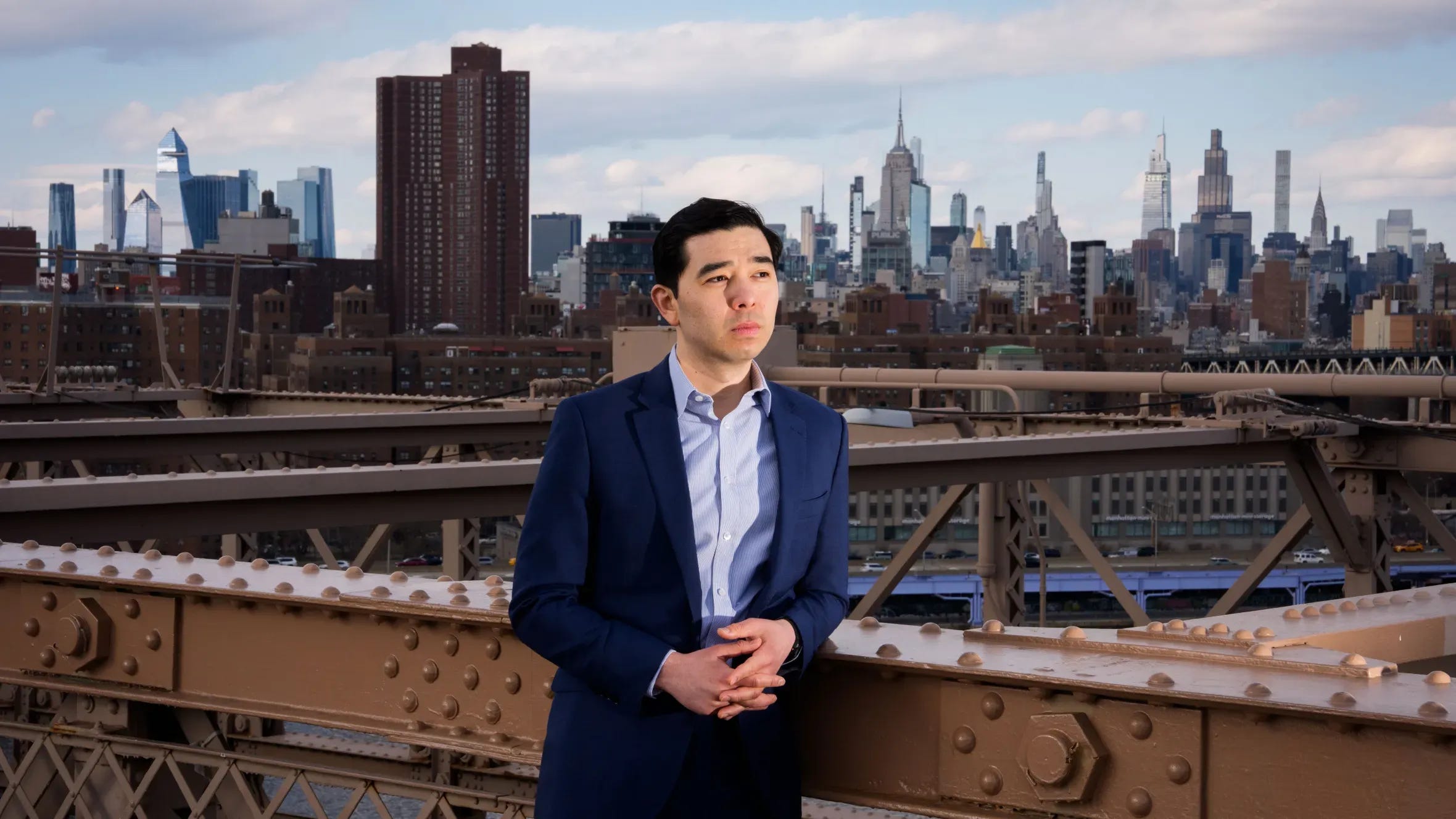
I was born into poverty. My mother, an immigrant from Seoul, suffered from drug addiction. When police and social workers arrived at our slum apartment in Los Angeles in 1993, she told them she didn’t know who my father was. I was three. It wasn’t until I reached 31 that I learnt I am half Mexican on my father’s side.
After being taken from my mother, I grew up in foster homes in California.
As a teenager, I worked as a busboy, a dishwasher and a supermarket bagger. At 17, I enlisted in the US air force.

After leaving the military, I attended Yale with the support of the GI Bill, where I earned a degree in psychology.
I later completed a PhD at the University of Cambridge as a Gates scholar. My first book became a national bestseller and was named one of the best books of 2024 by The Economist. The New York Times once described me as “self-made” and despite my uneasiness with that phrasing, I can’t fully deny it.
My story is what people often mean when they talk about the American Dream. Someone starts with very little and, through effort, opportunity and a bit of good fortune, builds a better life. Today, I am living proof that it’s possible to overcome hardship to achieve traditional success. It’s a promise that this country still offers, and continues to deliver.
By most broad measures, Americans today are better educated, live longer and have more disposable income than previous generations.
So why, as this country prepares to celebrate its 250th birthday, do so few Americans believe the dream is available to everyone?
A new YouGov survey commissioned by The Times reveals that 59 per cent of adult Americans say the American Dream is less attainable today than when they were growing up. Only 38 per cent believe it exists for everyone, and a mere 17 per cent that children today will be better off than their parents.
Moreover, 48 per cent said most of the wealthy made their fortunes by breaking the rules, while only 24 per cent believed they did so by following them — reinforcing the sense that success in the US is not earned but gamed.
The data suggests that we are, as a country, losing faith in ourselves. And when you look at which Americans express scepticism about the future, the pattern becomes even more alarming.
A 2025 study by the Archbridge Institute found that 60 per cent of Americans with only a high school diploma believed their children would do as well or better than themselves. Among college graduates, that number falls to 52 per cent.
Additionally, Americans who earned more than $100,000 a year were more likely to say their kids would have fewer opportunities when they grew up, compared with Americans who earned less than $60,000 a year. Another study found that people with high income and high social status were most likely to say success came from luck rather than hard work.
This is what I call a “luxury belief”, in which the wealthy express an idea that makes them look smart or self-reflective while harming opportunities for the less fortunate. If disadvantaged people come to believe luck is the key factor that determines success, they will be less likely to strive to improve their lives.
But it’s not just our wealthiest citizens who are eroding our belief in the American Dream. Social media is adding another layer to this pessimism, especially among the young.
Every day, people scroll through videos of seemingly ordinary individuals becoming rich and famous overnight. A teenager posts a clip that goes viral and wakes up with hundreds of thousands of followers. A content creator uploads a video and earns more in a month than most people do in a year. This can distort how people think about success. If wealth appears to come from luck rather than effort, the system starts to look unfair. Over time, this weakens faith in the idea that hard work pays off.
But here’s the reality: only 2 per cent of content creators make more than $50,000 a year. The vast majority earn little or nothing. What we see on our screens is not an accurate representation of reality. It is a highlight reel of the extremely lucky.
When people stop believing that effort pays off, they stop making the effort. Over time, that belief can become self-fulfilling.
And yet, as Americans debate whether the dream is fading, people around the world keep risking their lives to achieve it. Even amid widespread pessimism, most Americans recognise this. Fifty-five per cent of respondents in the Times-YouGov survey — and even a majority of adults under 30 — said the US offered above-average opportunities compared with other countries, while only 19 per cent said the opposite.
In short, although many doubt America, most admit it offers better opportunities than anywhere else.
That alone should give us pause. In recent years more than a million immigrants have arrived annually from countries such as Cuba, Mexico and India, escaping economies riven with scarcity, where advancement depends less on effort and more on connections or corruption.
No system is perfectly fair. But a system in which people rise based on their ability and hard work is far superior to any other.
I was reminded of this at a wedding in California two years ago. After dinner, I went into the kitchen and asked the cooks if they had any cigarettes. I ended up outside with the head caterer, who was born in the Philippines. He told me he gave the same advice to everyone on his team, which was entirely composed of fellow immigrants: if you work hard in this country, you can make money. It really is that simple, he said.
It was possible in the Philippines too, he said, but not like it was here. America was different because hard work was more reliably rewarded.
I often think back to that brief conversation as a reminder of what America represents, which is often overlooked by polls and surveys. In 1931, the historian James Truslow Adams defined the American Dream as a “dream of a land … in which each man and each woman shall be able to attain to the fullest stature of which they are innately capable, and be recognised by others for what they are, regardless of the fortuitous circumstances of birth or position”.
That ideal has never been perfectly realised, but it has been real enough to shape many lives for the better, including my own. All the naysayers and noise on social media can’t change that fact.
If the American Dream is dead, no one told the people who are still chasing it.
Here’s a video I did for The Times, on the question of the American Dream.
A version of this article was originally published by The Times under the title “The American Dream is dead? I’m living proof it’s not.”
I can understand the idea that if you are in the 1%, the odds of your kids being as successful (relative to others) is less than 50%. The opposite is true if you are in the bottom 50%. To some extent this is just the math of probability.
But it's also true that no matter where your kids end up relative to others, they will likely have any much better life than you because the march of human progress in the modern era is relentless. It is the same reason why almost everyone today lives better than John D. Rockefeller. Is useful to keep that in mind and be grateful for it.
Perhaps the American Dream is just harder to obtain, and to obtain in the same measure, as many from the Silent Generation and the Baby Boom experienced. Maybe they just had it extremely good.
Also, just my experience, but I work in the software industry in startups and it's remarkable to me how often people who have a successful exit _don't_ credit luck as part of it. Just their smarts and hard work. Those were real but man, take an inventory of all of the lucky breaks you got too.