

Last summer, I wrote a review titled “The Distinctiveness of Human Aggression.” Reprinted in The Critic here.
It was a discussion of Harvard evolutionary biologist Richard Wrangham’s superb 2019 book The Goodness Paradox: The Strange Relationship Between Virtue and Violence in Human Evolution.
In that post, I outlined what Wrangham referred to as the “self-domestication hypothesis”:
The “self-domestication hypothesis” is the idea that in the ancestral environment, early human communities collectively killed individuals prone to certain forms of aggression: arrogance, bullying, random violence, and monopolizing food and sexual partners.
Over time, our ancestors eliminated humans—typically males—who were exceedingly aggressive toward members of their own group.
If there was a troublemaker, then other less domineering males conspired to organize and commit collective murder against them.
Women, too, were involved in such decisions involving capital punishment, but men typically carried out the killing.
Humans tamed one another by taking out particularly aggressive individuals. This led us to become relatively peaceful apes.
But if humans are “self-domesticated,” then why are there so many violent people among us today?
The fact is, humans are not nearly as violent as our nearest evolutionary relatives.
Comparing the level of within-group physical aggression among chimpanzees with human hunter-gatherer communities, chimps are 150 to 550 times more likely than humans to inflict violence against their peers.
We humans are far nicer to members of our own group than chimps are. Thanks to our ancestors and their ability to plan organized murder. And tear overly dominant males to shreds.
Many people are familiar with the findings that bonobos are more peaceful than chimpanzees.
This is true.
Male bonobos are about half as aggressive as male chimpanzees, while female bonobos are more aggressive than female chimpanzees.
Bonobos are “peaceful,” relative to chimps. But bonobos are extremely aggressive compared to humans.
The basic idea: Early human ancestors united to kill aggressive bullies. Over time, this practice gradually made humans into relatively docile and cooperative apes.
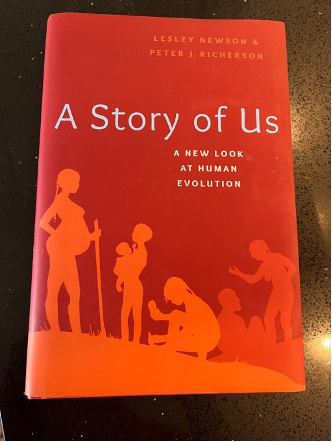
I’ve just finished reading A Story of Us: A New Look at Human Evolution by the evolutionary biologists Lesley Newson and Peter Richerson.
The book is full of useful insights. They offer an intriguing twist on the self-domestication concept:
“To be successful, a group that raises its offspring together needs youngsters who are capable of learning to control the way they respond to feelings of anger, hunger, and lust. Youngsters who can’t, or won’t, cooperate handicap the whole group and the offender might have to be eliminated. Groups that evolved the custom of casting out those who repeatedly misbehave are able to maintain an environment for raising offspring who are a credit to the group. And this custom also creates an environment in which future generations will be better behaved.”
Newson and Richerson continue:
“Difficult youngsters who have been cast out of their parental group are very unlikely to reach adulthood and produce offspring, so the genes associated with their damaging behavior will become less common in the population. As a result, generation by generation, group members will become less aggressive and competitive and more group-oriented.”
The language is gentle and euphemistic. But the point is clear: Early human parents (or other members of the community) ostracized or killed children who exhibited aggressive and bullying behavior.
In an endnote (I almost always read footnotes and endnotes; it’s the academic in me), the authors write:
“We suggest that the actions of carers discouraged aggression in youngsters to the extent that very aggressive youngsters often never made it to adulthood. Wrangham suggests that when an aggressive male did reach adulthood and tried to dominate other males, the lower-ranked males ganged up on him and killed him. We have discussed with Richard and agree that there is merit in both stories. Probably a bit of both went on.”
Newson and Richerson take something of a hereditarian position, suggesting that overly domineering behavior shows up early in childhood. And that human communities jettisoned these children. Still, they acknowledge that adult male bullies were also likely targets of ostracism and execution.
Parental Selection
As I read those passages, a paper by the trailblazing psychologist Judith Rich Harris came to mind.
Published in 2006, the paper is titled “Parental selection: A third selection process in the evolution of human hairlessness and skin color.”
Many people are aware of two forms of selection pressure in evolution.
Natural selection: the process whereby organisms better adapted to their environment are more likely to survive and reproduce
Sexual selection: the process whereby some individuals out-reproduce others because they are more attractive to mates
Harris introduces a third, unrelated form of selection: Parental selection. She states that this is the process whereby early human parents were more likely to nurture and invest in children that were good-looking.
Harris describes a true story from a woman from a hunter-gatherer community named Nisa. Nisa recounted how, when she was a child, she had a younger brother who was still nursing. But Nisa’s mother had become pregnant again. Nisa’s mother then explained to Nisa that she was planning to abandon the baby at birth so that her younger brother could continue to nurse.
When the baby was born, though, Nisa’s mother changed her mind. “I don’t want to kill her,” she told Nisa. “This little girl is too beautiful.”
Harris suggests (and this has been corroborated by anthropologists) that the practice of abandoning newborns that arrived at inopportune times was not uncommon among our ancestors. But if an infant happened to be particularly cute, that would tip the scales in their favor.
Harris goes on to make the speculative claim that this process of parental selection can account for hairlessness (parents selected smooth-skinned babies), among other uniquely human traits among primates. I was less persuaded by this than by the general point regarding the power of parental selection.
The basic idea of parental selection is consistent with Newson and Richerson’s claims about human self-domestication.
Judith Rich Harris suggests physical appearance was the crucial factor for parental selection. Newson and Richerson suggest being well-behaved was the crucial factor. Likely both factors played some role.
Harris’s idea also seems to be relevant even in modern contexts. In The Body Keeps The Score, psychiatrist Bessel van der Kolk shares research demonstrating that children in unstable and impoverished environments are more likely to grow up to be relatively healthy and successful if they are considered to be physically winsome. One of the two major privileges our equity-obsessed chattering class will never fully confront: attractiveness privilege.
The other is intelligence privilege. These are seldom discussed because much is at stake. Instead, our society promotes deceitful messages such as “everyone is beautiful” and “everyone is smart.”
Anyway, as I’ve discussed here, the anthropologist Sarah Hrdy has echoed similar findings on parental selection in her research:
Drawing on work from the primatologist and anthropologist Sarah Hrdy, the idea is that being a mother has, throughout evolutionary history, not inevitably been linked to unconditional love. Rather, evolution has selected for some level of strategy regarding how much a mother invests in an infant. Throughout human evolution, a variety of factors have been involved in a mother’s decision to supply care. These factors include the number of other babies and children to care for, the adequacy of available resources, the amount of available social support, the health of the infant in question, the mother’s current physical and mental state, and so on.
A world of limited resources forged a dynamic emotional system in mothers. This gave rise to a repertoire of possible behaviors in response to the arrival of a new infant.
In short, our ancestors had to make some difficult choices. Today, in the developed world, child mortality is all but negligible.
In the U.S., fewer than 1 percent of infants born die before their fifteenth birthday. In contrast, in traditional subsistence societies, between 30 and 60 percent of those born do not survive to age fifteen.
Historically, high child mortality rates have had a powerful impact on evolutionary trade-offs involved in mothering. At times, mothers had to withdraw commitment and care from a particular child.
[…]
Humans have historically had to make tough choices about how to direct attention, care, and other resources. They often withheld them if such resources were limited. Especially from sickly infants.
Humans developed myths and stories about these children being the offspring of elves, goblins, and so on. Perhaps to avoid confronting the reality of what they were actually doing—leaving an innocent baby to die.
Human Ancestors
Despite the often heartbreaking and cruel sacrifices our human ancestors had to make regarding their offspring, we are the descendants of those who survived. Your existence is the result of an unbroken chain of families who overcame countless dire environmental and social challenges, as well as multiple evolutionary bottlenecks (mass conflict, ice ages, disease, etc.).
In A Story of Us, the authors point out:
“Over the course of human evolutionary history, there may have been some independent-minded women who thought things through and decided to avoid the pain and risks of motherhood. These women are not our ancestors. There may also have been families that decided to do away with the rules and customs that encouraged the raising of children. Our ancestors didn’t belong to families like this. Our ancestors were part of families that believed in the importance of children and worked hard to produce the next generation. That’s why we exist.”
They continue:
“Our ancestors raised children in conditions that most of us today can't imagine surviving…even though some aspects of life are now much easier, humans don’t seem to be much happier. Objectively speaking, most of our ancestors lived more brutish, shorter, and less interesting lives than we do. But their culture provided them with beliefs that helped them to cope with this. Their expectations were lower, so bad outcomes were less of a shock.”
Many young people today claim they aren’t having children because it’s expensive. They’ll say that baby boomers had it economically easier than them. It seems peculiar, though, to say because your life doesn’t measure up to a particularly unique and prosperous period of American history, you won’t have kids. Imagine someone in the Dark Ages in the year 936 living in squalor and filth saying, “Well, life nowadays isn’t very good, so I’m not having kids.” Life across history and prehistory mostly sucked.
A recent paper has suggested that one reason young people are less likely to form families now is that they are optimizing for social status. The basic idea is that there is an evolutionary misfiring, so to speak. The desire for status arose in order to increase the likelihood of finding a partner and having offspring. But because humans are mismatched with the modern environment, we chase status at the expense of other goals. Similar to how we are prone to overeating in our evolutionarily mismatched modern environment of abundant food.
Optimizing for status definitely seems like part of the explanation for the drop in fertility in recent decades, as travel to cities has become easier and demand for more education has risen.
Alongside that explanation, I think there is something else going on.
The quote above points out that human ancestors had “less interesting lives than we do.” Up until relatively recently in human history, there weren’t many options for entertainment. Sex was one of them. In austere and undeveloped surroundings with relatively few sources of pleasure, sex can be a reliable way to experience joy.
Remember when the Netflix CEO said that their main competitor is “sleep?” Maybe the main competitor of sex (and its associated outcome of making babies) is Netflix, video games, Instagram, Pornhub and every other form of affordable and accessible pleasures.
Infant Crying as Signaling
Intriguingly, some researchers have suggested that infant crying is a signal of vigor that evolved to reduce the withdrawal of parental care.
The idea is that in the ancestral environment, inert, inanimate, lifeless infants were considered by parents to be physically weak or possibly in poor health and thus unlikely to survive. In contrast, being loud and relentlessly fussy demonstrated high energy, strong lungs, and good health. Indeed, infant crying is calorically costly, with a 13% increase in metabolic rate compared to resting.
Exhausted parent: “I’ve tried feeding you, changing you, holding you…What is it that you want?”
Crying baby: “To demonstrate to you how robust I am!”
This is likely why babies will often cry even when there is seemingly no immediate need, such as distress or hunger. Their unconscious, evolutionary aim is to ensure caregivers don’t neglect them or withdraw care or resources from them.
Of course, like most signals individuals send, babies don’t “know” they are doing this.
Infant crying also falls under the framework of error management theory. The idea is that it is more costly to under-react to potential dangers than overreact. In this case, it is better for a baby to be oversensitive and cry even when there is nothing wrong than to be under-reactive and not cry when something is wrong. A variation of this is the smoke detector principle.
A smoke detector produces a piercing, unmistaken alarm in the event of a fire. But it doesn’t actually detect fire—it detects smoke particles and activates upon the merest hint of potential danger. A false positive (e.g., alarm in response to burnt toast) is far more favorable than a false negative (failing to activate in response to flames). Thus these devices are calibrated to be annoyingly over-reactive.
Babies are nature’s little smoke detectors.
An Evolutionary Explanation for the Oedipus Complex
Continuing on the topic of childhood survival and parental selection, I’ll end with this final idea.
A very young child requires a lot of care, and doesn't want a competitor sibling.
Each additional child parents produce depletes their limited supply of attention and resources.
Thus the child interferes with the parents relationship. Crying, whining, and being territorial about the attention of one parent (usually the opposite sex parent). This can look like "falling in love" with one parent and deterring the other.
The (unconscious, evolutionary) aim is to prevent the parents from having another baby too soon, which could potentially reduce the existing child's access to crucial resources.
Thus at the psychoanalytic level, the child experiences something akin to innocent quasi-romantic interest in the parent. At the evolutionary level, the child is trying to boost their odds of survival.
I enjoy your increasingly frequent references to the "equity-obsessed chattering class".
Interesting read, as always, Rob. I’m curious about how theories survive. It seems like the ones that do are written by the best storytellers. Plausibility suggestions are the play of the day. They are like layers of stories told and retold into acceptable group think. Human psychological evolution seems very susceptible to imaginative myth making. All theories, of course, take a leap at some point where the missing evidence requires some measure of confabulation. So much of academia seems like that---groups of very imaginative storytellers striving to keep their myths alive. But I keep reading. I love stories true and otherwise.