


In the past 10 years there’s been a linguistic shift where instead of saying “Someone told me XYZ,” people now say “Had someone tell me XYZ.” An extension of main character syndrome where people place themselves at the center of everything and think in terms of consumption. “Had.”
One “has” interactions in the same way one “has” experiences or possessions. People increasingly view others’ comments as objects to be consumed and then later exploited for social media content.
We live in a quasi-surveillance state with no private moments. The weird thing is how this is bottom up rather than top down. People voluntarily do this, with no state coercion. Recall that in East Germany and other communist states, there existed people who actually relished the fact that they were deputized to spy on their neighbors and gleefully ratted them out to the authorities.
In The Culture of Narcissism, Christopher Lasch wrote that, “Modern life is so mediated by electronic images that we cannot help responding to others as if their actions- and our own- were being transmitted to an unseen audience or stored for scrutiny at some later time.”
In the above tweet, a woman mocks her houseguest for admiring her basic household items. Simple rugs and a budget knife set. It reminded me of how social media offers a platform for people with Dark Triad personality traits to turn small human exchanges into content manufactured for a digital audience.
A polite gesture (“You have a really nice home”) becomes public fodder. Complete with scornful commentary. And a dash of self-congratulation on the part of the poster.
Revisiting Christopher Lasch’s The Culture of Narcissism, it’s hard not to see a larger pattern at work.
Lasch pointed out that modern life is saturated with electronic images and performances, so we can’t help but act as if our every move is being broadcast. We’re both guard and inmate in our own digital panopticon.
With social media, every innocuous personal interaction is fodder for the rudest people on earth to mock in a public forum. The everyday—welcoming a guest, cooking dinner, or noticing a piece of décor—no longer belongs to the moment. Instead, it’s framed as content for likes, shares, or retweets.
Most people aren’t like this. Remember that only 10% of people produce 80% of the content you see online. Within this 10% are people who have extreme personality types who are happy to forego genuine human connection in exchange for quick bursts of digital approval. Instead of responding with warmth, such people are happy to seize the moment to share a snarky post, promoting their online persona at the expense of basic courtesy. It’s also possible that such people do respond with warmth in the moment, only to mock the person later online. This is even worse.
Scrolling through replies to a post like this, you’ll often see comments along the lines of “Straight men are so clueless,” or “Coworkers are the worst,” which is just another way to indulge in your darkest impulses by finding a socially acceptable target for your derision. The stronger the put-down, the bigger the digital reward.
Angry people are constantly looking for targets who they can be praised for mocking. If you say “Women are so annoying” you will be called a misogynist. But if you say “White women are so annoying” you will be applauded. Which is why you will now see both the left and the right post critical comments specifically about white women.
Anyway, if “I like your stuff” can yield that kind of dismissive treatment, no wonder more and more people are hesitant to be genuine. Who wants to risk being the target of a viral joke?
I suspect this is one reason among many why young people aren’t pairing up anymore. If you express interest on the apps or by text or DM, the other person can screenshot whatever you send and publicly mock you. If you ask someone out in person, you also risk being publicly scorned.
Of course, the odds of this happening are low. But all people see are the viral tweets and think the risks are much higher than they really are. A tweet about a single event gets a few thousand retweets and people adjust their behavior to lower the risk of being publicly humiliated.
Relatedly, the psychiatrist Edward Teach (AKA The Last Psychiatrist) has suggested that the reason real nude photographs are treated as more taboo/shocking than online/digital nudes is because digital nudes had to be made acceptable so that the system could profit from them. Not just money, but clicks, and views. Open your phone to look at a nude, and then you stay a while and open a few other apps. A digital nude keeps you plugged in. But a polaroid doesn’t. This is also why if you privately participate in unusual or extreme sexual activities, people think there’s something off about you. But if you are a public participant, e.g., in porn, or you speak openly about your sex life in a forum where audiences hear about it, the system profits from you, and thus you are cleared of all charges.
He writes:
“A private woman-- a woman who enjoys her privacy, or, at the very least, whose enjoyment is not diminished by being private-- cannot be allowed to exist. A deliberately private woman is much more of a threat to society today than what 200 years ago a deliberately childless woman was, but in the exact same way. Such a woman-- especially if she is desirable, i.e. is thought to have power-- for whom being public should be so fulfilling and obvious, yet she rejects it-- she causes other women, and men, to question if privacy might be valuable-- enhancing-- if they shouldn’t also be private.”
Privacy is the enemy of profit for the system. Genuine human connection doesn’t fuel what some have termed “limbic capitalism,” or the idea that the digital economy thrives on keeping people in a state of heightened emotional stimulation—angry, anxious, addicted, and engaged. Privacy, by contrast, is a quiet withdrawal from the marketplace. A private person, one who doesn’t document their every move or convert their relationships into content, disrupts the system by refusing to participate.
Every aspect of life is dragged into the public domain. Social media platforms, reality TV, dating apps, OnlyFans, personal branding—everything is designed to make people more visible, more legible, and ultimately, more monetizable. A person who insists on keeping their thoughts, their relationships, or their emotions private is, in this framework, almost subversive. Their refusal to be consumed makes them unprofitable.
Mocking people for a specific behavior online reduces the likelihood of others engaging in that same behavior. I suppose I’m sometimes guilty of this myself.
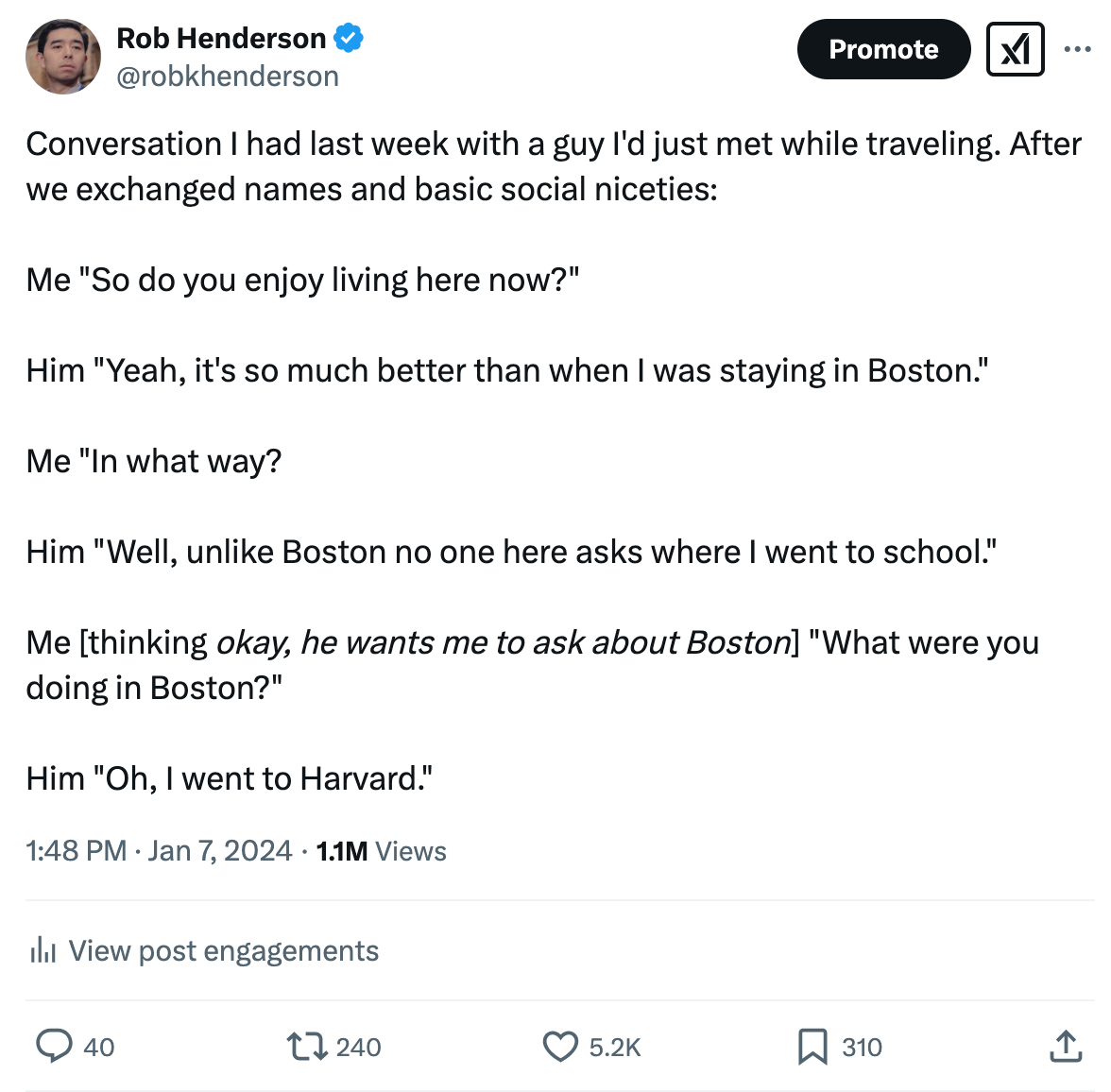
In my defense, though, the world would be a better place if fewer Harvard grads bragged about their alma mater. The world would be a worse place if people stopped complimenting others’ homes and personal possessions.
Just her "ex-bisexual" identity is the stuff of "hey, look at me... ain't I special" signaling.
If you think about a simple tribal society, which we humans are still in close evolutionarily proximity to, the children would get their behavior ordered by adults that previously had their behavior ordered. There is a process of development... a gauntlet of discipline and praise... that causes children to advance to a point of acceptable behavior based on the wisdom of history developed by the tribe.
With technology, we severed the tribal process and replaced it with electronic groupthink... where the children hang with other children and come up with their own "wisdom" of behavior. But there isn't an easy way to do a course correction once these disordered people become adults.
I have a theory that everyone is narcissistic. We all pursue self-interest primarily. The difference comes down to behavior... how we regulate ourselves to fit into society in a way that we feel accepted. Social media enables people to behave terribly.. and the likes and followers gives them positive feedback for behaving terribly. I think the tonic to that is to blast them on social media for their terrible behavior.
Wow, this is really insightful. I was a single guy until I was 36 and for some reason struggled to keep up with the bills. I probably let too much $$ slip through my fingers but ... for the longest time I had a brown sofabed I had purchased from a divorced friend for $50. It had orange and green racing stripes. Maybe enough of my mom's frugality wore off on me but when I got my first apartment all to myself I had it slipcovered instead of buying a new one at Macy's. But I always complimented the apartments of the women I dated: They all seemed so much more put together and tidy. Back in those pre-social media days they were gracious about it. I'd unfriend that ex-bisexual in a millisecond.