
The Smoke Detector Principle: The Evolutionary Advantage of Overreaction
Notes on anxiety, depression, and borderline personality disorder


You read this newsletter so you’re almost certainly a person of above average intelligence. Intelligence correlates with educational attainment and occupational success.
And people with the highest levels of educational attainment have higher anxiety than people with lower educational attainment. People in white-collar professional occupations also have higher scores for anxiety than those in blue-collar occupations.
Anxiety is, generally speaking, a first-world problem. A 2017 study in JAMA Psychiatry, which used data collected from nearly 150,000 adults in 26 countries, found that generalized anxiety is far more common and more severe among people in wealthy countries.
Considering that half of American adults under the age of 30 report feeling anxious all or most of the time, anxiety is something worth learning more about.
Moreover, the proportion of Americans diagnosed with clinical depression at some point in their lifetime reached an all-time high in 2023, at 29%. Depression can encompass suffocating sadness, an inability to feel pleasure, and lethargy that makes the smallest tasks seem insurmountable.
The percentage of U.S. undergraduates diagnosed with depression and anxiety doubled between 2009 and 2019. Given these findings, depression is something worth learning more about too.
I’ve been listening to lectures for a course titled “Understanding Human Emotions” by Dr. Lawrence Ian Reed, a Clinical Professor of Psychology at New York University.
Here are my notes on lecture 1, lecture 2, lectures 3 and 4, lectures 5 and 6, and lectures 7-9. I remember learning a lot of this stuff in college and in my doctoral program. A useful refresher for me. A good overview for anyone with an interest in the psychology of emotions.
Below are my highlights, notes and reactions to lecture 10.
In this lecture, Professor Reed concentrates on 3 specific disorders: anxiety, depression, and borderline personality disorder.
[In square brackets are thoughts/notes I jotted while listening]:
-It’s important here to distinguish between emotions and moods
-[As I noted in my notes to lecture 1, emotions describe states that last for a limited amount of time. Seconds or perhaps minutes. Facial expressions last for a few seconds. Bodily expressions typically last for seconds or minutes. Moreover, it’s rare that we don’t know the causes of our emotions. This is in contrast to moods, which can last for hours, days, weeks, or even lifetimes. Examples include depression (or low mood), anxiety, and mania. We can usually pinpoint the source of our emotions and why they change. But you’ve probably had times in your life when you’re in a bad mood and don’t know why. Unlike with our emotions, we aren’t always aware of the source of our moods, or what causes changes in our moods.]
- Emotions are superordinate programs that exert control over our mental and behavioral adaptations.
-For example, if you hear strange voices in your house in the evening, you’ll feel the emotion of fear. Suddenly, your hearing improves. The main priority is safety. Any other goals and the subsystems that serve them are deactivated. You might be hungry. You might be sleepy. You might be lonely or in physical pain. But when you feel fear, all of those things are subdued. You’re no longer worried about what you’re going to have for dinner, or getting ready for bed, or your lower back pain. Your information gathering programs also change. You’ll think about where your loved ones are. You’ll think about how to get help, or how to call the police, or where your nearest neighbors are. In addition to psychological changes, you’ll undergo physiological changes as well. Your blood will leave your digestive tract and enter your legs and muscles to enhance your strength and speed. Adrenaline will spike. Your heart rate will either increase or decrease depending on whether the situation calls for physical confrontation, fleeing, or immobility (sometimes described as fight, flight, or freeze).
-Our various emotions such as anger, sadness, disgust, shame, and so on all activate in response to different situations, and evolved in order to improve our ancestors’ likelihood of surviving and reproducing.
- [Emotions evolved because they generally work to confer evolutionary benefits to organisms, helping us to ultimately increase the likelihood of survival or reproductive capacities. For example, under an evolutionary framework, the emotion of happiness is not an end goal; it is a means to an end. The things that made us happy in the ancestral environment were typically things that benefited our likelihood of survival and reproduction. A successful hunt, locating a source of honey, eating, obtaining social allies, attracting romantic partners, having sex, having children, bolstering one’s status and respect, etc. Today, actions associated with accruing resources, satisfying fundamental needs like hunger and thirst, bolstering our esteem in the eyes of others, being thought of as attractive and desirable, being valued, etc. continue to make us happy.]
- [This raises the question: Why has evolution retained a heterogeneity of different traits within the same species? Particularly with regard to humans. In other words, why do we not all have some fixed optimal set of attributes with regard to our personalities, mental and physical abilities, temperament, preferences, and so on? A large body of research in evolutionary biology and psychology suggests that evolution has not selected a singular optimal set of traits because no such set exists across all possible varied environments. For example, Personality A (e.g., proneness to behavioral expressions of rage) might be optimal in environment Y whereas personality B (e.g., strong impulse control) might be best suited for environment X. In evolutionary terms, there are no universal selection pressures to eradicate individual human differences among people across different environments.]
-[Pain, envy jealousy, social anxiety, embarrassment, guilt, and shame. Natural selection armed human beings with an arsenal of reactions to ensure we never fail to detect and respond to events that might jeopardize our survival and possibility of reproducing.]
-One of the criterion for major depressive disorder is an extended duration (at least 2 weeks) of low mood; of feeling blue.
-Anxiety is a necessary emotion that helps us to stay vigilant to potential threats like heights, venomous or predatory animals, unfamiliar surroundings, whether your child is safe, and so on. People who lack anxiety are far more likely than average to be injured or die in preventable accidents. Or, as a more mundane example, people with low anxiety are more likely to fail an exam or bomb an interview because they didn’t have the requisite amount of anxiety needed to study or prepare properly.
-Roughly 1 in 5 people will be diagnosed with a clinical anxiety disorder at some point in their lives such as generalized anxiety disorder, panic disorder, or a specific phobia.
-Generally, most people are more likely to suffer from too much anxiety as opposed to too little. Why is this?
-Professor Reed suggests turning this question on its head—if anxiety is adaptive and helps us stay alive and prosper, then why not be anxious all the time?
-This would make us feel stressed out all the time. But natural selection doesn’t care how we feel. Our emotions benefit our genes more than they do us as individuals. For the evolutionarily minded scientist, pain and anxiety are not obstacles or problems but rather solutions.
-The reason we are not always anxious, though, because experiencing anxiety has costs. It uses extra calories and, over time, overtaxes our physiology to the point where it damages bodily tissue. Part of the physiological response to anxiety is the release of cortisol, which in the short term makes us more alert and energetic but in the long term inflicts damage to our bodies and organs.
-Averaged out over the entire period of evolutionary history, the benefits of anxiety have outweighed the costs in keeping our ancestors alive long enough to procreate
-Anxiety has both benefits and costs. We often feel it unnecessarily when there is no actual danger or looming threat. So why isn’t the regulatory mechanism for anxiety calibrated so that we only feel it when we absolutely need to?
-The answer is that it is not clear in every situation whether or not anxiety is needed, and, if so, how much.
-[The evolutionary psychiatrist Randolph Nesse pioneered what he termed “the smoke detector principle.” I described this concept in my PhD thesis: A smoke detector provides a piercing, unmistaken alarm in the event of a fire. But it doesn’t actually detect fire—it detects smoke particles and activates upon the merest hint of potential danger. A false positive (e.g., alarm in response to burnt popcorn) is far more favorable than a false negative (failing to activate in response to flames). Thus these devices are calibrated to be annoyingly overresponsive. Similar to error management theory, the smoke detector principle proposes that evolved systems that govern defensive responses tend to generate false alarms and apparently excessive responses to trivial risks. The body’s response to the possibility of contamination, illness, or danger—disgust, anxiety, fear, pain, fever, coughing, vomiting, diarrhea, and so on—are often more intense than is needed. But such reactions tend to be relatively small costs compared with the possibility of severe illness or death if no response were expressed. In other words, evolution shaped defensive systems on the principles of error management. When met with ambiguous risks, the body is calibrated to respond as if the danger is bigger than it really is, rather than under-respond. As Nesse and his co-author have put it, “the cost of getting killed even once is enormously higher than the cost of responding to a hundred false alarms.”
-[Our tendency to overreact to the possibility of danger is why we can safely take medication to reduce pain and nausea. Pain and nausea are adaptive responses. They are not problems—they are actually evolutionary solutions telling you how your body is doing and how much exertion it can take. But because humans have evolved to respond to unpleasant stimuli with outsized pain or nausea, dialing down these adaptive functions do not place people at a higher risk. If you are pushing your body to what seems to be its limit (e.g., an ultramarathon), you can take some meds to push yourself even further and often you will not get hurt. This is because your body is designed to ring the alarm bells telling you that your body is in danger well before it really is. So you can ingest drugs to override your body’s natural defenses and keep going. This isn’t wise and not recommended, but it is simply meant to illustrate the smoke detector principle.]
-We pay the small cost of oversensitivity to anxiety to avoid the larger catastrophic cost of severe injury or death. Throughout evolutionary history, humans who weren’t as prone to anxiety were more likely to die. And didn’t pass their genes on.
-[Interestingly, the psychologist Sarah E. Hill has pointed out that mood-related issues like anxiety and depression are highly common among women who go on the pill. She writes that “even though some women’s doctors continue to tell them that those changes in their moods aren’t real...a growing body of research suggests otherwise.”]
-[Also: people who score highly on Dark Triad Machiavellianism tend to score highly on measures of anxiety and depression]
-[Here I’ll point out that people with major depression are 0.90 standard deviations lower in conscientiousness. People with generalized anxiety disorder are 1.1 SD lower in conscientiousness. People with substance abuse diagnoses are lower in agreeableness by 0.75 sd. I myself score low in agreeableness, and when I was in rehab I noticed many of my fellow patients were also not exactly the nicest people you’ve ever met.]
-[Physically stronger people tend to score lower on anxiety. Women tend to report more anxiety than men and physical strength partially accounts for this sex difference. Though it’s important to understand that within sexes, strength is still inversely correlated with anxiety. That is, a strong woman will experience less anxiety, on average, than a physically unformidable woman. Same goes for men.]
-What about depression? Professor Reed shares the definition of depression from the DSM-V: In order to be diagnosed, one must meet at least 5 of the following 9 criteria during the same 2 week period. At least one of these criteria must be depressed mood or loss of interest or pleasure:
Depressed mood every day or nearly every day
Marked loss of pleasure in most activities every day or nearly every day
Significant weight loss or weight gain
Insomnia or hypersomnia (too much sleep)
Psychomotor agitation or retardation
Fatigue or loss of energy
Feelings of worthlessness or guilt
Diminished ability to think or concentrate or indecisiveness
Recurrent thoughts of death or suicidal ideation or plans to commit suicide
-The behavioral model of depression holds that depression arises when we put forth a great deal of time and effort into something without receiving any reward. For example, you might get depressed if you work really hard all semester and still don’t pass a class. Or you’ve devoted time and opportunity cost into a relationship that has ended. The misguided feeling that effort doesn’t matter can give rise to depressive symptoms.
-Another model suggests that stressful life events leads to depressive symptoms. The purpose of these symptoms is to elicit social support and gain reassurance about one’s self-worth from others.
-A third model, known as the cognitive model of depression, states that beliefs about the world and ourselves cause depression. The belief “If I’m not successful to others, then I’m worthless,” is one example.
-Finally, the evolutionary model, proposed by Randolph Nesse (the same evolutionary psychiatrist who proposed the smoke detector principle), suggests that depression is nature’s way of telling us that we are misapplying effort toward goals we are unlikely to achieve. If you work toward something and your efforts aren’t paying off, then it is wise to withdraw and conserve your energy for other activities and aims. People with highly sensitive depressive responses react with depression not only to tasks they are unlikely to accomplish, but also to everyday tasks that are within their grasp.
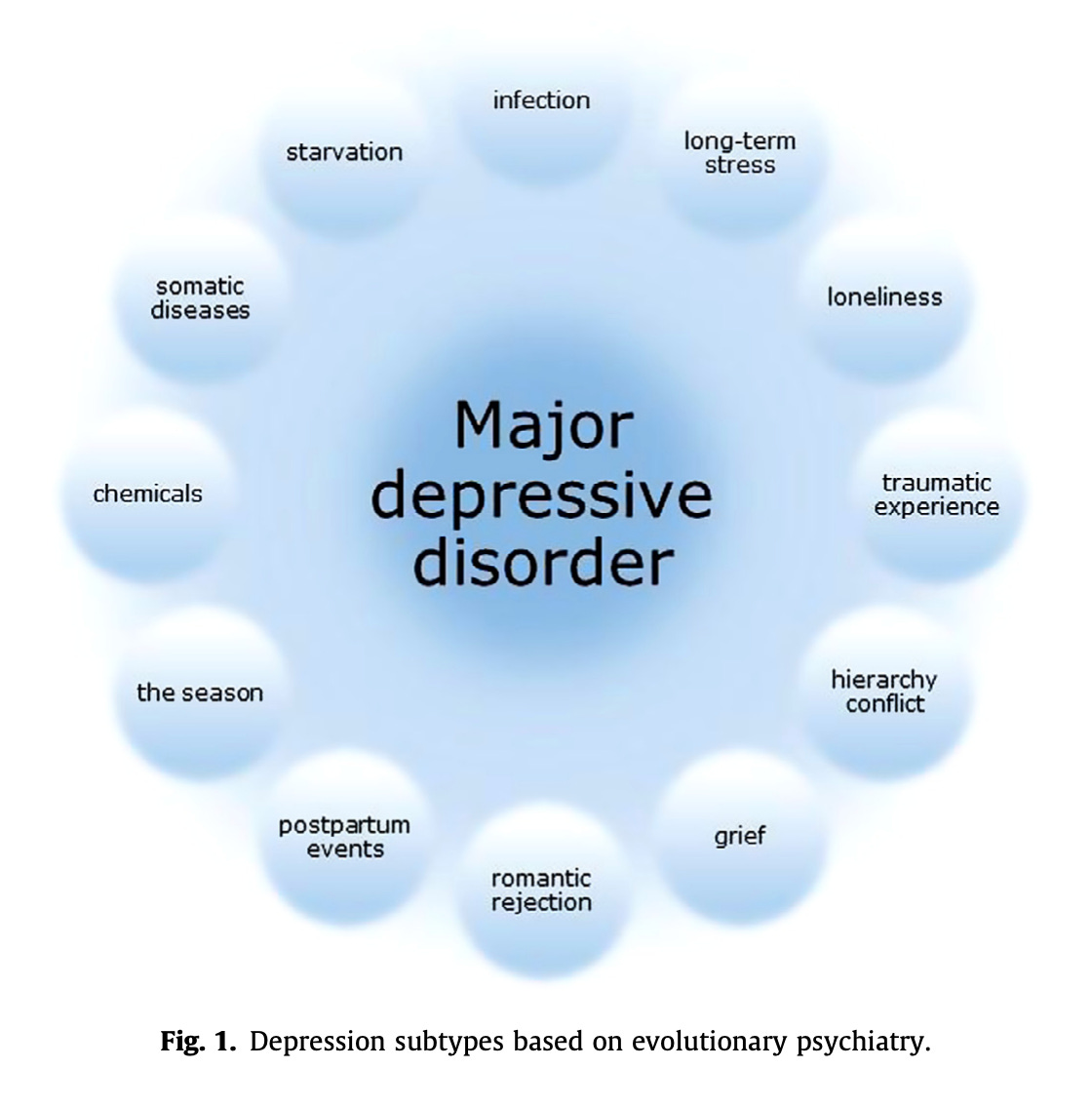
-Reed describes patients who seek therapy in response to a major perceived failure in their lives (getting fired, marriage ending, etc.) and then feel better once they redirect their energy to goals that are within their ability to accomplish or make progress towards
-Reed suggests that depression can tell us when to cut our losses—if we’ve been striving for too long on a particular unrealistic goal with no sign of progress on the horizon, that feeling helps us to decide to conserve our energy and expend it elsewhere
-[The standard way to tell if a drug will be an effective antidepressant is to see if it makes an animal persist in useless efforts. The Porsolt test measures how long a rat swims when dropped in a beaker of water. Rats on Prozac swim longer.]
-[William Costello has found that 73% of incels qualify to be clinically diagnosed with severe or moderate depression, versus 33% of non-incels. The inability to attract a romantic partner, or the perceived belief that you’re not good enough to attract one, likely plays some role here.]
-[Depression also sets in when you suffer adversity and the solution to it isn't clear. So you shift your cognitive resources and attention. Intense rumination is a major component of depression. When you do this, you can't do anything else. There's a tradeoff.]
-[Many people believe achieving big objectives will give them a lot of happiness and are disappointed to find that doing so is a letdown. After a big achievement, lots of people experience depressive symptoms. True satisfaction comes from progress in the struggle toward a goal, not the accomplishment itself.]
-[Doing anything that helps you feel effective can keep depressive symptoms at bay. A study of 140,000 adults found that consistent engagement in moderate or vigorous exercise at least once per week was associated with less current depression and predicted lower likelihood of depression onset four years later.]
-[Male depression is commonly overlooked because depression questionnaires typically don’t ask about ‘acting out’ symptoms of depression [e.g., anger, fighting, risk-taking], and male depression is recorded instead as substance abuse disorder or criminality.] More on this point here.]
-[A review of 58 studies found that masculinity (independent, active, competitive, makes decisions easily, never gives up easily, self-confident, feels superior, stands up well under pressure) is linked to lower depression in men.]
-[Another fascinating finding from Sarah E. Hill is that women on hormonal contraceptives are 50 percent more likely to be diagnosed with depression 6 months later. Moreover, women on hormonal contraceptives are 40 percent more likely to be prescribed an antidepressant.]
-[Interestingly, despite the frequent claim that major depression is a chronic disease, the median duration of major depression in a recent study of a nationally representative community sample was six months. Only 12-15% of individuals with at least one episode of major depression have chronic MD.]
-One reason depression is more common during cold winters is that, throughout evolutionary history, food was more scarce and moving our bodies was more calorically expensive during the cold seasons
-Reed then shifts from these two mood disorders (anxiety and depression) to an emotional disorder: borderline personality disorder
-Borderline personality disorder is among the most prevalent and widely studied disorders. Yet it remains esoteric and difficult to understand and treat.
-The term “borderline” was originally coined to describe someone who is somewhere between neurosis and psychosis (thus on the “border”)
-It is marked by immaturity, identity diffusion (unstable sense of self), and the use of specific defense mechanisms, interpersonal difficulties, and emotional instability
-According to the DSM-V, a personality disorder is defined as “an enduring pattern of inner experience and behavior, that deviates markedly from the expectation of the individual’s culture. It is pervasive and inflexible, has its onset in adolescence or early adulthood, is stable over time, and leads to distress or impairment.”
-Borderline personality disorder is defined as a pervasive pattern of instability of interpersonal relationships, self-image and affects, and marked impulsivity, beginning by early adulthood and present in a variety of contexts as indicated by 5 or more of the following:
Frantic efforts to avoid real or imagined abandonment
A pattern of intense and unstable interpersonal relationships characterized by alternating extremes of idealization and devaluation
Identity disturbance; markedly and persistently unstable self-image or sense of self
Impulsivity in at least 2 areas that are potentially damaging (e.g., spending, sex, substance abuse, reckless driving, or binge eating)
Recurrent suicidal gestures, threats, attempts, or self-mutilating behavior
Affective instability and reactivity of mood (irritability, anxiety, etc.)
Chronic feelings of emptiness
Inappropriately intense anger or difficulty controlling anger
Paranoia
-People with BPD have a slow return to baseline after an emotional experience
-Regarding unstable identity, it is difficult to have a strong sense of self when one’s emotional experiences are fleeting, unpredictable, and inconsistent
-Women with BPD describe emotions with less granularity compared with non-BPD control participants. Women with BPD over-emphasized valence and under-emphasized arousal when self-reporting emotional experiences. They described emotions as feeling good or bad without specifying the emotions or how intensely they were experienced. This might help to explain the all-or-nothing style of people with BPD.
-People who score highly on BPD self-report less emotional clarity, or how well they understand their feelings. They also show lower levels of emotional awareness. This limited ability to understand their own emotions might help to explain why they have difficulty regulating them.
-[People with borderline personality disorder are prone to disavowing their own rage, hate, envy, and disgust, seeing these emotions as separate from themselves. They then orchestrate ways to elicit these feelings in others, and react angrily at them for experiencing these feelings. This is sometimes called projective identification.]
-[Dr. Drew told me that women with borderline personality traits [impulsive, thin-skinned, severe mood shifts, lack of clear identity, fear of abandonment], tend to attract and be attracted to psychopathically oriented men. And men who are psychopathic are often interested in and attract borderlines. This is consistent with other work indicating that people with personality disorders tend to enter relationships with one another.]
Was so pumped to receive your extra piece this morning!
So much worthy content to consume.
Feeling grateful 🙏🏼 thank you
Great article.