

Communism is on the rise in America. More than that: It is being celebrated.
With the midterm elections just over one month away, at least eight congressional candidates with avowedly socialist perspectives are poised to take office, polling well ahead of their opponents in states from New York to Colorado.
Think there’s no connection between socialism and communism? Think again. Nearly half of the members of the Democratic Socialists of America’s (DSA) leadership body identify as communists. As Stu Smith reported earlier this summer, “Members with Communist political tendencies now significantly shape the DSA’s leadership.” In their December 2025 newsletter, members of the DSA’s Red Star Caucus celebrated Mao Zedong’s 132nd birthday.
All of which raises some natural questions: Where is this revolutionary romance coming from? And as it steadily seeps into our leadership class, where will it lead?
The best guide to understanding these questions is a book published more than 50 years ago under a pseudonym—because the author feared what pro-Maoist intellectuals would do to him if they discovered who wrote it.
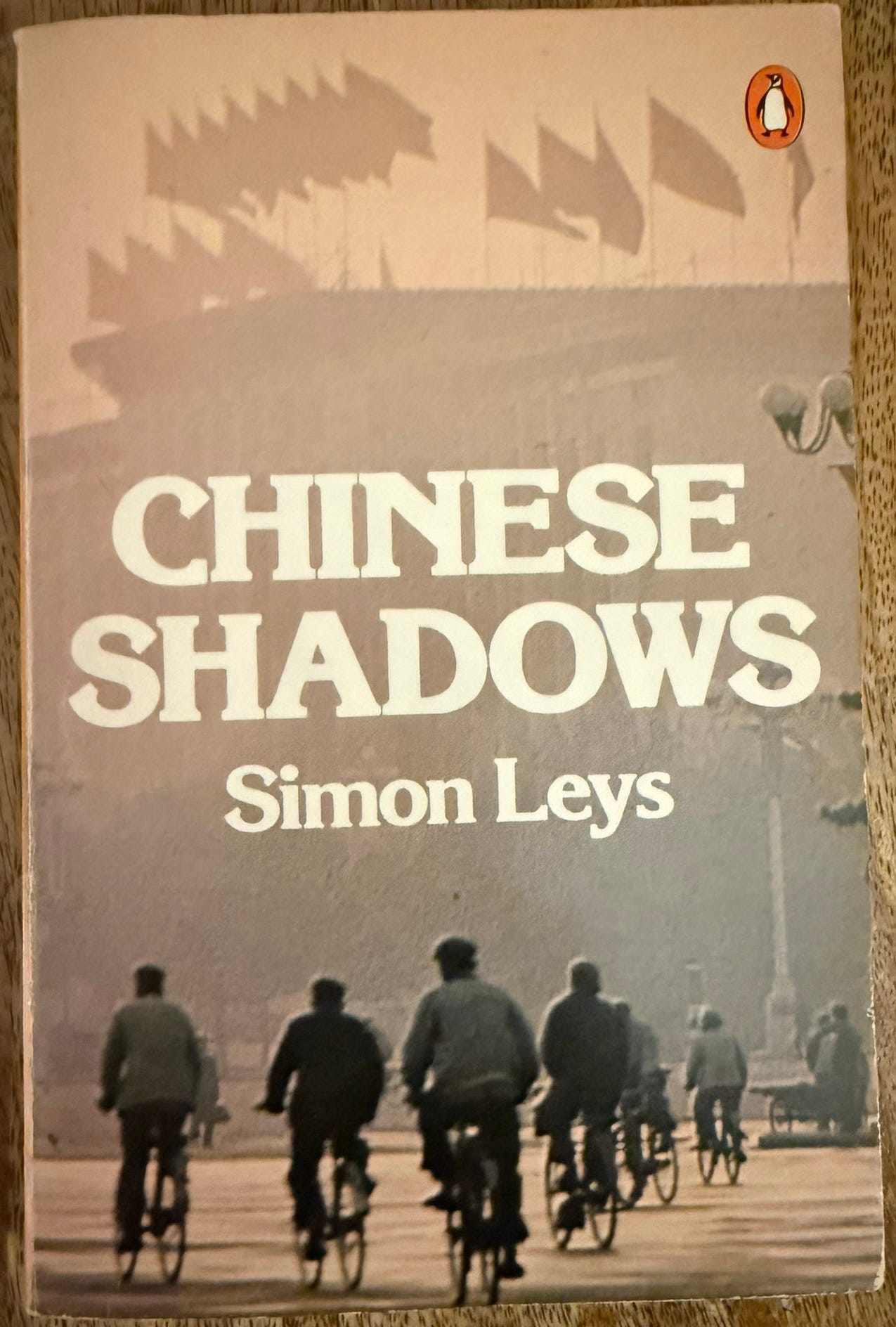
Simon Leys, whose real name was Pierre Ryckmans, was a Belgian-Australian scholar of Chinese art and literature. In 1974, he published Chinese Shadows, a record of the cultural and political destruction he saw in China in the years just after the Cultural Revolution. The book is full of eerily relevant observations. One of them, which I will get to, is the most haunting thing I’ve read about what political terror does to the human soul. And nearly all of them describe habits of mind that didn’t die with Mao. In fact, they are now alive in America.
First, some background. In The Cultural Revolution: A People’s History, 1962-1976, the historian Frank Dikötter explains how it began. Mao Zedong wanted to purge rivals at the top of the Communist Party. So he turned to radical students, giving them permission to denounce every authority except his own. Party officials egged on these young militants as they raided the homes of “class enemies” and turned them into social outcasts. What followed was violence, looting, the legitimization of hatred, and the denunciation of family, friends, neighbors, and coworkers.
When the resulting catastrophe became impossible to deny, Mao and the regime’s officials disavowed their own shock troops, claiming that an “extreme left” had been responsible for the atrocities.
Sound familiar? Americans witnessed a milder version of this in the summer of 2020. Rioting and looting that year caused between $1 billion and $2 billion in damages. As this transpired, prominent voices in politics and media minimized the destruction. And some leading officials quickly insisted that the destruction was not the work of their own residents. Minnesota governor Tim Walz, later the 2024 Democratic nominee for vice president, estimated that 80 percent of those causing damage came from out of state, while Minneapolis mayor Jacob Frey declared that “the people that are doing this are not Minneapolis residents.” Jail records showed the opposite.
If the scale is different, the pattern is the same: indulgence first, followed by disingenuous disavowal after the damage is done.
Leys saw the pattern clearly: Communist governments alternate between stretches of relative relaxation and unexpected spasms of revolutionary terror. As Leys writes, “The Cultural Revolution had been hard on Chinese nerves—the years of unremitting tension, battle, uncertainty, and violence...the authorities evidently realized it was necessary to give the masses some breathing space; for two years, no new mass movement was started.”
The absurdity of the period is hard to overstate. After each revolutionary spasm, museums were closed so that historians could rewrite history to conform to the latest dogma. Here one can’t help but think of a recent White House report which details how the Smithsonian has been rewriting the country’s past to fit the dogmas of the present. According to the report, the museum describes Mickey Mouse as part of the “vestiges of long-standing traditions of blackface minstrelsy.” It described ukuleles as “a product of U.S. imperialism.”
An old Soviet joke illuminates this trend: “Under communism, the future is certain; it is only the past that is unpredictable.”
The rewriting extended to biography. Mao was raised well off, but he was described as a “member of the working classes.” Regime-approved figures were invariably described as having “working-class origins.” Enemies of the regime, even those who grew up in dire poverty, were always described as having a “wealthy capitalist background.”
Enter Zohran Mamdani, the son of an Ivy League professor and an award-winning filmmaker, who campaigned for mayor as the tribune of New York City’s working class. The socialist movement behind him is powered less by workers than by the highly educated. Class, in these circles, is mostly about the aesthetic costume you wear for political purposes rather than the objective material facts about your life. Mao’s propagandists understood this, as did Mamdani’s social media team.
The Red Guards, the paramilitary youth movement guided by Mao, were upset that red, the color of the revolution, meant “stop” at traffic lights. They demanded the signals be inverted so that traffic would advance on red and stop on green. The regime officials talked them down, telling them that stopping on red was a way “to respect the revolutionary order.”
For a movement devoted to abolishing class, the Communist hierarchy was obsessed with status. Officials fussed over exact titles, the length of red carpet rolled out for each guest, the order in which leaders’ names were presented, and who sat where at dinner.
Leys tells the story of a young European diplomat naive enough to believe the regime actually cared about equality. He decided, instead of using a car, to ride a bicycle to the Foreign Affairs Ministry. A Chinese interpreter intervened and told him to take a car. “To ride in a car marks you as an official,” Leys wrote, “but the model, color, and size will vary according to your importance.”
The regime also eliminated first, second, and third class on its trains. The new categories were “sitting hard,” “sleeping hard,” and “sleeping soft.” These were the same classes as before, and the fares still ranged in price. But the word “class” was removed, so obviously everyone was equal now.
Top officials earned more than workers, lecturers, and lower-level bureaucrats. More important than pay, though, were the privileges that came with power: foreign travel, university seats for one’s children, jobs for relatives, and access to scarce goods through personal connections.
Ordinary people measured status in humbler forms. By the early 1970s, bicycles in China were “like cars in the West: both a vehicle and a status symbol. In rural areas, many girls ask boy friends to guarantee them the ‘three things that go round’ (a watch, a bicycle, and a sewing machine) before agreeing to marry them.” Even after decades of revolutionary emphasis on egalitarianism, the marriage market still operated based in part on the ability to obtain resources. Human nature is unchanging in that way.
What the revolution could change, though, was the status of acceptable reality. The Propaganda Department of the Party’s Central Committee determined the variable “truth” of the moment. The significance of historical monuments, art, literature, science, and medicine was determined by how well each served the aims of the regime.
Some people refused to play along and paid the price. Wang Shih-wei was an experienced revolutionary and Marxist theorist who pilloried the emerging ruling class for being “arrogant, unmerciful, intolerant of criticism, hungry for privileges.” He ended his essay by apologizing for writing so much about “affection” and “human warmth.” Was this, he asked, a sign of his “petty-bourgeois sentimentality”? Five years later, he was executed. When other intellectuals challenged the regime and defended the value of truth, the regime replied that the idea that “all men are equal before the truth” is a “bourgeois slogan.”
Lu Xun, the celebrated satirist and essayist, regarded the writer’s job as being a permanent critic of power, any power. Mao rejected this view, stating that Lu Xun’s combative satire was formerly justified only because he lived under an oppressive regime without free speech, but that in the communists’ “liberated zones,” where writers supposedly enjoyed full democratic freedoms, critical journalism in the Lu Xun manner must be abandoned.
In other words, when the bad guys are in charge, it is right to challenge the power structure. But when the good guys (communists) are in charge, it is wrong to challenge the power structure.
The universities absorbed the lesson. The psychological climate for teachers and professors was “poisoned by fear and defeatism.” Applicants without the proper class background had “practically no chance of admission,” though applicants from wealthy, landowning families could theoretically get in by demonstrating “a progressive conception of the world.”
Ideology seeped into every corner of life. Activists forbade the private ownership of goldfish and songbirds—two popular Chinese hobbies—in order to liberate the energy required for revolutionary activity and the hatred of class enemies.
Everything got uglier, too, and on purpose. Citizens tried to look as poor and shabby as possible, to avoid their neighbors’ envy and escape persecution. Bookshops were set up like pharmacies, with a counter between customers and shelves to prevent access to forbidden or problematic texts. In libraries, books that did not conform to the ideology simply vanished.
Organized religious life was brutally suppressed. The regime understood that devout individuals and religious organizations could challenge communist ideology. The same logic played out in Cambodia. In Survival in the Killing Fields, Haing Ngor describes the communist takeover: “They abolished religion – disrobed the monks, destroyed the Buddha statues. They abolished family too. They wanted us to renounce personal attachments of any kind...this was ‘liberation’, because it freed us from the time of caring for others and gave us more time to work.”
The Cultural Revolution’s most visible destruction was concentrated in the large urban areas, where officials, institutions, students, and organized political factions were densely gathered. Cities are where government officials and their shock troops resided. The bureaucrats of the regime sensed that ordinary people held them in low regard. So they built “watertight walls” between themselves and the citizens they ruled.
All of this brings me to the passage worth committing to memory. Leys observed that communism transformed Chinese culture from being hospitable, welcoming, and warm to being cold, sanitized, and alienating. He noted the “scars” in people’s psyches and the “electric tension” in the atmosphere. The “Maoist regime has only repeated Soviet experiences,” he writes. Both regimes cultivated cynicism and pessimism, and both eroded commonsense morality and kindness. Leys quotes Nadezhda Mandelstam, on life under Stalin:
“There were once many kind people, and even unkind ones pretended to be good because that was the thing to do. Such pretence was the source of the hypocrisy and dishonesty so much exposed in the realist literature at the end of the last century. The unexpected result of this kind of critical writing was that kind people disappeared. Kindness is not, after all, an inborn quality but it has to be cultivated, and this only happens when it is in demand. For our generation, kindness was an old-fashioned, vanished quality, and its exponents were as extinct as the mammoth. Everything we have seen in our times—the dispossession of the kulaks, class warfare, the constant ‘unmasking’ of people, the search for an ulterior motive behind every action—all this has taught us to be anything you like except kind.”
Kindness has to be cultivated, and this only happens when it is in demand. A regime that rewards denunciation will produce denouncers.
Will Storr offers another example in The Status Game. He describes the men sent to strip peasants of their land and possessions during the forced collectivization in the Soviet Union. They were told to “throw your bourgeois humanitarianism out of the window and act like Bolsheviks worthy of Comrade Stalin.” One of these men, Lev Kopelev, was disturbed by the screams of children but scolded himself for feeling pity. As Storr writes, “Status was awarded for actively suppressing natural human sympathy.”
We now have our own taxonomy of permitted sympathy. After Brian Thompson, the CEO of UnitedHealthcare, was shot in the back on a Manhattan sidewalk in December 2024, 41 percent of voters under 30 said the killing was acceptable. His alleged killer became a hero to them. When Charlie Kirk was assassinated in September of 2025, many progressives argued over whether he deserved to be mourned. The logic in both cases was similar to the pattern described by Leys. First, decide who counts as a victim. Then decide who deserves compassion. If a person falls into the wrong category, cruelty rather than kindness is the right response.
What does Leys suggest we do? He placed his hope in ordinary people. For example, he describes meeting a young museum curator in the backroom of an art shop, where the curator unrolled a dozen forbidden paintings. Shop assistants periodically slipped in to look at the paintings, “as if conscious of taking part in some clandestine ritual.” Leys wanted, he writes, “to thank them for being, simply, what they were”—human beings willing to risk punishment for the sake of appreciating beauty.
Leys even devised a test to see who around him was capable of independent thought. He would ask people where in China they would most like to live. Most gave the approved answer: wherever they could best “serve the people.” Once in a while, though, someone would reply with a region known for its pleasant climate, or a particular town where family members resided. Leys took note of such individuals because they had dared to admit that they loved a place, or a person, for reasons of their own. As George Orwell noted in 1946, caring for ordinary things unrelated to ideology could make “a peaceful and decent future a little more probable.”
Refuse the small and forgettable reward that comes from joining an online pile-on. Show sympathy for a victim of violence even when you dislike what he stands for. Notice and befriend people who have not been captured by ideology. These are all approaches we’d do well to adopt today.
Leys wrote under a pseudonym for good reason. The largely pro-Maoist Western intelligentsia of the time was furious at him for recording his honest observations of the regime, and eventually they tracked him down and exposed his true identity. He was not surprised. “I have seen intellectuals of the left...refuse to publish the truth, even though it was absolutely certain, even though they did not contest it; but they found it painful, they preferred to ignore it, it was in contradiction with their moral and material interests.”
Consider the case of novelist Lao She, who killed himself during the Cultural Revolution. His suicide was considered a scathing denunciation of the Maoist regime. Western Maoists developed a three-part defense. First, Lao She did not commit suicide; that is a Taiwan fabrication. Second, his suicide can easily be explained by his bourgeois mentality. Third, in any case, the episode is pointless, so why harp on it?
In other words: that didn’t happen, it’s good that it did, and why are you so obsessed with it? Western activists and ideologues still use versions of this tactic today.
Western praise for communism, Leys concluded, was “a myth, an abstract ideal projection, a utopia which allows them to denounce everything that is bad about the West without taking the trouble to think for themselves.”
The DSA members who toasted Mao’s 132nd birthday never lived in the country over which he ruled. Leys did. Mao promised to clear away the reactionary forces oppressing the masses. What he actually obliterated were museums, libraries, intellectuals, novelists, goldfish, songbirds, and kindness itself.
Leys hid his name to tell the truth about a regime that punished honesty and kindness. Every social order gets the character it rewards, and the question worth asking about ours is what we are rewarding now.
A version of this article originally appeared in The Free Press under the title “How Communism Kills Kindness.”
Great piece. One of the things I've seen, though, is a re-definition of kindness. Which then will very likely lead to regulations about it, and persecution in the name of social order. Lots of folks running around saying "be kind" rarely are. It becomes another behavioral blanket enforcement process.
Rob,
Just curious if you know about the 20th century Catholic Archbishop Fulton J. Sheen who was considered the foremost authority on Communism in his time?