

My second book is officially underway.
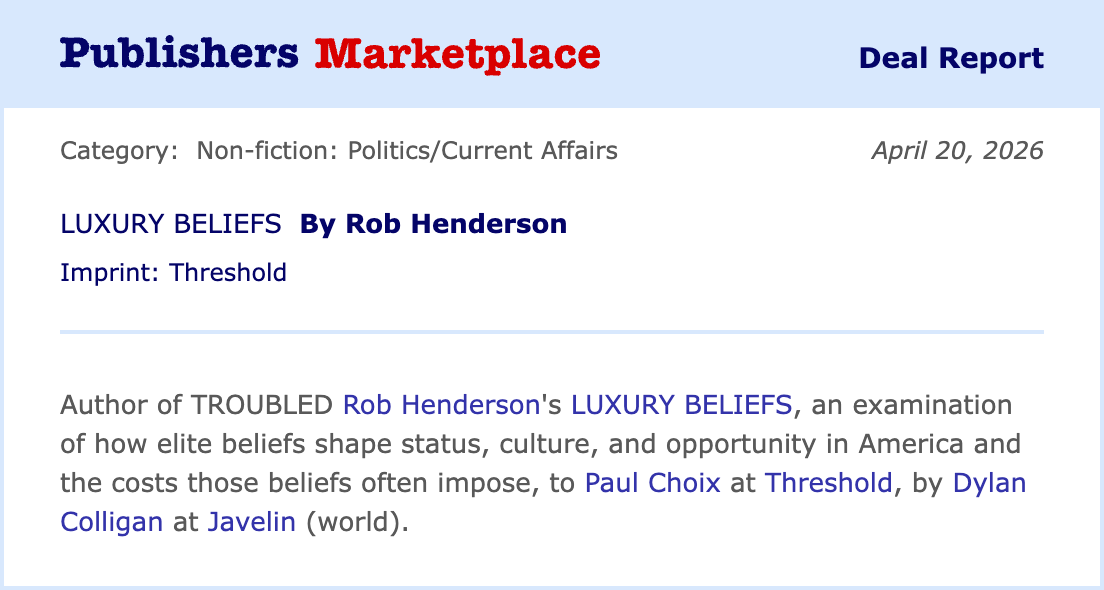
It is titled Luxury Beliefs (I know you didn’t see that one coming).
The news was recently announced on Publishers Marketplace:
Luxury beliefs are ideas and opinions that confer status on the upper class while inflicting costs on the less fortunate.
I first coined the phrase in 2019. I elaborated on the luxury beliefs framework in a series of essays in the NY Post, Quillette, The Free Press, The Wall Street Journal, and The New York Times, as well as here on Substack. Since then, the term has entered everyday conversation in ways I didn't expect. It sometimes gets misused and misunderstood. A full book will help to set the record straight.
The core idea came from my own experience moving between social classes, plus reading deeply about the sociology of class and the psychology of social status. As I spent more time around upper and upper-middle-class people, I noticed a pattern: many of them held beliefs they did not actually live by. And when those beliefs did carry costs, these people had the money and other resources to protect themselves. People lower on the ladder do not have that option.
Most people who hold luxury beliefs are sincere. But I have also met people who express these views for cynical reasons, to protect their reputation or advance their career. They don't necessarily believe what they are saying. They just know that saying it pays off.
Just as some people buy expensive objects they don’t really like just to impress other people, they also espouse luxury beliefs for the same reason.
This will likely be the last time I share anything about Luxury Beliefs until there is a pre-order link, which will be available late this year or perhaps early next year. It’s a good feeling to land a second book deal. It came with far fewer headaches than the first time around with Troubled. But writing about writing and the process of publishing, while mildly interesting, takes time away from doing the actual work of writing the book.
Candidly, there have been moments when I’ve worried whether luxury beliefs will retain relevance by the time the book comes out (late 2027). I’ve thought, well, maybe the moment has passed.
Recently, though, after the lunacy of that recent NYT interview where 3 prominent members of the cultural elite glorified shoplifting (which they termed “microlooting” because so much of upper middle class life is about rebranding disreputable behaviors in order to retain one’s position in the hierarchy) and all but justified the killing of healthcare executives, those concerns were put to rest.
The pathology of elite status signaling, as expressed in the form of luxury beliefs, shows no signs of burning itself out.
From an interview with Jerry Seinfeld:
David Remnick: I was once talking to the writer Adrian LeBlanc, who’s been working on a book about comedy, and I asked, “Who are the two smartest comedians about comedy?” I expected her to name two obscurities. And she said you and Chris Rock, because you study it. You’ve been thinking about this; it’s not just a bunch of jokes.
Jerry Seinfeld: Yes. Chris is the smartest person, maybe, I’ve ever met…I was with Chris a couple of weeks ago, and he was talking about a young comic. He was asking the comedian about what he did that day. And the guy said, “Nothing. But I’m going to do a set tonight.” And Chris explained to him, “You make money during the day. You collect it at night. During the day is where the money is made.”
You make money during the day. You collect it at night. During the day is where the money is made.
Seinfeld is saying that becoming a good standup comic requires you to live life, pay attention to your surroundings, have lots of experiences, and speak with interesting people. Then you take all of this material and convert it into art. Elsewhere in the interview, Seinfeld goes on to say “This is a writer’s game. If you can write, you succeed. If you can’t, you will not make it. The performing, being funny onstage, that’s great. Any comedian can be funny onstage. But the bullets are the writing.”
Good material comes from taking what you have accrued and making it informative, entertaining, or thought-provoking.
As my friend David Perell points out, even full-time writers spend the majority of their time away from their computer. You don’t log 40 hours a week typing away at your keyboard. Doing so would leave you with nothing of substance to say. More from David:
“Experiences become shareable creations the way tree sap becomes maple syrup. It takes 50 gallons of sap to make one gallon of syrup. So whenever I feel like I don’t have enough ideas to create something meaningful, I go collect more experiences and spend time processing them by writing and talking to friends.”
Most good writing happens beyond the page. Gathering experiences, observing the world, letting ideas take shape. By the time you sit down to write, you’ve already lived through the material. Even if the exact words have yet to come.
Depending on the type of writer you are, reading is also critical. Being social and engaging with others is important. So is solitude and quiet reflection while engaging with ideas.
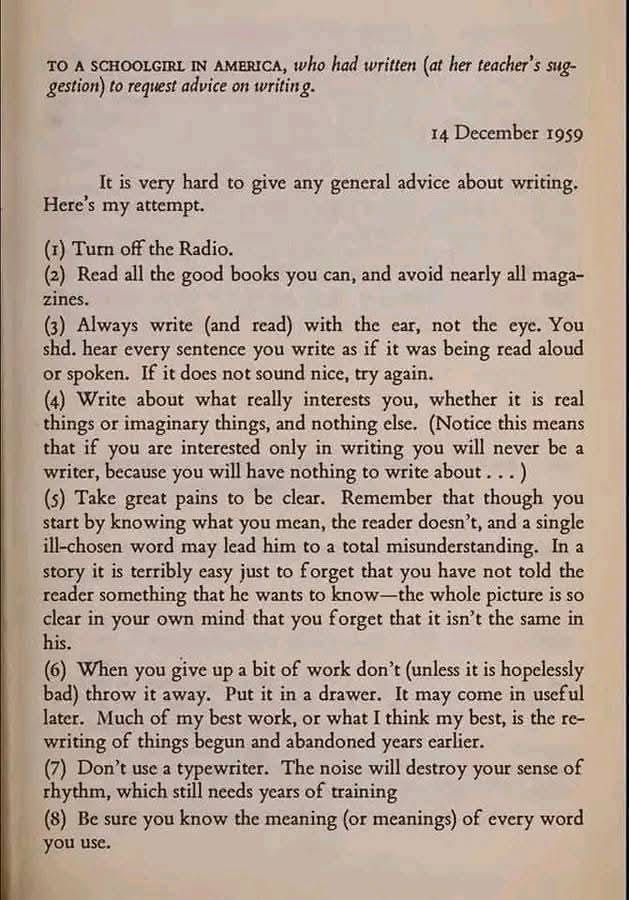
When asked for advice on how to become a better writer, C.S. Lewis shared 8 tips, one of which was “Write about what really interests you, whether it is real things or imaginary things, and nothing else. (Notice this means that if you are interested only in writing you will never be a writer, because you will have nothing to write about…).”
Shane Parrish of Farnam Street writes, “If you want new ideas, read old books.”
Gustave Flaubert once declared, “My life is as flat as the table I write on.” Aside from a few trips abroad and occasional appearances in high-society Paris, he fiercely protected his quiet routine and solitude—conditions he deemed essential to his work. This reclusive tendency is common among public intellectuals; developing the implications of a system of thought often demands long stretches of retreat from public life, as deep knowledge rarely emerges without the private disciplines of reading and writing.
According to some accounts, Carl Jung was known to value solitude deeply and often retreated to his secluded tower in Bollingen, Switzerland, where he read, carved stone, and reflected in silence—often with his pipe in hand. While he did produce a vast body of written work, he did not always enjoy the act of writing in the conventional sense. Jung viewed writing more as a means of clarifying his thoughts and sharing his psychological insights than as a pleasurable pursuit in itself. Jung wrote extensively. But he preferred quiet contemplation with a pipe and a book.
Hemingway compared daily writing to regularly drawing a few buckets of water from a well; each time the water will naturally rise back to its original level. If, however, you suddenly pump out a large amount all at once, you might find yourself without water for a long while. You gotta take breaks on occasion.
Your unconscious spits out material related to whatever you put in. I learned this while writing Troubled, which consumed my life for the better part of four years. Your unconscious can produce profound insights seemingly from nowhere. But if you spend your days engaged in arguments on social media or whatever, your mind will generate clever dunks during your walks. Read lots of news and current events, and your unconscious will cloud your inner life with gloom and pessimism. Concentrate fully on a project or a piece of art, though, and ideas will come to you. The more mindless external stimuli and meaningless minutiae you absorb, the more mental clutter will block your creativity. If you want those gifts, if you want your unconscious to deliver creative and insightful outputs, you have to protect its inputs.
From mathematician Richard Hamming’s famous 1986 lecture, “You and Your Research”:
“Everybody who has studied creativity is driven finally to saying, ‘creativity comes out of your subconscious.’ Somehow, suddenly, there it is. It just appears. Well, we know very little about the subconscious; but one thing you are pretty well aware of is that your dreams also come out of your subconscious. And you’re aware your dreams are, to a fair extent, a reworking of the experiences of the day. If you are deeply immersed and committed to a topic, day after day after day, your subconscious has nothing to do but work on your problem. And so you wake up one morning, or on some afternoon, and there’s the answer. For those who don’t get committed to their current problem, the subconscious goofs off on other things and doesn’t produce the big result. So the way to manage yourself is that when you have a real important problem you don’t let anything else get the center of your attention - you keep your thoughts on the problem. Keep your subconscious starved so it has to work on your problem, so you can sleep peacefully and get the answer in the morning, free.”
At this point, being a regular reader of books will put you ahead of many writers who are merely reacting to the latest headlines and trending topics. Even though I read a lot, I can be guilty of this myself. I’ve noticed that when I write about topics directly or indirectly related to politics and culture war stuff, these posts get a lot more readers to convert to paid subscribers. The occasional culture war essay or comments on topical events. These usually yield a lot of paid subs, which allows me to spend more of my time thinking and reading and writing about the things that I find more interesting.
A few people have asked how much time I spend running this newsletter. In terms of actual, physical, writing, re-writing, and editing, maybe 8 hours a week. But I spend the majority of my waking hours—maybe 50-60 hours a week—reading, thinking, note-taking, brainstorming, speaking with other writers, academics, journalists, and so on. All of that goes into my writing. When I’m in the shower mulling over a recent psychology paper or having a coffee chat with a professor or reading my Kindle app on the train or dictating notes on my phone when I’m out for a walk, does that count as “working on my Substack?” I also occasionally write about my life more generally. Unclear whether “living life” also counts as being on the clock. In a given week, we’re awake for 110-120 hours. So in a typical week, I either put in about 8 hours into my Substack or 100+. Depends on how you look at it. A lot of jobs that require creativity or innovation or unique skill sets are like this. In a way, you’re always on the clock.
I launched the first iteration of this newsletter in January of 2020 on MailChimp. A little over two years later, in April of 2022, I moved over to Substack.
Today there are more than 80 thousand subscribers and 3,183 paid subscribers.
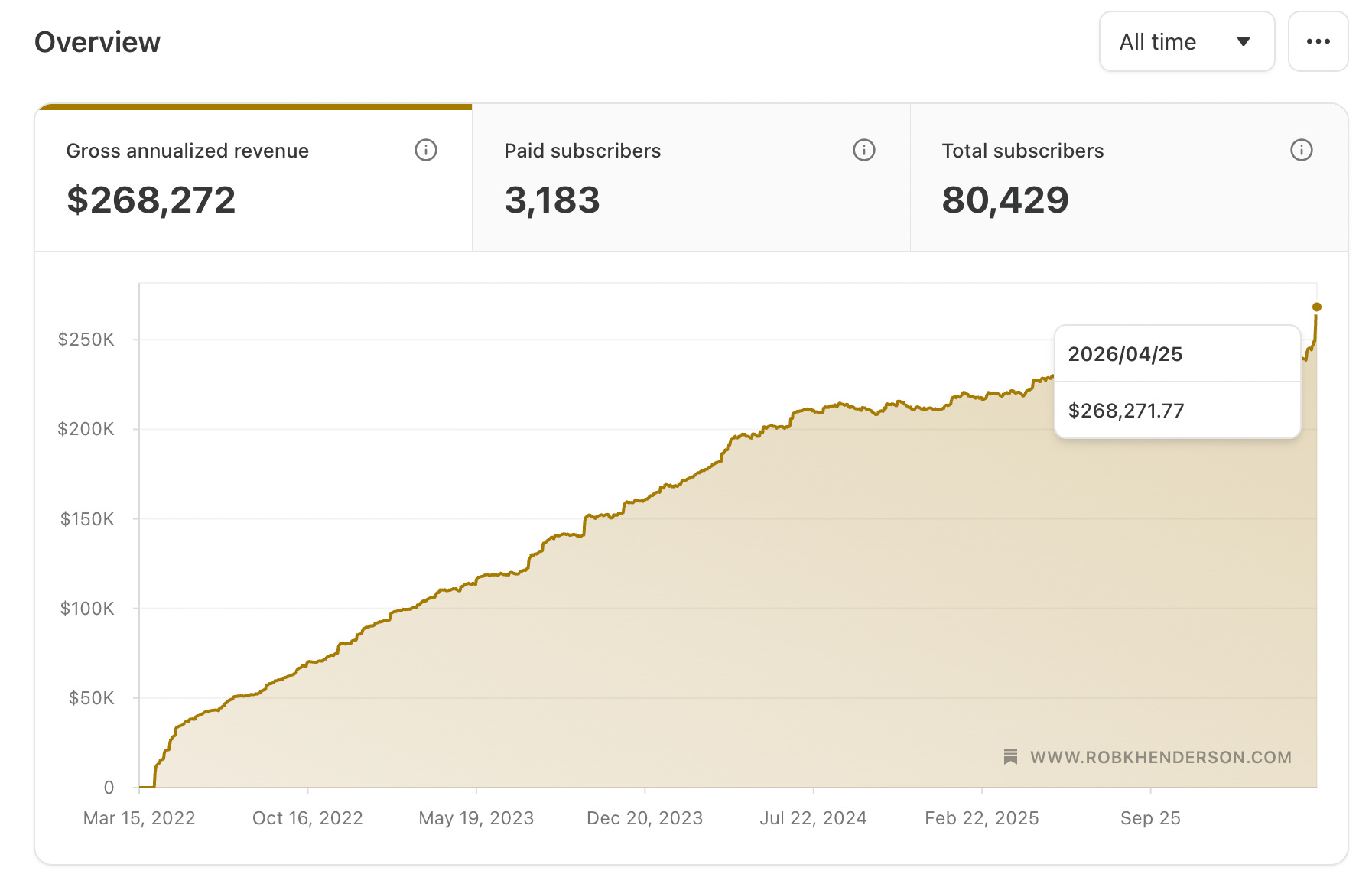
There’s a number floating around out there suggesting you can expect 10% of your free subscribers to go paid. In my experience (and from what I’ve heard from other Substack writers), though, the number is typically something closer to 4 or 5 percent. Paid subscriber growth has slowed somewhat, perhaps because there are more writers on Substack and it’s becoming harder for readers to pay individual subscriptions for each writer they like.
Still, as I’ve mentioned before, I haven’t concentrated much effort on growth for the sake of growth. More than one popular Substacker has told me that they have become a little too preoccupied with tracking metrics, open rates, growth, etc. This to me makes sense if you are just starting out and are searching for feedback from the world that you are writing something worth reading. But at a certain point, each additional minute you spend on growth hacks or whatever is a minute you’re not spending actually living life, reading books, and doing things that make your writing interesting.
With the rise of AI, having a unique point of view is becoming even more important. I worry about whether LLMs are going to make people generally wary of any text they encounter online. Why would you pay for something you suspect might be written by a robot? If a human didn’t care enough to write it, why should you care enough to read it, let alone pay money to do so?
For this reason, I suspect personal writing is going to become more important. I wrote a whole book of personal writing and didn’t enjoy it nearly as much as I enjoy writing about psychology, social trends, status games, etc. Given the way things are going, though, I’ll continue to share more personal essays.
I also do occasional livestreams now, but haven’t been keeping to a steady schedule because I’ve been traveling so much. But in the second half of this year, my calendar will be clearer as I prioritize writing Luxury Beliefs. Due to the book, I’ll dial back on the number of essays I write during this time, and will do more livestreams. Anyone (both free and paid subscribers) can watch them live. But only paid subs can watch or listen to the recordings.
Throughout building my newsletter, I haven’t implemented much readership growth advice from other people. Growth is not number one on my agenda. This might be why I haven’t received spectacular bursts of attention and subscribers. I’ve seen other writers who share charts indicating rapid and punctuated instances of major subscription increases. My Substack is not that way. Similar to Twitter, my experience with newsletters (both the first Mailchimp version and now Substack) has been one of gradual, reliable growth, brick by brick, fueled primarily by word of mouth. I think growth is important, it’s nice to see, and I’m not shy about sharing my work online and on Twitter. Still, growth has never been my primary goal.
The psychologist (and excellent Substacker) Steve Stewart-Williams has written that the “3 most beautiful words in the English language: New Paid Subscriber.”
I remember when I started the first iteration of this newsletter on MailChimp, I added a little donorbox button for readers to tip me if they wanted. Each time I saw $5, $15, or (incredibly) the occasional $100+ donation, it encouraged me to keep going.
Four years after joining Substack, we have jumped up to the number 5 science newsletter on this platform.
Writing online started as a side hustle when I was in grad school. The original iteration of my newsletter began as a hobby, and I found myself putting more and more work into it. It has become a primary income stream, which was unplanned. I’ve discovered that few things give me more pleasure than sharing my writing directly with my readers. I’m happy to support other writers I enjoy reading, and I’ve always welcomed subscribers to support me. After the first year of building a newsletter and seeing the extent of its reach, I realized I could potentially earn a living as a writer. Still, I periodically offer free upgrades to readers who are unable to afford a paid subscription. I grew up poor and spent much of my young adulthood broke, so while I enjoy getting paid for my work, I try to make it accessible to everyone.
This underscores the need for independent writing. Weekly essays delivered to your inbox on a reliable day at a reliable time (Sunday morning), along with bonus posts and recommendations, without any ads, affiliate links, pop-ups, SEO bait, or any other increasingly familiar features of our online landscape.
Mechanical consistency is an underrated approach to building a readership. Everyone wants the secret sauce or the smash hit viral article. But the real secret is to develop a reliable and dependable writing schedule.
The psychologist Dean Keith Simonton points out that one notable attribute that distinguishes high performers is volume:
“A small percentage of workers is responsible for the bulk of the work...the top 10% of the most prolific elite can be credited with 50% of all contributions, whereas the bottom 50% of least productive workers can claim only 15%...the most productive contributor is about 100 times more prolific than the least.”
This goes for anyone in a competitive domain that requires some creativity. It definitely applies to podcasters (the vast majority of podcasters never produce more than 20 episodes) and newsletter writers (so often you’ll see people write a few good Substack posts and then go dark). Regular output is key. Do the work, accept that most of your work will be fair-to-middling, and be grateful for the occasional home run.
Writing is like going to the gym. Don’t over-romanticize it. You go there, you do the thing. Do it enough times and magic will sometimes appear. Gradually you get better at the craft; or you’ll look better with your shirt off. Just stick with your routine.
Interestingly, 19th century English novelist Anthony Trollope’s literary reputation suffered as a result of the revelation that he treated writing as a routine and humdrum task rather than a romanticized and divine calling. Many people prefer the myth, not the reality:
“[Trollope] made up his mind to do his stint of writing no matter what happened. Often he would write on trains. What writers call ‘waiting for an inspiration’ he considered nonsense. The result of his system was that he accomplished a vast amount of work. But, by telling the truth about his system, he injured his reputation. When his ‘Autobiography’ was published after his death, lovers of literature were shocked, instead of being impressed by his courage and industry. They had the old-fashioned notion about writing, which still persists, by the way. They liked to think of writers as ‘inspired,’ as doing their work by means of a divine agency.”
Many of you are recent subscribers, coming here after having read my debut book Troubled. If all goes well, there will be a film adaptation.
One thing I learned recently is that yes, you can use social media and your newsletter to promote a book. But you can also use your book to promote your newsletter and your other platforms.
When you have a book out and it gets some buzz and attention, you get invited on podcasts. Maybe you get a segment or two on TV. Most people who see you on a 3 minute TV segment or listen to you on a long form podcast aren’t going to buy your book. That’s just the reality. A small number of listeners and viewers, though, will look you up online.
Perhaps they decide to follow you on X or Instagram. Or sign up for your newsletter. Maybe they follow you for a while. If, after a few weeks or a few months, they like what they see, they consider getting your book. Maybe they sign up for a paid newsletter subscription.
The funnel goes something like you listen to the person on a podcast —> follow them on X —> enjoy their tweets —> sign up for their newsletter —> take pleasure in or find useful information in their writing —> get their book and/or subscribe for premium membership.
Many people have noted how difficult it is to sell books. Even celebrities with millions of followers are having difficulty moving as many copies as their sizeable social media platforms would supposedly predict.
As with anything, there’s an element of luck that goes into a book’s success. Still, things aren’t entirely up to fortune. Authors have some degree of control.
Platform matters. The medium through which people become accustomed to your work matters. Generally speaking, people will enjoy a creator’s work in the mode they’re used to. For example, if readers enjoy reading a writer’s material online, then they’ll most likely enjoy reading it in book-form, too. But if you’re used to watching a TikTok influencer on your phone or a movie star on the big screen, it’s less clear if that will translate into book sales.
If you want people to read your book, it helps if they’re accustomed to reading your writing. I’ve heard that popular podcasters who become authors often sell far more audiobooks than hardcovers or ebooks. Which makes sense. People are used to hearing their voice. They’re comfortable with that person in their ear. So they buy the person’s book in the format they’re accustomed to. All this implies that if you want people to read your book, start a newsletter. If you want people to listen to your book, maybe podcasting or TikToking is the right call.
I wrote the first draft of Troubled telling myself to not think about the audience, because no one is going to read this anyway. Of course, during the editing process, I did my best to take on the perspective of the reader to help them understand the story. But that first part of the process is key. Letting the ideas flow without allowing self-consciousness to cloud your mind. I worry that I will be stifled as I work on this second book by the fear of wanting the ideas to be good or impressive or interesting or whatever. That if this book isn’t at least as successful and well-received as the first book, I’ve somehow failed. All of those doubts must be set aside for me to make Luxury Beliefs the best book it can be.
A quote from Rick Rubin’s book The Creative Act:
“If we can tune in to the idea of making things and sharing them without being attached to the outcome, the work is more likely to arrive in its truest form…How shall we measure success? It isn’t popularity, money, or critical esteem. Success occurs in the privacy of the soul. It comes in the moment you decide to release the work, before exposure to a single opinion. When you’ve done all you can to bring out the work’s greatest potential.”
Something I’ll be keeping in mind as I work on Luxury Beliefs.
Here are some notable posts throughout the past year:
Thanks for your support. Thanks for reading.
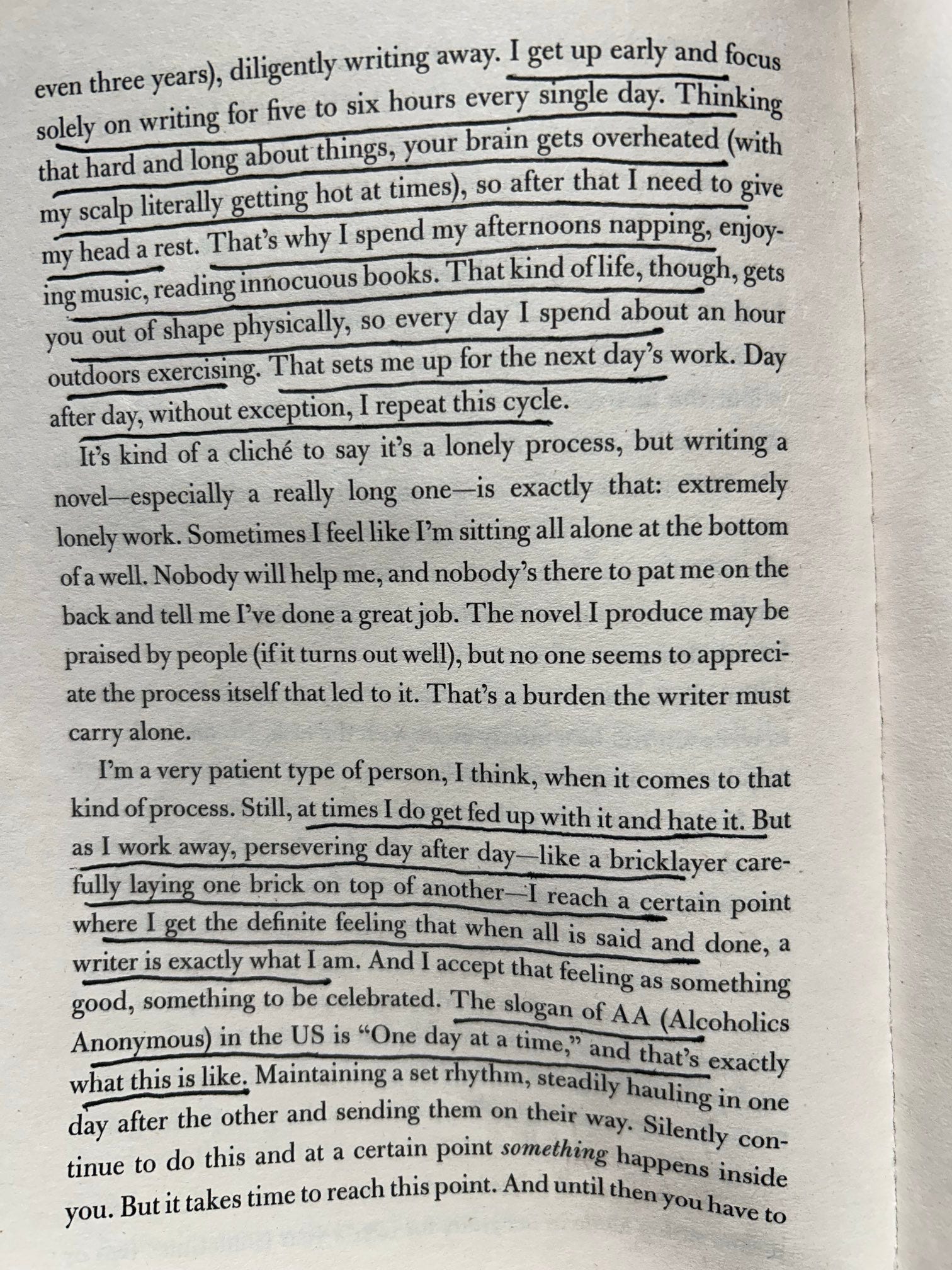
I’ll conclude here with this passage from Haruki Murakami:
Rob, this post sums up why I'm a paid subscriber: your thoughtfulness, your rigour and honesty, your determined curiosity and your generous humanity - plus of course engaging writing about things that matter. I can't remember how I first heard about your writing (Twitter back in the day?), but I do remember meeting you briefly at an event in London for Troubled, and how kind and helpful you were when I asked for advice about a troubled family member. I signed up to your newsletter, and found the same depth and humanity and humour. My troubled family member read your memoir, and I think it helped. For myself, I have learned so much from your posts & conversations, and very much look forward to reading Luxury Beliefs. Thank you!
I have been a free subscriber of yours for a while, and my hesitation to upgrade to paid has been because I already pay for too many subscriptions and I don't have time to read them all. I just upgraded to pay for your newsletter because I so appreciate all the free information you provided in today's newsletter, without a paywall. It sounds counter-intuitive, I know. But I appreciate who you are and how you share your knowledge with us — with humility and intelligence. Thank you!